On this page
Throw a superball forward and down under a table. It hits the floor, then the underside of the table, then the floor again, and comes back out towards you. A smooth ball would keep going forward. The superball reverses because it grips as well as it bounces, and every grip swaps some of its forward motion for spin and back again. It is a short, clean JEE Advanced-style problem in angular momentum about the point of contact.
What makes a superball different from an ordinary ball?
In smooth-bounce problems, only the vertical velocity changes at impact, by the coefficient of restitution, as in bouncing-ball problems on total distance and time. The horizontal velocity and the spin are untouched.
An ideal superball is perfectly rough and perfectly elastic. At each impact:
The normal velocity reverses with no loss (e = 1).
The contact point's velocity along the surface also reverses. The rubber grips, stretches sideways and springs back.
Richard Garwin analysed this ideal ball in "Kinematics of an Ultraelastic Rough Ball" (American Journal of Physics, 1969). He showed that it behaves unexpectedly after one bounce and that, after striking the floor, the underside of a table and the floor, it returns to the hand. He also noted that a real Super Ball only approximates this ideal.
Why is angular momentum about the contact point conserved?
During the impact, the surface pushes on the ball with a large normal force and a large friction force, both acting at the contact point. Gravity is tiny by comparison over such a short time. So about the contact point, the impact forces have no torque, and the ball's angular momentum about that point does not change. It is the same idea used in finding when a sliding ball starts pure rolling, applied to an impact instead of a slow slide.
For a solid sphere of mass m and radius r, I = 2mr²/5 about its centre. Let v be the horizontal velocity (forward positive) and s = rω the spin speed of the surface, counted positive when the spin is in the sense that would roll the ball forward. Rolling without slipping means s = v.
Floor bounce (contact below the centre):
Angular momentum about the contact: m(v + 2s/5) r stays the same.
Contact point speed v − s reverses: v′ − s′ = −(v − s).
Solving: v′ = (3v + 4s)/7 and s′ = (10v − 3s)/7.
Underside bounce (contact above the centre): the top of the ball moves at v + s, and angular momentum about the top point is m(v − 2s/5) r. The same steps give v′ = (3v − 4s)/7 and s′ = −(10v + 3s)/7.
A check: the kinetic energy, proportional to v² + 2s²/5 (plus the vertical part), comes out the same after every bounce, as it must for a perfectly elastic ball.
What does one floor bounce do to a ball with no spin?
Put s = 0 into the floor rule: v′ = 3v/7 and s′ = 10v/7. The ball keeps only three-sevenths of its forward speed, and the floor turns the rest into spin in the forward-rolling sense, faster than rolling: s′ is 10/3 times v′. Energy check: v² becomes (9/49)v² + (2/5)(100/49)v² = v². Nothing is lost; it is just moved into rotation.
That fast forward spin is what makes the next bounce dramatic. When the ball hits the underside of the table, its top surface is moving forward at v + s, and the grip throws that motion back.
Worked example: how fast does the ball come back?
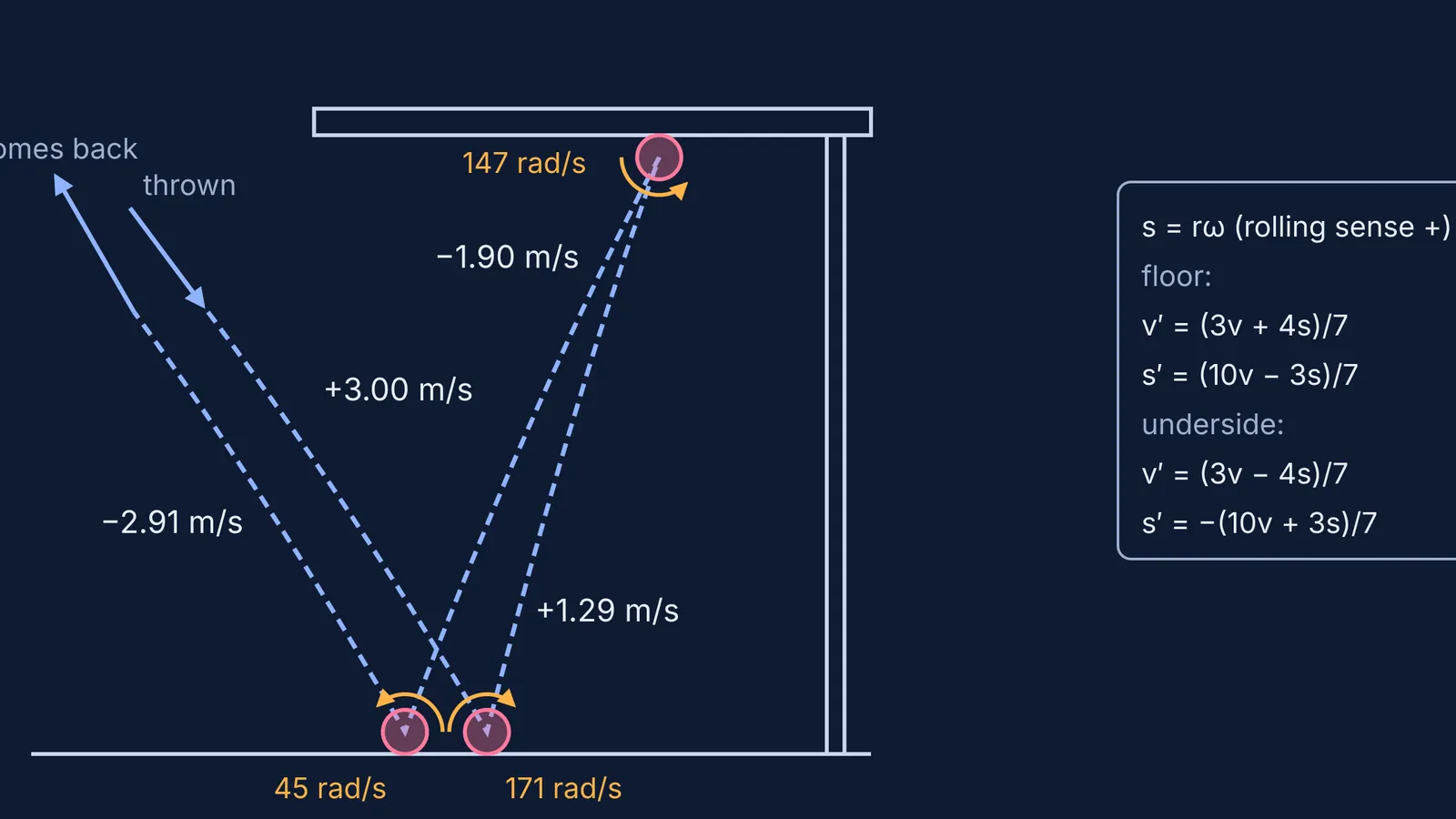
Illustrative values: ball radius r = 2.5 cm, thrown from a height of 0.50 m (centre) at 3.0 m/s forward and 4.0 m/s down with no spin; the table's underside is 0.70 m above the floor; g = 9.8 m/s².
To the floor. The centre falls 0.475 m to the contact height. Vertical speed at impact = √(4.0² + 2 × 9.8 × 0.475) = 5.03 m/s. Time = (5.03 − 4.0)/9.8 = 0.105 s, so the ball lands 3.0 × 0.105 = 0.316 m ahead.
Floor bounce 1 (v = 3.0, s = 0): v′ = 9/7 = 1.29 m/s forward; s′ = 30/7 = 4.29 m/s, so ω = 4.29/0.025 = 171 rad/s. Vertical speed 5.03 m/s up.
Up to the table. The centre rises from 0.025 m to 0.675 m. Vertical speed at impact = √(5.03² − 2 × 9.8 × 0.65) = 3.55 m/s, after 0.152 s. The ball hits the underside at 0.316 + 1.29 × 0.152 = 0.51 m.
Underside bounce (v = 1.29, s = 4.29): v′ = (3 × 1.29 − 4 × 4.29)/7 = −1.90 m/s. The ball now moves backwards. s′ = −(10 × 1.29 + 3 × 4.29)/7 = −3.67 m/s (147 rad/s, now in the backward-rolling sense).
Down to the floor. By symmetry it takes 0.152 s again and lands at 0.51 − 1.90 × 0.152 = 0.22 m.
Floor bounce 2 (v = −1.90, s = −3.67): v′ = (3 × (−1.90) + 4 × (−3.67))/7 = −2.91 m/s; s′ = (10 × (−1.90) − 3 × (−3.67))/7 = −1.14 m/s (45 rad/s).
The ball leaves at 2.91 m/s backwards, almost as fast as it was thrown forwards, and rises back to 0.50 m about 8 cm behind the point it was thrown from. Units check: every v and s is in m/s, and ω = s/r is in rad/s.
If you are preparing for JEE Main & Advanced and want more multi-step rotation problems like this one, Fermi Test Prep offers personalised preparation with an AI tutor, live classes, adaptive mocks, mentorship and a study plan that updates based on mastery.
Does a real superball do exactly this?
Not exactly. A real ball loses a little energy at each bounce and reverses only part of its contact-point speed, so the numbers come out smaller, which is why Garwin called the Super Ball an approximation to the ideal. The pattern survives, though: forward speed into spin at the floor, spin into backward speed at the underside. That pattern is the answer an exam wants.
The link to where a ball is struck is direct too: a cue or bat that puts spin on a ball changes how it moves off a surface, as in the height to hit a ball so it rolls at once.
Quick checklist
Ideal superball: normal velocity and contact-point velocity both reverse.
Angular momentum about the contact point is conserved during each impact.
Floor: v′ = (3v + 4s)/7, s′ = (10v − 3s)/7. Underside: v′ = (3v − 4s)/7, s′ = −(10v + 3s)/7.
No spin in: v′ = 3v/7 and s′ = 10v/7.
Floor, underside, floor: a 3.0 m/s throw comes back at 2.91 m/s.
Check with energy: v² + 2s²/5 stays the same.