On this page
Ask three friends to rank three options, and you might expect a clear group favourite. In 1785 the Marquis de Condorcet showed it need not, and in 1951 Kenneth Arrow proved something much stronger: no rule for turning individual rankings into a group ranking can meet every fairness condition we would like (Stanford Encyclopedia of Philosophy). Both ideas fit in examples you can check with a pencil.
What is the Condorcet paradox?
The Condorcet paradox is the observation that majority preferences can be intransitive even when every individual's preferences are perfectly sensible, as the Stanford Encyclopedia of Philosophy entry on social choice theory puts it. Condorcet described it in his 1785 essay on applying probability to majority decisions.
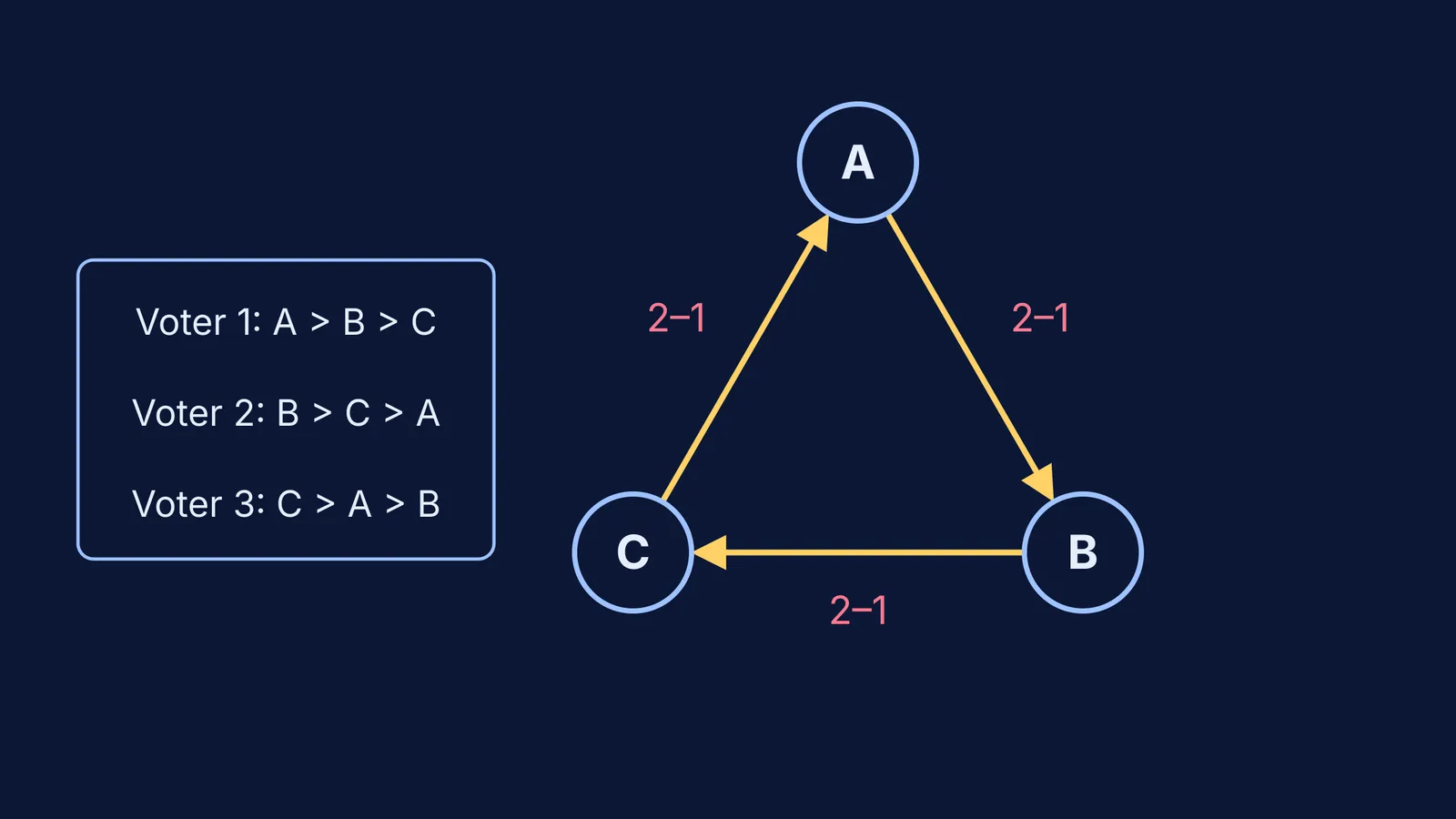
The smallest case has three voters:
Voter 1: A > B > C
Voter 2: B > C > A
Voter 3: C > A > B
Now compare options two at a time. A beats B, because voters 1 and 3 put A higher (2 to 1). B beats C, because voters 1 and 2 put B higher (2 to 1). C beats A, because voters 2 and 3 put C higher (2 to 1). The group prefers A to B, B to C and C to A: a cycle, with no option that beats all the others. Each voter is consistent; the majority is not.
How can plurality, runoff and Borda pick different winners?
With three cyclic voters, every common rule ties. Add voters and the rules disagree. The Borda count, named after Jean-Charles de Borda, gives each option points by its place on a ballot; with three options we use 2 points for first, 1 for second and 0 for last. Here are nine ballots:
4 voters: A > B > C
3 voters: C > B > A
2 voters: B > C > A
Now count them four ways:
Plurality (most first-place votes wins): A has 4, C has 3, B has 2. A wins.
Runoff (top two go to a second round): A and C go through. The 2 voters whose first choice was B prefer C to A, so C gets 3 + 2 = 5 against A's 4. C wins.
Borda (2, 1, 0 points): A gets 4 × 2 = 8. B gets 4 × 1 + 3 × 1 + 2 × 2 = 11. C gets 3 × 2 + 2 × 1 = 8. B wins.
Head to head: B beats A 5 to 4 and C 6 to 3, so B is the Condorcet winner, yet plurality put it last.
Same ballots, three winners: only the counting rule changed.
What did Arrow's impossibility theorem prove?
Kenneth Arrow asked whether any rule for turning individual rankings into a group ranking could avoid such trouble. He published the result as "A Difficulty in the Concept of Social Welfare" in the Journal of Political Economy in 1950, and gave the original proof in his 1951 book, according to the Stanford Encyclopedia of Philosophy entry on Arrow's theorem. In plain words, the conditions are:
Unrestricted domain: it works for any set of rankings.
Social ordering: the result is a consistent ranking, with no cycles.
Weak Pareto: if every voter prefers X to Y, so does the group.
Independence of irrelevant alternatives: the verdict on X versus Y depends only on how voters rank X versus Y.
Non-dictatorship: no single voter always decides.
Arrow's theorem states that when there are more than two alternatives, no rule satisfies all five conditions, as set out in the Stanford Encyclopedia of Philosophy. Arrow received the Nobel Prize in economics in 1972, the same entry notes.
Each rule pays somewhere. Borda breaks independence of irrelevant alternatives, the encyclopedia shows with a worked example; pairwise majority breaks social ordering, as our three-voter cycle shows.
Does this mean voting is broken?
No. Arrow removed the hope of a perfect rule for ranking, not the case for voting. Cycles need a particular mix of preferences. Duncan Black proved in 1948 that if every voter's preferences are single-peaked (options lie along one line, like tax rates, and each voter likes options less the further they are from a favourite), majority cycles cannot occur, the Stanford Encyclopedia of Philosophy entry on social choice theory explains. Choosing a rule means choosing which condition to give up.
How do you check a voting puzzle yourself?
When a question gives you ballots, work in this order:
Group identical ballots with a count beside each.
Find the plurality winner from first choices.
Run the runoff: move eliminated voters to their next choice.
Add Borda points and check the total equals voters × points per ballot: here 9 × 3 = 27 = 8 + 11 + 8.
Do every head-to-head contest and look for a Condorcet winner or a cycle.
The St Petersburg paradox is another case where a sensible-looking rule gives a strange answer, and counting with a bijection sharpens the tallying habit.
If transitivity and orderings feel shaky, the Fermi Concept Library gives every mathematics concept its own lesson. For practice, the Fermi Problem Library has worked problems with a step-by-step solver that explains the reasoning rather than printing an answer. Then change one ballot above and see which winners move.