On this page
Continuity is about one point at a time. Uniform continuity asks whether one tolerance can serve the whole domain at once. The difference is a swap in the order of "for every" and "there exists", and it decides why x² is fine on [0, 1] but not on ℝ.
What is uniform continuity?
A function f is continuous at a point a if, for every ε > 0, there is a δ > 0 such that |x − a| < δ forces |f(x) − f(a)| < ε. For the ways continuity can break at a single point, see our guide to removable and jump discontinuities.
A function f is uniformly continuous if, for every ε > 0, there is one δ > 0 such that |x − y| < δ forces |f(x) − f(y)| < ε for every pair x, y in the domain (Wikipedia, Uniform continuity).
In ordinary continuity δ may depend on both ε and the point; in uniform continuity δ depends on ε alone (Wikipedia). Every uniformly continuous function is continuous, but not the other way round.
How is uniform continuity different from continuity?
In quantifiers:
Continuity: for every x and every ε, there is a δ. You choose δ after you know x.
Uniform continuity: for every ε, there is a δ that works for every x. You choose δ before you know x.
Why is x² uniformly continuous on [0, 1] but not on ℝ?
On [0, 1], factor: |x² − y²| = |x + y| · |x − y| ≤ 2|x − y|, because x + y is at most 2. So δ = ε/2 works at every point.
On ℝ, take ε = 1 and let someone offer any δ > 0. Pick x = 1/δ and y = x + δ/2. The inputs are δ/2 apart, yet y² − x² = (δ/2)(2x + δ/2) = 1 + δ²/4, more than 1. No δ survives.
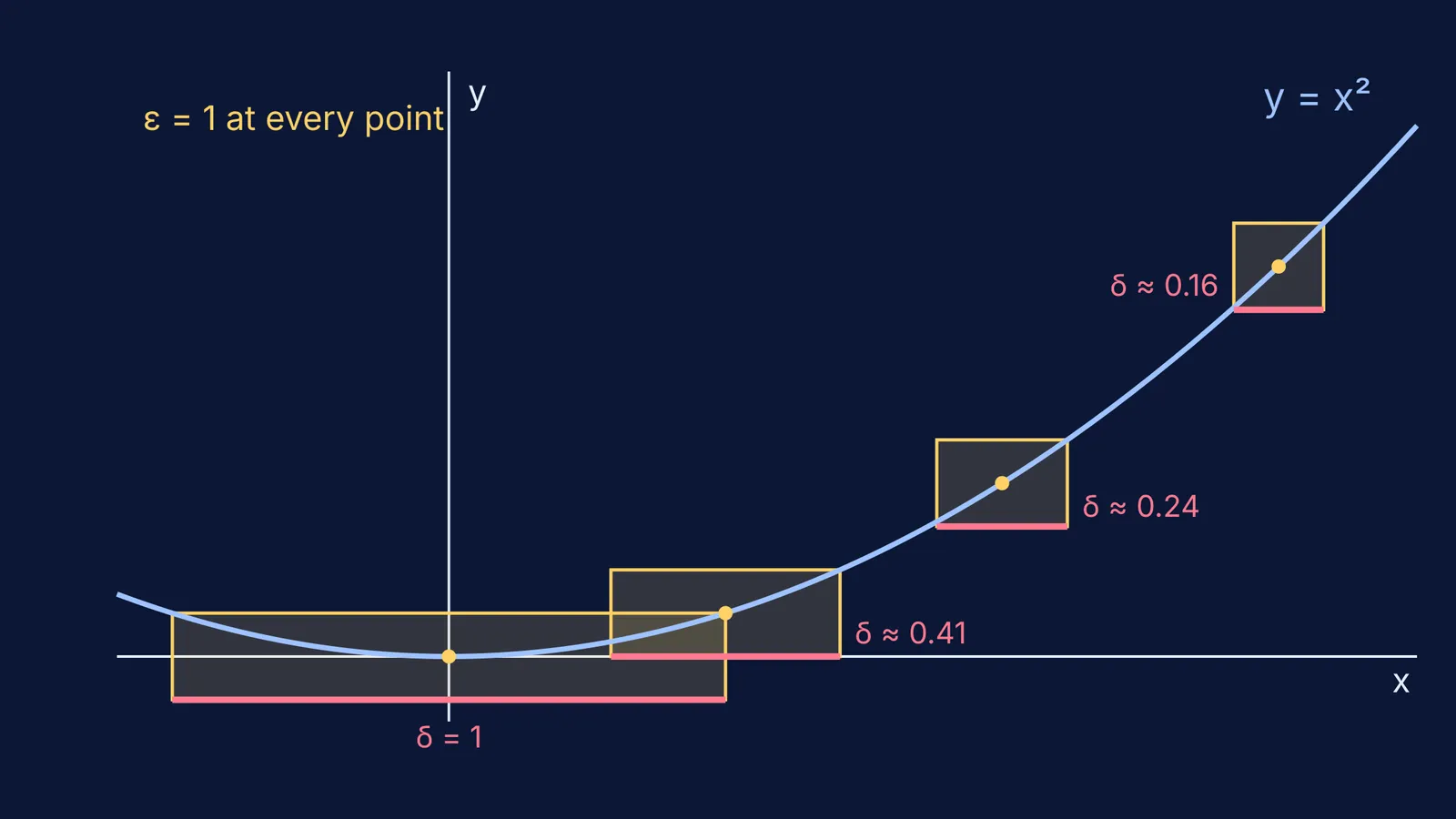
x² is still continuous at every a: δ = min(1, ε/(2|a| + 1)) works, but it shrinks as |a| grows. In the picture above, with ε = 1, the widest δ falls from 1 at x = 0 to about 0.16 at x = 3 as the curve steepens. Slopes that grow without bound on an infinite domain are one way continuity fails to be uniform (Wikipedia).
Why does 1/x fail on (0, 1)?
Here the domain is short, but the function blows up near 0. A useful test: f is uniformly continuous exactly when every pair of sequences with xₙ − yₙ → 0 also has f(xₙ) − f(yₙ) → 0 (Wikipedia).
Take xₙ = 1/n and yₙ = 1/(n + 1). Their gap, 1/(n(n + 1)), goes to 0, but f(yₙ) − f(xₙ) = 1 every time. So 1/x fails. Pointwise, δ = min(a/2, εa²/2) works at each a, but it shrinks like a² as a approaches 0.
What does the Heine–Cantor theorem say?
The Heine–Cantor theorem says that a continuous function on a compact domain is uniformly continuous; in particular, every continuous function on a closed, bounded interval [a, b] is uniformly continuous (Wikipedia, Heine–Cantor theorem). The MacTutor archive credits Eduard Heine with introducing uniform continuity and notes that Dirichlet proved the closed-interval theorem in his 1862 lectures, before Heine proved it in 1872 (MacTutor, Eduard Heine).
A sketch by contradiction: if f is continuous on [a, b] but not uniformly, then for some ε every δ = 1/n fails, giving xₙ, yₙ in [a, b] with |xₙ − yₙ| < 1/n but |f(xₙ) − f(yₙ)| ≥ ε.
[a, b] is bounded, so by Bolzano–Weierstrass a subsequence of xₙ converges to some c.
[a, b] is closed, so c is in it and f is continuous at c.
The matching yₙ converge to c too.
Continuity at c pulls f(xₙ) and f(yₙ) together, contradicting ≥ ε.
Each example above breaks one hypothesis. For x² on ℝ the sequences run off to infinity, so step 1 fails. For 1/x on (0, 1) they close in on 0, outside the domain, so step 2 fails. Our piece on Cauchy sequences and the ε–N idea builds the sequence intuition.
How do you check a function for uniform continuity?
In order:
Continuous on a closed, bounded interval? Yes, by Heine–Cantor.
|f′| ≤ M on an interval? The mean value theorem gives |f(x) − f(y)| ≤ M|x − y|, so δ = ε/M works; our guide to proving inequalities with the mean value theorem uses the same step.
Unbounded on a bounded interval, like 1/x on (0, 1)? No.
Otherwise, hunt for two sequences whose gap goes to 0 while their values stay ε apart. Find them, and the answer is no.
To revise the ε–δ ideas, the Fermi Concept Library covers every concept in physics, chemistry, biology, mathematics and computing. If a proof stalls, the Fermi Problem Library has a step-by-step solver that explains the reasoning.
Try it: is sin(x²) uniformly continuous on ℝ? Test xₙ = √(nπ) and yₙ = √(nπ + π/2).