

On this page
Many calculus inequalities compare a curve with a straight line: ln(1 + x) with x, sin x with x, eˣ with 1 + x. The mean value theorem turns each into a short argument, and you never need to find the point c.
What does the mean value theorem say?
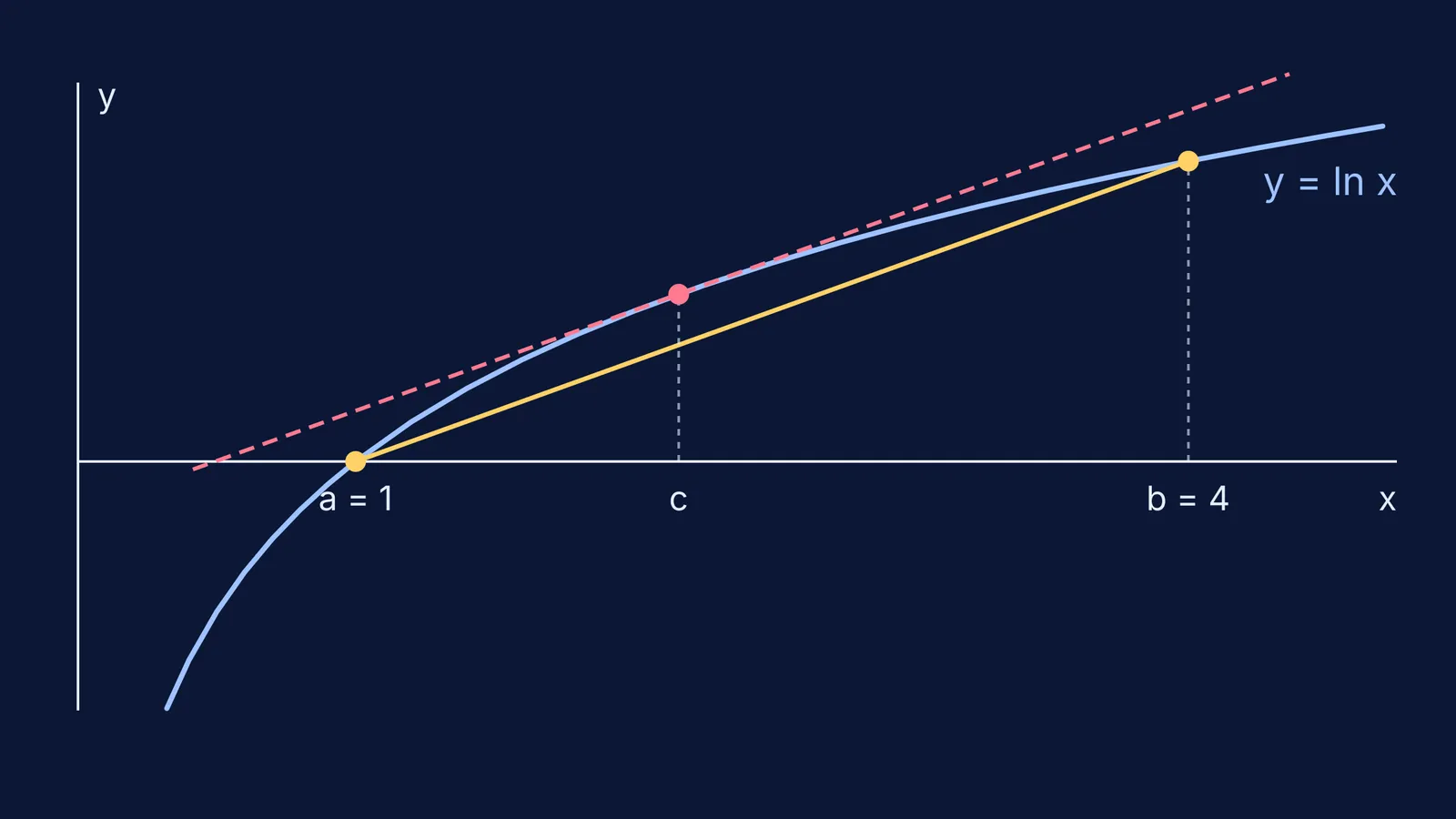
The mean value theorem says that if f is continuous on [a, b] and differentiable on (a, b), then there is at least one c in (a, b) with f′(c) = (f(b) − f(a))/(b − a), as stated in OpenStax Calculus Volume 1, section 4.4 and Wolfram MathWorld.
Somewhere between a and b, the tangent is parallel to the chord joining the curve's two ends, as the diagram above shows for y = ln x on [1, 4]. Rolle's theorem, in the same OpenStax section, is the special case f(a) = f(b), where that tangent is horizontal.
For inequalities, write it as f(b) − f(a) = f′(c)(b − a). Bound the derivative on the right using a < c < b, and you have bounded the left.
How do you prove an inequality using the mean value theorem?
Spot the difference. Look for f(b) − f(a): ln(1 + x) is ln(1 + x) − ln 1; sin x is sin x − sin 0.
Name f, a and b. Check, and write down, that f is continuous on [a, b] and differentiable on (a, b).
Apply the theorem. Write f(b) − f(a) = f′(c)(b − a) with a < c < b.
Bound f′(c). If f′ is increasing or decreasing on [a, b], f′(c) lies between f′(a) and f′(b). If f′ is a sine or cosine, use |cos c| ≤ 1 or |sin c| ≤ 1.
Multiply back, watching signs. Multiplying by b − a keeps the direction only because b − a > 0. For a negative x, use the interval [x, 0].
Worked proof 1: why is x/(1 + x) < ln(1 + x) < x?
Take f(t) = ln t on [1, 1 + x], with x > 0. It is continuous and differentiable there, and f′(t) = 1/t. The theorem gives ln(1 + x) − ln 1 = x · (1/c) for some c with 1 < c < 1 + x.
Taking reciprocals reverses the order: 1/(1 + x) < 1/c < 1. Multiply through by x, which is positive:
x/(1 + x) < ln(1 + x) < x.
At x = 1 this says 1/2 < ln 2 < 1, and ln 2 ≈ 0.693. The same argument on [a, b] with 0 < a < b gives the general form (b − a)/b < ln(b/a) < (b − a)/a.
Worked proof 2: why is sin x < x for every x > 0?
Take f(t) = sin t on [0, x]. The theorem gives sin x − sin 0 = x cos c for some c with 0 < c < x.
If 0 < x ≤ 2π, then c lies strictly between 0 and 2π, so cos c < 1, and sin x = x cos c < x. If x > 2π, then sin x ≤ 1 < x anyway. So sin x < x for every x > 0. The same step with |cos c| ≤ 1 gives |sin b − sin a| ≤ |b − a| for any a and b.
Two more to try yourself
eˣ > 1 + x for every x ≠ 0. Use f(t) = eᵗ on [0, x], or on [x, 0] if x < 0. You get eˣ − 1 = x·eᶜ. For x > 0, eᶜ > 1. For x < 0, eᶜ < 1 but x is negative, so x·eᶜ > x: the sign trap from step 5.
tan x > x for 0 < x < π/2. Use f(t) = tan t on [0, x]. You get tan x = x·sec²c, and sec²c > 1 whenever 0 < c < π/2.
If step 4 is where you get stuck, the Fermi Problem Library has worked problems with a step-by-step solver that explains the reasoning rather than printing an answer.
When is the mean value theorem the wrong tool?
The method needs a hidden difference f(b) − f(a). A symmetric sum such as a/(b + c) + b/(c + a) + c/(a + b) has none, so reach for a tangent line bound applied term by term or Jensen's inequality for convex functions instead.
Also check the hypotheses every time. For f(t) = 1/t on [−1, 1], the chord has slope (1 − (−1))/2 = 1, yet f′(t) = −1/t² is negative wherever it exists. No such c exists, because f is not even defined at 0.
If derivatives still feel shaky, the Fermi Concept Library gives every concept in mathematics its own lesson. Then pick any ln, sin or eˣ inequality from a past paper and run the five steps.


