

On this page
Mix acetone with a little iodine in dilute acid and the brown colour slowly fades. Measure how fast, and you find something odd: doubling the iodine concentration does not change the rate at all. Iodine is a reactant, it is used up, and yet it does not appear in the rate law. This is one of the classic results in chemical kinetics, because it tells you exactly which step of the mechanism is slow.
What is the rate law for the iodination of acetone?
The overall reaction, catalysed by acid, is:
CH₃COCH₃ + I₂ → CH₃COCH₂I + HI
Check the balance: C₃H₆O + I₂ on the left, C₃H₅IO + HI on the right. Three C, six H, one O and two I on each side.
The experimental rate law, measured from initial rates, is:
rate = k[CH₃COCH₃][H⁺]
It is first order in acetone, first order in H⁺, and zero order in iodine. That makes it second order overall, not zero order. Only one reactant has zero order. If you need a refresher on how orders are read from experiments, see finding the order of a reaction from initial rates data.
Why does iodine not appear in the rate law?
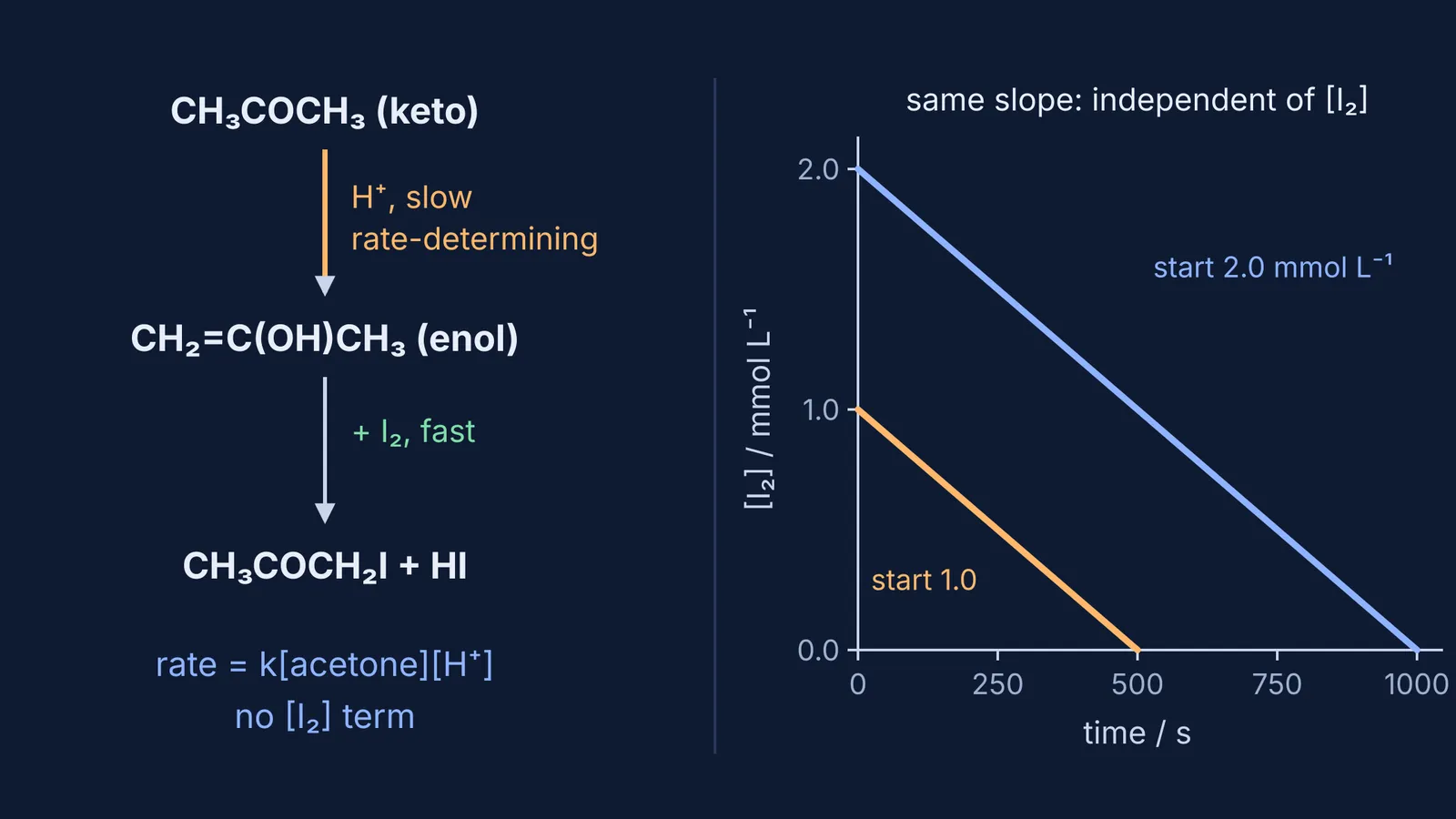
Because iodine does not take part in the slow step. The mechanism runs through the enol form of acetone.
Fast, reversible: H⁺ adds to the carbonyl oxygen. CH₃COCH₃ + H⁺ ⇌ CH₃C(OH⁺)CH₃.
Slow: a water molecule removes an H⁺ from an α-carbon, giving the enol. CH₃C(OH⁺)CH₃ → CH₂=C(OH)CH₃ + H⁺.
Fast: the electron-rich C=C of the enol attacks I₂. The intermediate loses H⁺ from oxygen, giving CH₃COCH₂I and I⁻ (which together with that H⁺ is the HI).
Step 2 is the rate-determining step. It needs acetone and H⁺ (through step 1), so both appear in the rate law. Iodine only joins in step 3, and step 3 is so fast that every enol molecule is caught by iodine almost as soon as it forms. More iodine cannot make enol form any faster, so it cannot speed up the reaction.
H⁺ is a true catalyst here: it is used in step 1 and given back in step 2. The keto-enol equilibrium itself lies almost entirely on the keto side for acetone, as explained in keto-enol tautomerism and which form wins. This post is about how fast the enol forms, not how much of it there is at equilibrium.
How do bromination, deuterium exchange and racemisation prove the mechanism?
If enol formation is the slow step, then any reaction that needs the enol and then reacts fast should go at the same rate. That is what is found.
Bromination of acetone in acid has the same rate as iodination under the same conditions. Swapping I₂ for Br₂ changes nothing, because the halogen is not in the slow step.
Deuterium exchange. In D₂O with acid, the α-hydrogens of acetone are replaced by D at that same rate. Each time an enol re-forms the ketone, it picks up D from the solvent.
Racemisation. A ketone whose α-carbon is a stereocentre loses its optical activity in acid at the same rate as it is halogenated. The enol is flat at that carbon, so when it turns back into the ketone, H can add to either face.
Three different observations, one rate. The simplest explanation is a single shared slow step, and that step is enolisation.
Worked example: an initial-rates table
The numbers below are illustrative, chosen to show the pattern. All concentrations are in mol L⁻¹ and rates in mol L⁻¹ s⁻¹.
Run 1: [acetone] = 0.40, [H⁺] = 0.20, [I₂] = 0.0010. Rate = 2.0 × 10⁻⁶.
Run 2: [acetone] = 0.40, [H⁺] = 0.20, [I₂] = 0.0020. Rate = 2.0 × 10⁻⁶.
Run 3: [acetone] = 0.80, [H⁺] = 0.20, [I₂] = 0.0010. Rate = 4.0 × 10⁻⁶.
Run 4: [acetone] = 0.40, [H⁺] = 0.40, [I₂] = 0.0010. Rate = 4.0 × 10⁻⁶.
Step 1: order in iodine. Compare runs 1 and 2. [I₂] doubles, the rate does not change. Order in I₂ = 0.
Step 2: order in acetone. Compare runs 1 and 3. [acetone] doubles, the rate doubles. Order = 1.
Step 3: order in H⁺. Compare runs 1 and 4. [H⁺] doubles, the rate doubles. Order = 1.
Step 4: rate constant. k = rate / ([acetone][H⁺]) = 2.0 × 10⁻⁶ / (0.40 × 0.20) = 2.5 × 10⁻⁵ L mol⁻¹ s⁻¹.
Step 5: time for the colour to vanish. The rate stays at 2.0 × 10⁻⁶ mol L⁻¹ s⁻¹ until the iodine is gone. In run 1, t = 0.0010 / 2.0 × 10⁻⁶ = 500 s. In run 2, t = 0.0020 / 2.0 × 10⁻⁶ = 1000 s. Doubling the iodine doubles the time, which is the fingerprint of zero order in that reactant.
Why does the iodine colour fade in a straight line?
Write the rate as the loss of iodine: −d[I₂]/dt = k[acetone][H⁺]. In these runs acetone and acid are in large excess. Run 1 uses up only 0.25% of the acetone, and the HI formed raises [H⁺] by only 0.5%. So the right-hand side is effectively constant, and [I₂] falls at a constant rate. A plot of [I₂] against time is a straight line with slope −k[acetone][H⁺], the zero-order shape described in zero-order reactions: the graph and half-life.
This only works when iodine is the limiting reagent. If iodine were in excess, acetone would be used up noticeably, its concentration would fall, and the line would curve.
What can go wrong with this experiment?
Autocatalysis. Each iodination makes one HI, which adds H⁺. If you start with little acid, the H⁺ concentration grows as the reaction runs, so the reaction speeds up. That is why the rate law is found from initial rates, with plenty of added acid.
Base instead of acid. In base, the enolate forms instead, and each iodine put on the α-carbon makes the remaining α-hydrogens more acidic. The second and third iodinations are faster than the first, the reaction runs on to CI₃, and you get iodoform by the haloform reaction. Keep the medium acidic if you want one iodine and a clean rate law. In acid, an iodine on the α-carbon makes the carbonyl oxygen less basic, so the second enolisation is slower and the reaction stops cleanly at one iodine.
To check your own initial-rates working, the Fermi Problem Library has a step-by-step solver that explains the reasoning, not just the final order.
Quick checklist
CH₃COCH₃ + I₂ → CH₃COCH₂I + HI, catalysed by H⁺.
Rate = k[acetone][H⁺]: zero order in I₂, second order overall.
The slow step is enol formation; iodine traps the enol fast.
Bromination, D-exchange and racemisation go at the same rate, which supports the mechanism.
[I₂] falls linearly only when I₂ is limiting and acetone and acid are in excess.
HI produced speeds the reaction up, so use initial rates and keep the medium acidic.


