

On this page
Diamond is the hardest natural material, yet its atoms fill only about 34% of the space in its crystal. That sounds like a contradiction until you build the unit cell yourself. Here you will place every carbon atom, count Z, get the bond length and the packing fraction, and then see how zinc blende (ZnS) uses the same frame with two kinds of atom.
How do you build the diamond unit cell from an fcc lattice?
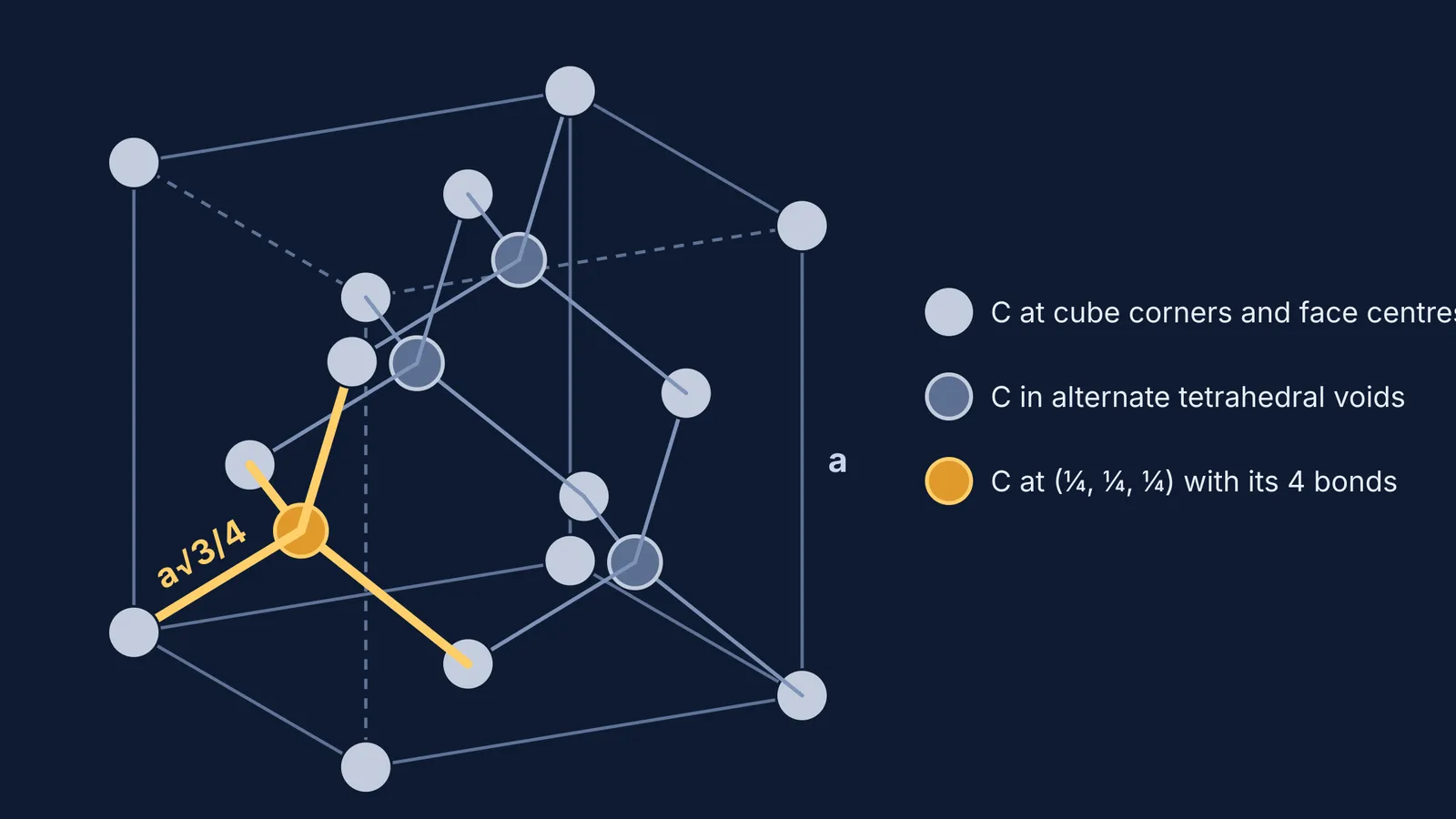
Start with a face-centred cubic (fcc) cell of carbon atoms: one at each of the 8 corners and one at the centre of each of the 6 faces.
An fcc cell has 8 tetrahedral voids, all inside the cube. Each one sits a quarter of the way along a body diagonal from a corner. In fractional coordinates they are every point of the form (¼ or ¾, ¼ or ¾, ¼ or ¾).
If you split the cube into 8 small cubes, one void sits at the centre of each. Diamond puts a carbon atom in only 4 of these 8 voids, in every other small cube, like alternate squares of a chessboard in 3D:
(¼, ¼, ¼)
(¾, ¾, ¼)
(¾, ¼, ¾)
(¼, ¾, ¾)
Look at the first one. Its four nearest neighbours are the corner atom at (0, 0, 0) and the face-centre atoms at (½, ½, 0), (½, 0, ½) and (0, ½, ½). Those four atoms form a regular tetrahedron around it, so the bond angle is 109.5°, exactly what you expect for sp³ carbon.
In diamond the "lattice" atoms and the "void" atoms are identical: every carbon has four carbon neighbours. Splitting them is only a way of counting. Equivalently, diamond is two fcc lattices shifted by a quarter of the body diagonal.
What is the number of atoms per unit cell (Z) in diamond?
Count the contribution of each position:
Corners: 8 × ⅛ = 1
Face centres: 6 × ½ = 3
Inside the cube (tetrahedral voids): 4 × 1 = 4
So Z = 1 + 3 + 4 = 8 carbon atoms per unit cell. This is double the fcc value of 4, because the four void atoms lie wholly inside the cube.
The same cell describes silicon, germanium and grey tin, which all have the diamond structure.
What is the bond length in diamond in terms of a?
The atom at (¼, ¼, ¼) is bonded to the corner atom at (0, 0, 0). The line between them runs along the body diagonal, which has length a√3. They are a quarter of that diagonal apart.
So the C–C bond length is a√3/4.
If you model the atoms as identical touching spheres, the bond is two radii: 2r = a√3/4, so r = a√3/8. Notice how different this is from bcc, where atoms touch along the whole body diagonal (4r = a√3).
What is the packing efficiency of diamond?
Packing efficiency is the volume of the spheres in the cell divided by the volume of the cell.
Volume of 8 spheres = 8 × (4/3)πr³, with r = a√3/8.
(a√3/8)³ = 3√3 a³/512.
8 × (4/3)π × 3√3 a³/512 = 96√3 πa³/1536 = (π√3/16) a³.
Divide by a³: packing efficiency = π√3/16 ≈ 0.340.
So only about 34% of the space is filled. That is exactly half the bcc value (π√3/8 ≈ 68%) and well below fcc (about 74%).
Why is diamond so hard if it is so empty?
Packing tells you how much space the spheres fill, not how strongly they are held. Metallic bonding is not directional, so metal atoms pack tightly with 8 or 12 neighbours. Each carbon in diamond makes four strong sp³ covalent bonds along fixed directions. Four neighbours at 109.5° cannot fill space tightly, so the structure is open. But to scratch or deform it you must break C–C bonds running in all three dimensions. Diamond is hard because of its bonds, not because of its packing. The diamond vs graphite structure in 3D post covers how this bonding sets its other properties.
Worked example: bond length and density of diamond
The edge length of the diamond unit cell is 356.7 pm. Find the C–C bond length, the atomic radius and the density. Take M(C) = 12.011 g mol⁻¹ and N_A = 6.022 × 10²³ mol⁻¹.
Bond length. C–C = a√3/4 = 356.7 × 1.7321/4 = 154.4 pm.
Radius. r = 154.4/2 = 77.2 pm, which matches the textbook covalent radius of carbon (about 77 pm).
Cell volume. a = 356.7 pm = 3.567 × 10⁻⁸ cm, so a³ = 4.538 × 10⁻²³ cm³.
Mass of the cell. Z × M = 8 × 12.011 = 96.09 g per mole of cells.
Density. d = ZM/(N_A a³) = 96.09/(6.022 × 10²³ × 4.538 × 10⁻²³) = 96.09/27.33 ≈ 3.52 g cm⁻³.
This agrees with the measured density of diamond, about 3.5 g cm⁻³. The usual slip is to use Z = 4 because the cell "looks fcc". That gives 1.76 g cm⁻³, half the real value.
How is zinc blende (ZnS) related to diamond?
Zinc blende is the diamond frame with two kinds of atom. S²⁻ ions form the fcc lattice and Zn²⁺ ions fill the same alternate 4 tetrahedral voids. Swapping the roles gives an identical structure.
Three things change compared with diamond:
Z is counted in formula units. There are 4 S²⁻ (1 + 3) and 4 Zn²⁺ (inside), so Z = 4 ZnS units. Eight atoms, but four formula units. Use Z = 4 with M = 97.44 g mol⁻¹ in the density formula.
Coordination is 4:4. Each Zn²⁺ sits in a tetrahedron of S²⁻, and each S²⁻ in a tetrahedron of Zn²⁺. The radius ratio rule for NaCl, CsCl and ZnS predicts this from ion sizes.
The 34% figure does not apply. It assumes identical touching spheres. Zn²⁺ and S²⁻ have very different radii, so the packing fraction depends on the radii you use.
The nearest Zn–S distance is still a√3/4. With a ≈ 541 pm, Zn–S ≈ 234 pm, and d = 4 × 97.44/(N_A a³) ≈ 4.09 g cm⁻³, close to the measured density of zinc blende.
What if all 8 tetrahedral voids are filled?
Filling half the voids, the alternate set, gives zinc blende. Filling all eight gives the fluorite structure: Ca²⁺ in the fcc lattice and F⁻ in every tetrahedral void, so the formula becomes CaF₂ with Z = 4. Compare the two cells in the fluorite and antifluorite unit cells. Other compounds with the zinc blende structure include CuCl, cubic BN and GaAs.
To build these cells in 3D and turn them around, try the Simulation Lab.
Quick checklist
Diamond = fcc carbon + carbon in the alternate 4 of 8 tetrahedral voids.
Void positions: (¼,¼,¼), (¾,¾,¼), (¾,¼,¾), (¼,¾,¾).
Z(diamond) = 1 + 3 + 4 = 8 atoms.
Bond length = a√3/4; for identical touching spheres r = a√3/8.
Packing efficiency = π√3/16 ≈ 34%, half of bcc.
Hardness comes from directional covalent bonds, not from packing.
Zinc blende: same frame, Zn and S alternating, Z = 4 formula units, 4:4 coordination.
All 8 voids filled gives fluorite, not zinc blende.


