

On this page
Calcium fluoride, CaF₂, gives its name to one of the structures you are expected to know for JEE and NEET: the fluorite structure. Swap the roles of the cation and the anion and you get the antifluorite structure of Na₂O, Li₂O and K₂O. Both come from one idea: an fcc arrangement of one ion with every tetrahedral void filled by the other. Once you can place the ions, the formula, Z, the coordination numbers and the density all follow from a short count.
What is the fluorite structure of CaF₂?
Start with a cubic unit cell of edge a.
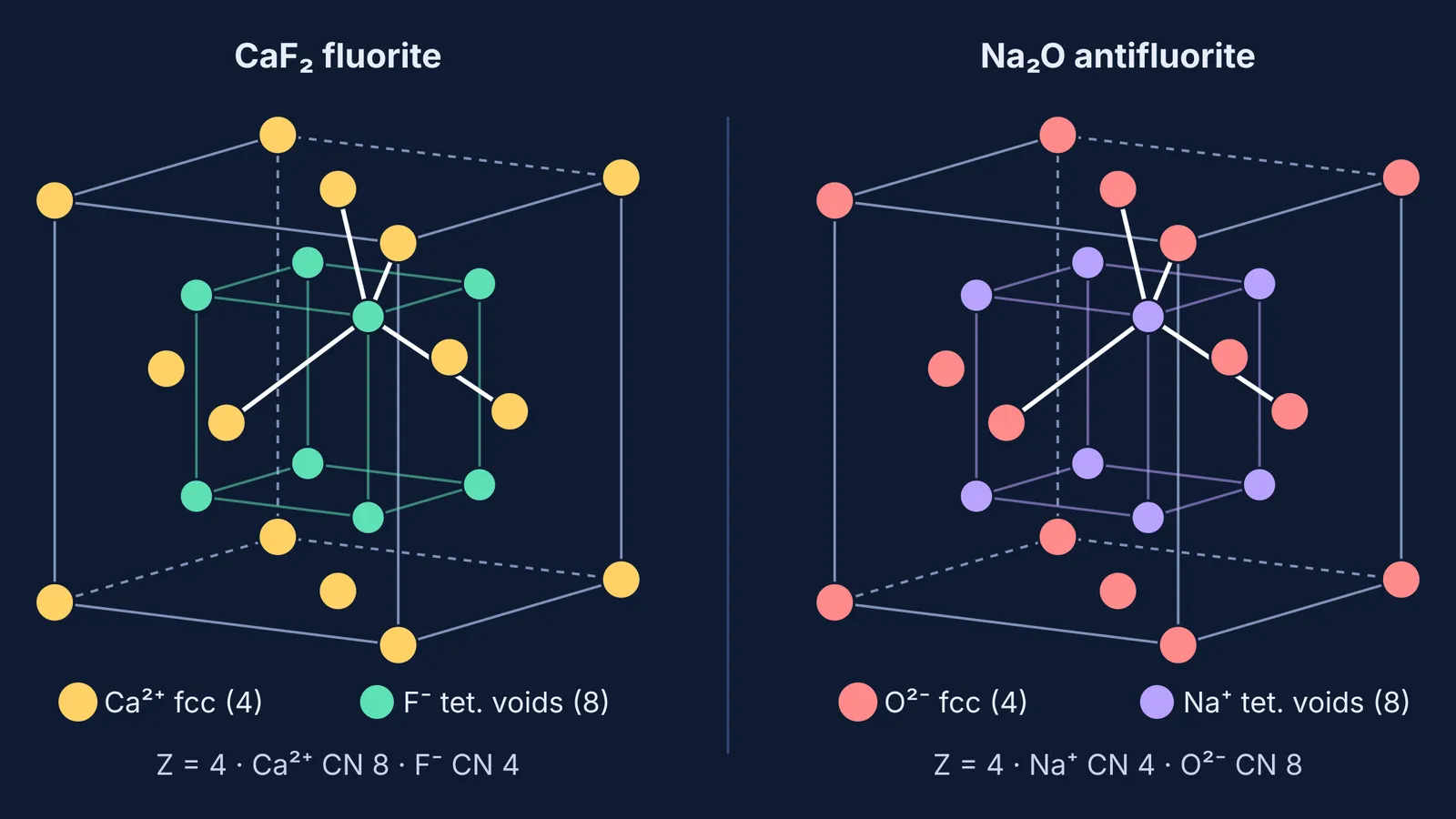
Ca²⁺ ions sit at the 8 corners and the 6 face centres: an fcc (ccp) arrangement.
F⁻ ions sit in all 8 tetrahedral voids. These are at the points (¼, ¼, ¼), (¾, ¼, ¼) and so on: every combination of ¼ and ¾ for x, y and z. Together they form a smaller cube, of edge a/2, entirely inside the unit cell.
Now count the ions that belong to one cell:
Ca²⁺: 8 corners × ⅛ + 6 faces × ½ = 1 + 3 = 4.
F⁻: 8 ions fully inside the cell × 1 = 8.
Ratio Ca : F = 4 : 8 = 1 : 2, which gives CaF₂.
So Z = 4: each unit cell holds four CaF₂ formula units. The general rule, that an fcc lattice of N ions has N octahedral and 2N tetrahedral voids, is covered in how to find a formula from the voids occupied. Fluorite is the case where all 2N tetrahedral voids are full and every octahedral void is empty.
Why is the coordination 8:4 in CaF₂?
Each F⁻ has 4 Ca²⁺ neighbours. Take the F⁻ at (¼, ¼, ¼). Its nearest Ca²⁺ ions are the corner at (0, 0, 0) and the three face centres (½, ½, 0), (½, 0, ½) and (0, ½, ½). These four points are the corners of a regular tetrahedron, all at a distance of √3a/4. That is what "tetrahedral void" means.
Each Ca²⁺ has 8 F⁻ neighbours. Take the Ca²⁺ at the centre of the top face, (½, ½, 1). The F⁻ ions at (¼, ¼, ¾), (¾, ¼, ¾), (¼, ¾, ¾) and (¾, ¾, ¾) lie just below it, and four more lie in the same positions in the cell above. Those 8 F⁻ form a cube around the Ca²⁺, again all at √3a/4.
A quick check that works for any ionic structure: the ratio of coordination numbers is the inverse of the ratio in the formula. In CaF₂ there are twice as many F⁻ as Ca²⁺, so each Ca²⁺ must have twice as many neighbours as each F⁻: 8 against 4.
Is calcium really close-packed in fluorite?
Not in the sense of touching spheres, and this is where the usual textbook wording oversimplifies. Put numbers in. With a = 546 pm, the Ca–Ca distance is a/√2 ≈ 386 pm, while two Ca²⁺ ions (radius about 112 pm in this structure) would touch at about 224 pm. The Ca²⁺ ions are far apart. Also, F⁻ (about 131 pm) is larger than Ca²⁺. A true tetrahedral void in a close-packed array can hold a sphere of only 0.225 times the host radius, so F⁻ could never fit in a real gap between touching Ca²⁺ ions.
So "Ca²⁺ in ccp, F⁻ in tetrahedral voids" is a correct description of where the ions are, not of which ions touch. The physical picture is the other way round. The F⁻ ions form a simple cubic array of edge a/2 ≈ 273 pm, close to two F⁻ radii, so they almost touch. Ca²⁺ sits at the centre of every second one of those small cubes, so it has 8 F⁻ around it, as in CsCl. The radius ratio agrees: r(Ca²⁺)/r(F⁻) ≈ 112/131 ≈ 0.85, above 0.732, the range where the radius ratio rule predicts 8-fold coordination.
What is the antifluorite structure of Na₂O?
Antifluorite is the same geometry with the ions swapped:
O²⁻ ions take the fcc positions: corners and face centres, 4 per cell.
Na⁺ ions fill all 8 tetrahedral voids, 8 per cell.
Na : O = 8 : 4 = 2 : 1, giving Na₂O with Z = 4.
Each Na⁺ has 4 O²⁻ around it (tetrahedral). Each O²⁻ has 8 Na⁺ around it (cubic). The coordination is 4:8.
The swap is needed because the formula is M₂X: twice as many cations as anions. Whichever ion is more numerous goes into the tetrahedral voids.
Which compounds have fluorite and antifluorite structures?
Fluorite (MX₂): CaF₂, SrF₂, BaF₂, and dioxides of large cations such as UO₂, ThO₂ and CeO₂.
Antifluorite (M₂X): Li₂O, Na₂O, K₂O, and sulphides such as Li₂S, Na₂S and K₂S.
How do you find the density of CaF₂? A worked example
Question: CaF₂ has the fluorite structure with a = 546 pm. Find its density and the shortest Ca–F distance. (Ca = 40.08, F = 19.00, N_A = 6.022 × 10²³ mol⁻¹)
Z. From the count above, Z = 4.
Molar mass. M = 40.08 + 2 × 19.00 = 78.08 g mol⁻¹.
Cell volume in cm³. a = 546 pm = 546 × 10⁻¹⁰ cm, so a³ = 1.628 × 10⁻²² cm³.
Density. d = ZM ÷ (N_A a³) = (4 × 78.08) ÷ (6.022 × 10²³ × 1.628 × 10⁻²²) = 312.3 ÷ 98.0 ≈ 3.19 g cm⁻³. This is close to the measured density of fluorite, about 3.18 g cm⁻³.
Ca–F distance. F⁻ at (¼, ¼, ¼) and Ca²⁺ at (0, 0, 0) are a quarter of the body diagonal apart: √3a/4 = 1.732 × 546 ÷ 4 ≈ 236 pm.
Coordination numbers. Ca²⁺ 8, F⁻ 4.
The common slip is in step 3: forgetting to convert pm to cm, or cubing only the 546 and not the 10⁻¹⁰. The same formula run backwards, from density to a or to Z, is worked in density of a unit cell, worked both ways.
Seeing the inner cube of F⁻ inside the fcc cell is much easier when you can turn the cell around. The Simulation Lab has interactive simulations for ideas that are easier to see than to read.
Quick checklist
Fluorite: Ca²⁺ at fcc sites, F⁻ in all 8 tetrahedral voids at (¼, ¼, ¼)-type points.
Z = 4 for CaF₂: 4 Ca²⁺ and 8 F⁻ per cell.
Coordination 8:4 (cubic around Ca²⁺, tetrahedral around F⁻).
Antifluorite (Na₂O): O²⁻ at fcc sites, Na⁺ in all 8 tetrahedral voids; coordination 4:8.
Ca–F = √3a/4; F–F = a/2.
Density of CaF₂ from a = 546 pm ≈ 3.19 g cm⁻³.
The Ca²⁺ ions do not touch; F⁻ in a simple cube with Ca²⁺ in alternate cube centres is the better physical picture.


