

On this page
Nickel and platinum sit in the same group, group 10, yet their chemistry looks very different. Nickel is almost always Ni(II), and Ni(IV) turns up only in a handful of compounds. Platinum forms stable Pt(II) and stable Pt(IV) compounds, and K₂[PtCl₆] is an ordinary laboratory salt. NCERT explains the difference with a simple idea: add up the ionisation enthalpies needed to reach each oxidation state and compare the totals. This post walks through that argument with NCERT's numbers, works the classic exam question, and says where the argument stops.
Which is more stable, Ni(II) or Pt(II)?
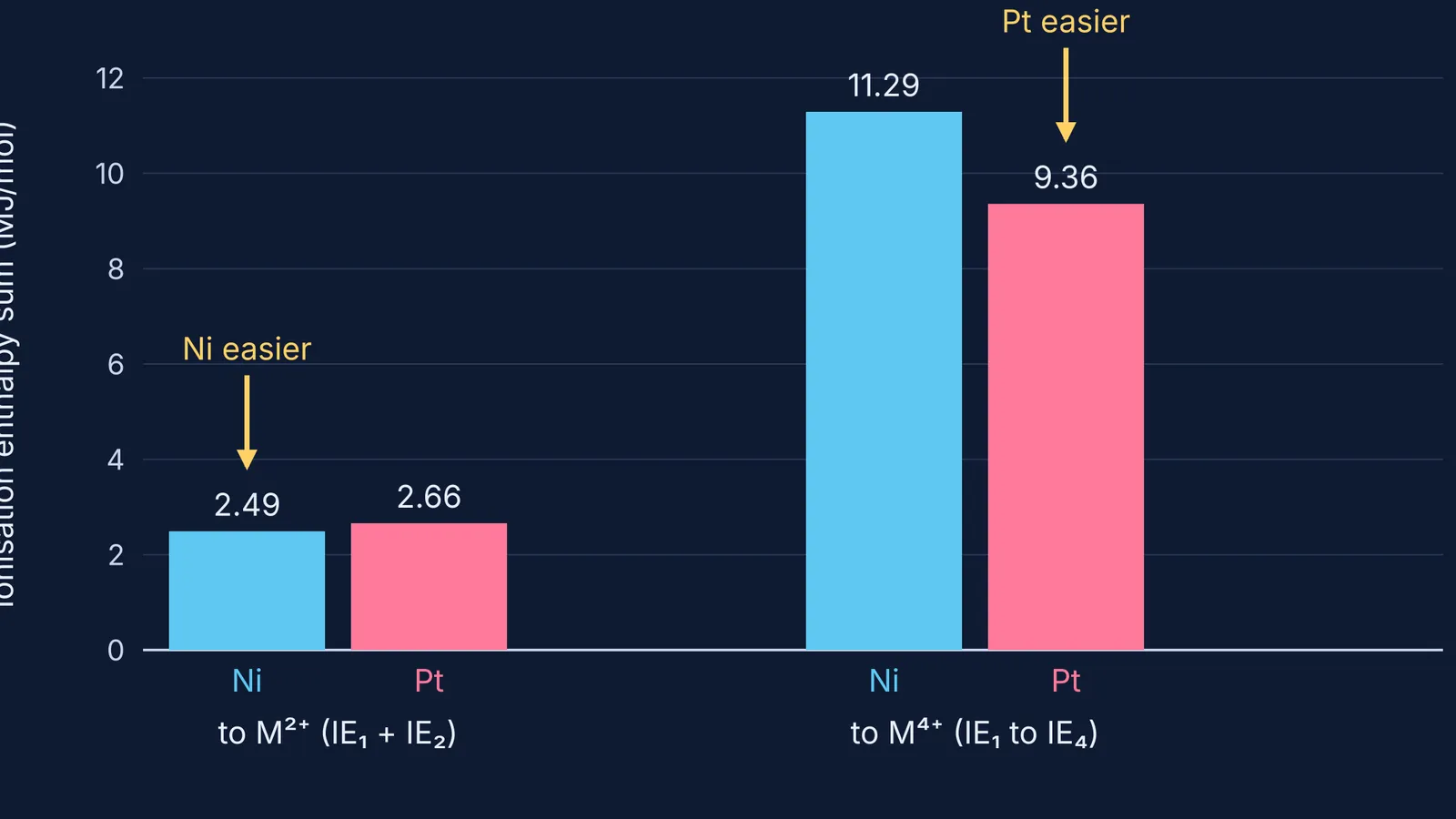
To form M²⁺ from a gaseous atom, you pay the first two ionisation enthalpies. NCERT gives these sums (in MJ/mol, which is 10³ kJ/mol):
Ni: IE₁ + IE₂ = 2.49 MJ/mol
Pt: IE₁ + IE₂ = 2.66 MJ/mol
Nickel needs less energy, by 2.66 − 2.49 = 0.17 MJ/mol (170 kJ/mol). So, on NCERT's argument, Ni(II) compounds are thermodynamically more stable than Pt(II) compounds.
Why is platinum harder to ionise at the start? Its outer 6s electron feels a large effective nuclear charge, because the 4f electrons filled in before it shield poorly. The full explanation, including the lanthanoid contraction, is in why 5d elements have higher ionisation enthalpy than 4d. Here we only need the result: platinum's first two ionisations cost slightly more.
Why is Pt(IV) more stable than Ni(IV)?
To reach M⁴⁺, you pay all four ionisation enthalpies. NCERT splits the next two out:
Ni: IE₃ + IE₄ = 8.80 MJ/mol
Pt: IE₃ + IE₄ = 6.70 MJ/mol
Add these to the first two:
Ni: IE₁ + IE₂ + IE₃ + IE₄ = 2.49 + 8.80 = 11.29 MJ/mol
Pt: IE₁ + IE₂ + IE₃ + IE₄ = 2.66 + 6.70 = 9.36 MJ/mol
Now platinum is ahead by 11.29 − 9.36 = 1.93 MJ/mol. The small 0.17 MJ/mol advantage nickel had at +2 is wiped out more than ten times over by the 2.10 MJ/mol gap in IE₃ + IE₄. On NCERT's argument, Pt(IV) compounds are more stable than Ni(IV) compounds.
The trend flips between +2 and +4. That flip is the whole point of the comparison, and it is why exam questions pair these two metals.
Why does platinum lose its third and fourth electrons more easily?
Look at where the third and fourth electrons come from.
Ni is [Ar] 3d⁸ 4s². Ni²⁺ is 3d⁸, so IE₃ and IE₄ remove 3d electrons, giving Ni⁴⁺ as 3d⁶.
Pt is [Xe] 4f¹⁴ 5d⁹ 6s¹. Pt²⁺ is 5d⁸, so IE₃ and IE₄ remove 5d electrons, giving Pt⁴⁺ as 5d⁶.
3d orbitals are small and held close to the nucleus. Pulling electrons out of an already doubly charged, compact Ni²⁺ ion costs a lot. 5d orbitals are larger and more spread out, so their electrons sit further from the nucleus on average and are easier to remove from Pt²⁺. That is why the order reverses after the first two electrons: at the 6s/4s stage platinum holds on harder, but at the d stage nickel does.
This is the same pattern you see across the whole d block. Heavier members of a group (4d and 5d) are more comfortable in higher oxidation states than the 3d member. For the 3d series on its own, see oxidation states of transition metals: which are stable and why.
Worked example: would you expect [NiCl₆]²⁻ or [PtCl₆]²⁻?
The question: Using the ionisation enthalpy sums below, predict which of [NiCl₆]²⁻ and [PtCl₆]²⁻ is the stable, well-known complex. (Ni: IE₁ + IE₂ = 2.49, IE₃ + IE₄ = 8.80; Pt: IE₁ + IE₂ = 2.66, IE₃ + IE₄ = 6.70, all in MJ/mol.)
Find the oxidation state. Six Cl⁻ give −6. The overall charge is −2. So x − 6 = −2, and x = +4. Both complexes contain M(IV).
Write the total energy to reach M⁴⁺. Ni: 2.49 + 8.80 = 11.29 MJ/mol. Pt: 2.66 + 6.70 = 9.36 MJ/mol.
Compare. Pt⁴⁺ costs 1.93 MJ/mol less to form than Ni⁴⁺.
Predict. [PtCl₆]²⁻ is the expected stable complex. It is found in salts such as K₂[PtCl₆] and in H₂[PtCl₆], the acid formed when platinum dissolves in aqua regia.
Sanity check with real chemistry. Ni(IV) is very rare. It is found in a few compounds such as K₂[NiF₆], where the ligand is fluoride, the most electronegative element and the hardest to oxidise. Chloride is easier to oxidise, so a Ni(IV) chloride complex would not be expected to survive.
A reverse version of the question asks which of NiCl₂ and PtCl₂ is the more stable +2 compound. Use only IE₁ + IE₂: nickel's total is lower, so the expected answer is Ni(II).
Is the ionisation enthalpy argument the whole story?
No, and it is worth saying so in a long answer. Ionisation enthalpy is the energy cost of making the gaseous ion. Whether a compound is stable also depends on the energy released when that ion forms bonds, a lattice or a hydrated ion: lattice enthalpy, hydration enthalpy and bond enthalpies. A small, highly charged ion can release a lot of energy this way, which partly offsets a high ionisation cost.
For Pt(IV) there is an extra factor. Pt⁴⁺ is d⁶, and in an octahedral complex with the large crystal field splitting typical of 5d metals, all six electrons pair up in the lower t₂g set. This low-spin d⁶ arrangement gains a large crystal field stabilisation energy, which helps Pt(IV) complexes.
So treat the sums as NCERT's argument: a useful first comparison that gives the right answer here, not a full energy balance. Also note that published values of IE₃ and IE₄ for platinum vary between data tables. Quote NCERT's figures in a board or entrance exam and do not mix in numbers from elsewhere.
One more point people miss. Pt(II) is not unstable. [PtCl₄]²⁻ and cisplatin are common Pt(II) compounds. The comparison is relative: Ni(II) versus Pt(II), and Pt(IV) versus Ni(IV). If you want to see how the same data are used for a different job, finding a group from the jump in successive values, read successive ionisation enthalpies: finding the group from data.
To revise the d-block ideas behind this, such as effective nuclear charge, shielding and crystal field splitting, the Fermi Concept Library covers every concept in physics, chemistry, biology, mathematics and computing.
Quick checklist
Ni(II) beats Pt(II): IE₁ + IE₂ is 2.49 MJ/mol for Ni and 2.66 for Pt.
Pt(IV) beats Ni(IV): the four-electron sum is 9.36 MJ/mol for Pt and 11.29 for Ni.
The flip comes from IE₃ + IE₄ (8.80 vs 6.70), because 5d electrons are easier to remove than 3d.
K₂[PtCl₆] is a common stable salt; Ni(IV) appears only in rare compounds such as K₂[NiF₆].
Call it NCERT's argument: lattice, hydration and bond enthalpies also matter.
Use NCERT's numbers, not values from other tables.


