

On this page
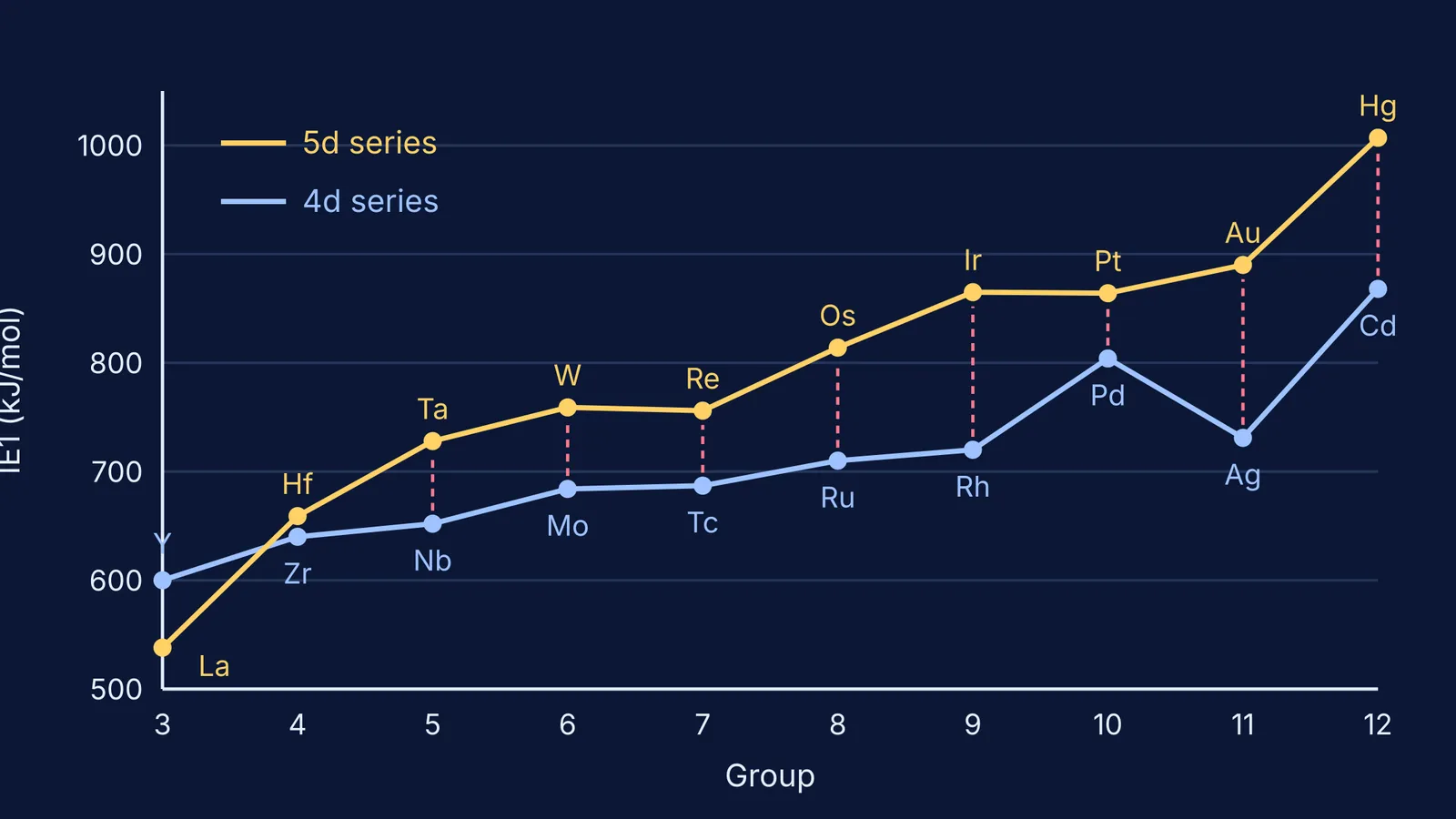
Going down a group usually makes an atom easier to ionise, because the outer electron sits further from the nucleus. In the d-block this rule breaks between the second and third rows: hafnium, tungsten, platinum and gold hold their outer electron more tightly than zirconium, molybdenum, palladium and silver above them. The reason is fourteen electrons you never see in the group: the 4f set.
Why do 5d elements have higher ionisation enthalpy than 4d?
Zirconium has atomic number 40 and hafnium has 72, so hafnium carries 32 more protons, and its electrons include a complete 4f subshell that zirconium lacks, as the configuration tables in the NCERT Class 12 chapter on d- and f-block elements show.
The same NCERT chapter states that the shielding of one 4f electron by another is less than that of one d electron by another. So each added proton is only partly cancelled, and the effective nuclear charge (the net positive charge an outer electron actually feels) on the 5d and 6s electrons climbs.
That extra pull shrinks the atom. NCERT calls the steady fall in size across the 4f series the lanthanoid contraction, and gives the result: zirconium has a radius of 160 pm and hafnium 159 pm (NCERT, Unit 4). The size that should have grown going down the group did not grow at all.
Put the two facts together. A 5d electron sits at about the same distance from the nucleus as the 4d electron above it, yet it feels a larger effective nuclear charge. More pull at the same distance means more energy to remove it, which is a higher ionisation enthalpy.
What do the real numbers show?
The first ionisation energies below come from the NIST Atomic Spectra Database, converted from electronvolts using 1 eV = 96.485 kJ/mol (the Faraday constant, 96 485.332 C/mol per NIST, divided by 1000). Values are rounded to the nearest kJ/mol.
Zr 640, Hf 659: 5d higher by 19 kJ/mol
Nb 652, Ta 728: higher by 76 kJ/mol
Mo 684, W 759: higher by 75 kJ/mol
Ru 710, Os 814: higher by 104 kJ/mol
Rh 720, Ir 865: higher by 145 kJ/mol
Pd 804, Pt 864: higher by 60 kJ/mol
Ag 731, Au 890: higher by 159 kJ/mol
Cd 868, Hg 1007: higher by 139 kJ/mol
The gap generally grows towards the right of the block, though platinum's lead over palladium is smaller. To practise reading a jagged trend like this, see our post on reading the first ionisation enthalpy vs atomic number graph.
Does relativity play a part for gold and mercury?
For the heaviest elements there is a second effect on top of the lanthanoid contraction. As the Royal Society of Chemistry's Education in Chemistry explains, relativity causes s and p orbitals to contract, and the relativistic contraction of the 6s orbital reaches a sharp maximum at gold. A smaller 6s orbital holds its electron closer and tighter, which fits gold having the largest jump in the list above.
For JEE Main, NEET-UG and board answers, write the NCERT explanation. Relativity is a good extra line for olympiad answers, not a replacement.
How do you write this answer in an exam?
Use a four-step chain, one sentence per step.
Name the cause: in 5d elements, the 4f subshell is filled before the 5d.
State the shielding fact: 4f electrons shield the nuclear charge poorly.
State the consequence: the effective nuclear charge on the 5d and 6s electrons increases, and the lanthanoid contraction keeps the atomic size almost equal to the 4d element (Zr 160 pm, Hf 159 pm, per NCERT).
Conclude: a higher effective nuclear charge at a similar distance makes the outer electrons harder to remove, so the ionisation enthalpy is higher.
Worked example: "Why is the first ionisation enthalpy of gold higher than that of silver?" Write the four steps with gold and silver in place of 5d and 4d, then add the NIST numbers: about 890 kJ/mol for gold and 731 kJ/mol for silver. Before you move on, check that you mentioned 4f, effective nuclear charge and size.
The common slip is to stop at "lanthanoid contraction" without saying why it raises ionisation enthalpy. Contraction is the evidence; the larger effective nuclear charge is the cause.
Where does this fit with the other d-block trends?
The 3d series has its own irregular ionisation pattern, driven by exchange energy and half-filled shells, covered in why the ionisation enthalpy trend in the 3d series is irregular. The same poor 4f shielding also explains why lanthanoids behave so alike, which our comparison of lanthanoids and actinoids takes further.
If shielding and effective nuclear charge still feel fuzzy, the Fermi Concept Library has a lesson for each concept in chemistry, with its place in the map, so you can see what lanthanoid contraction depends on. To practise the written chain, the Fermi Problem Library has worked problems with a step-by-step solver that explains the reasoning rather than printing an answer.


