

On this page
Both lanthanoids and actinoids form the f-block of the periodic table, known as inner transition elements. The IUPAC Recommendations 2005 establish the terms lanthanoid and actinoid instead of lanthanide and actinide to avoid confusion with binary anions ending in "-ide". Lanthanoids comprise 15 elements from lanthanum (Z = 57) to lutetium (Z = 71), filling the 4f subshell. Actinoids comprise 15 elements from actinium (Z = 89) to lawrencium (Z = 103), filling the 5f subshell.
In 1945, Glenn T. Seaborg published the actinide hypothesis in *Chemical & Engineering News*, showing that heavy radioelements form a second f-series. While both families share a +3 oxidation state, lanthanoids display chemical uniformity, whereas actinoids exhibit multiple oxidation states and complex ions. When studying the electronic configuration of transition and inner-transition ions, distinguishing between buried 4f orbitals and exposed 5f orbitals explains every periodic difference.
Why do actinoids show a wider range of oxidation states?
The principal oxidation state for both families is +3, but departures reveal contrasting orbital energetics. In NCERT Class 12 Chemistry Unit 4, lanthanoids show few oxidation states: alongside +3, only a few elements form +2 or +4 ions. These exceptions occur where an ion achieves an empty, half-filled, or filled 4f subshell, such as Ce⁴⁺ (4f⁰), Eu²⁺ (4f⁷), and Yb²⁺ (4f¹⁴). The large energy gap between 4f and 5d/6s orbitals keeps 4f electrons localized.
In actinoids, energy gaps between 5f, 6d, and 7s subshells are minimal, allowing electrons in all three to participate in bonding. Early actinoids exhibit multiple states: thorium forms +4, protactinium +5, uranium +3 to +6, and neptunium and plutonium reach +7, as catalogued in NCERT Class 12 Chemistry Unit 4. Beyond americium, 5f orbitals stabilize, causing later actinoids to revert to a dominant +3 state.
Why is actinoid contraction greater than lanthanoid contraction?
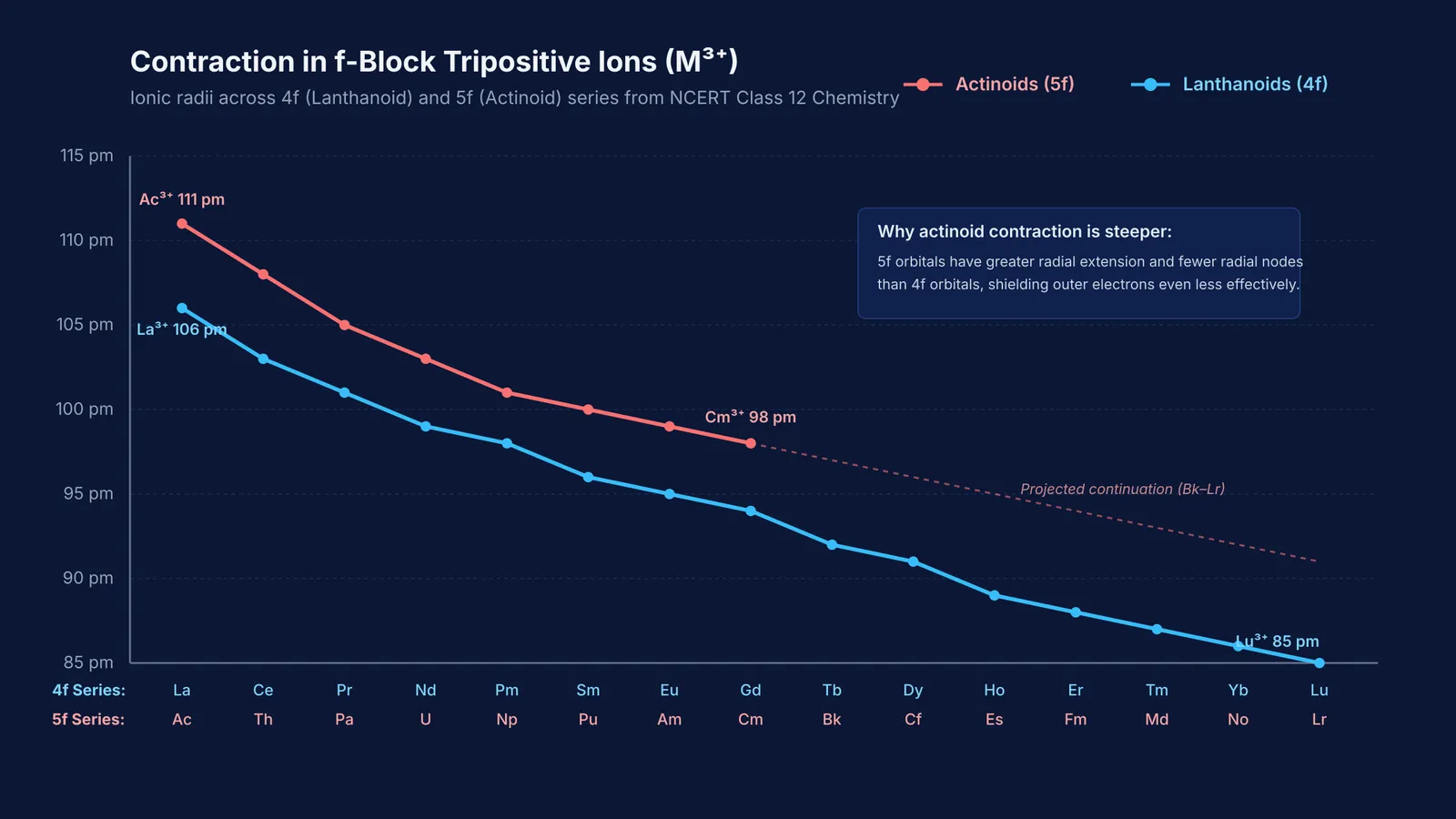
Both series exhibit a steady decrease in ionic radii with increasing atomic number. In lanthanoids, added nuclear charge is counterbalanced by electrons entering diffuse 4f orbitals that shield poorly. In NCERT Class 12 Chemistry Unit 4, the trivalent radius falls from 106 pm for La³⁺ to 85 pm for Lu³⁺, a net contraction of 21 pm.
Actinoid contraction is steeper because 5f orbitals extend further and shield even less effectively than 4f orbitals. Across early trivalent actinoids in NCERT Class 12 Chemistry Unit 4, ionic radii drop from 111 pm for Ac³⁺ to 98 pm for Cm³⁺ across the 8 elements from actinium to curium. This steeper contraction yields high charge densities in early actinoids, strengthening covalent interactions.
Why is actinoid chemistry much harder to study?
While 14 of the 15 lanthanoids have stable isotopes—promethium (Z = 61) is the sole radioactive exception in NCERT Class 12 Chemistry Unit 4—every actinoid is radioactive. Thorium and uranium have half-lives of billions of years, but transuranic elements decay in days, minutes, or seconds. As explored in radioactive decay series and half-lives, intense specific activity requires hot cells and remote handling.
Radioactivity also alters solution chemistry. Alpha particles induce solvent radiolysis, breaking water into peroxide and reactive radicals. As Miner and Seed showed in *Chemical Reviews*, these radicals continuously oxidize or reduce dissolved actinoids. Furthermore, later actinoids exist only in trace quantities. In *Nature*, Sato and colleagues measured the first ionization potential of lawrencium (Z = 103) at 4.96 eV by capturing atoms produced one at a time.
How do complex formation and oxocations differ?
Due to large radii and low charge densities, trivalent lanthanoids form few complexes, interacting primarily through electrostatic forces with hard oxygen donors like EDTA. In contrast, actinoids possess smaller ionic radii in higher oxidation states (+4 to +6), and their 5f orbitals participate directly in covalent bonding, as covered in coordination compounds and complex formation.
This covalent participation allows actinoids to form stable oxocations like uranyl (UO₂²⁺) and plutonyl (PuO₂²⁺), motifs unknown in lanthanoid chemistry, as noted in NCERT Class 12 Chemistry Unit 4. To master these relationships, the Fermi Concept Library covers every concept in physics, chemistry, biology, mathematics and computing, each with its own lesson and its place in the map.
How to solve f-block comparison questions in exams?
When answering inner-transition questions in CBSE, JEE Main, or NEET-UG, follow this four-step checklist:
Identify the subshell: Check whether the problem involves 4f (lanthanoid) or 5f (actinoid) electrons.
Predict oxidation states: Assign +3 as default. Check for +2 or +4 in lanthanoids only with f⁰, f⁷, or f¹⁴ configurations; allow +3 through +7 for early actinoids.
Compare contraction: Remember actinoid contraction is steeper due to poorer 5f shielding, while hydroxide basicity decreases across both series as ionic size shrinks.
Check for oxocations and radioactivity: Attribute oxocations (such as UO₂²⁺) strictly to actinoids, and remember all actinoids are radioactive.
For complex reduction potentials or multiconcept problems, the Fermi Problem Library has worked problems with a step-by-step solver that explains the reasoning rather than printing an answer.


