

On this page
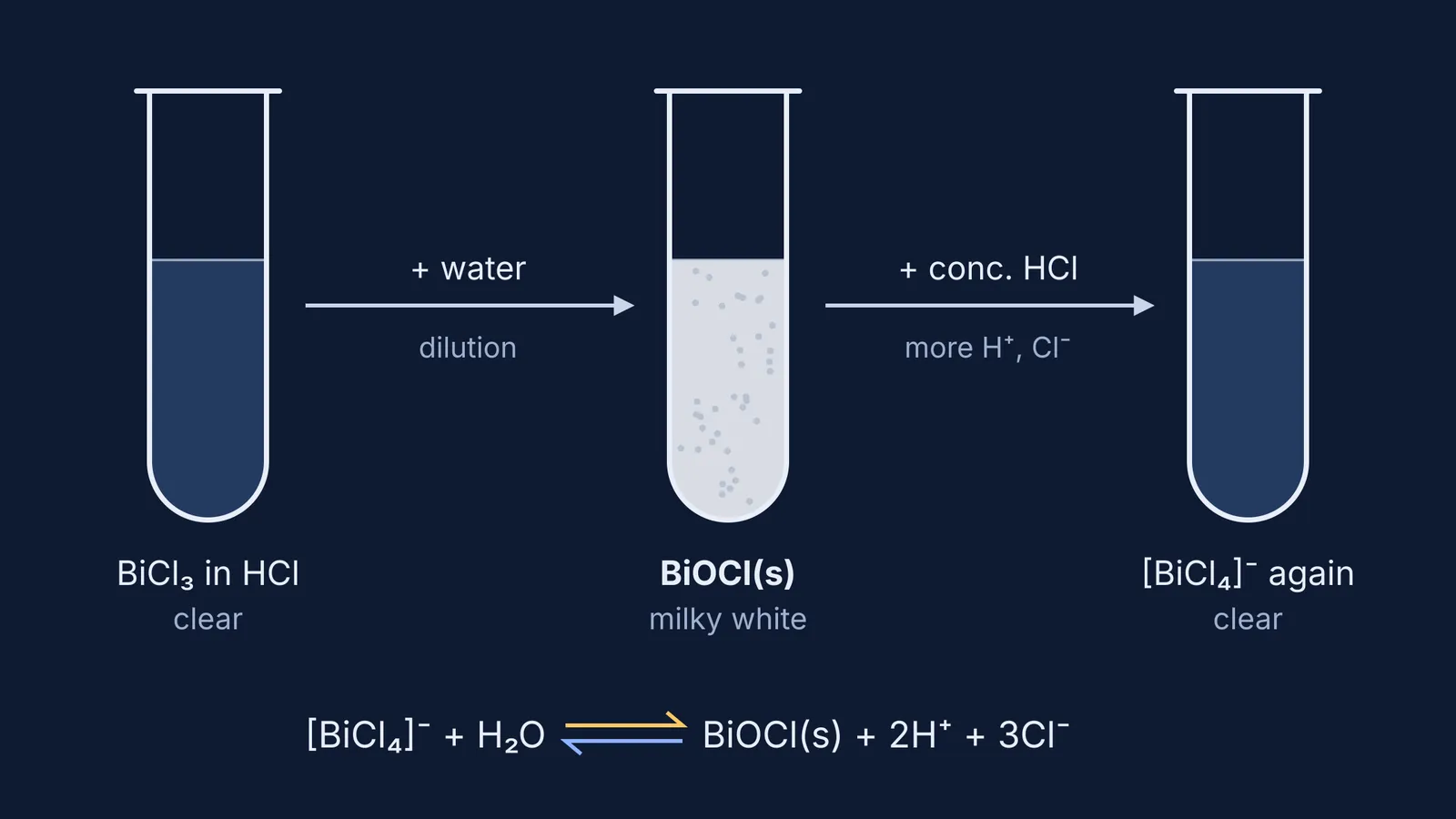
Dissolve a little bismuth chloride in concentrated hydrochloric acid and you get a clear solution. Pour it into a beaker of water and it turns milky white at once. Add concentrated HCl and it clears again. Dilute once more and the white cloud comes back. This reversible white turbidity is the classic confirmatory test for Bi³⁺ in salt analysis. The usual one-line explanation, "water is a reactant, so adding water pushes the reaction forward", is not correct. The real reason is about counting ions, and it only works once you write the bismuth species correctly.
What is the white precipitate when BiCl₃ is added to water?
It is bismuth oxychloride, BiOCl, a white solid that is only very slightly soluble in water. Bismuth(III) is a highly charged cation that polarises water strongly, so BiCl₃ hydrolyses as soon as the acid around it is diluted:
BiCl₃ + H₂O ⇌ BiOCl↓ + 2HCl
Check the balance: Bi 1 = 1, Cl 3 = 1 + 2, O 1 = 1, H 2 = 2. The hydrolysis stops at the oxychloride. It does not go all the way to the hydroxide, so do not write Bi(OH)₃ as the product of this test.
Two colour facts are worth keeping apart. BiOCl is white. Bi₂S₃, the precipitate bismuth gives earlier with H₂S in Group 2, is dark brown to black. If an answer says "brown precipitate on dilution", it has mixed up the two steps.
Antimony behaves the same way. SbCl₃ in water gives white antimony oxychloride, SbOCl, which also dissolves in concentrated HCl:
SbCl₃ + H₂O ⇌ SbOCl↓ + 2HCl
Antimony is in Group 2B, though, while bismuth stays in Group 2A, because only antimony's sulphide dissolves in yellow ammonium sulphide. The split is explained in how yellow ammonium sulphide separates Group 2A from Group 2B.
Where does this test come in Group 2A analysis?
In the usual scheme, the Group 2A sulphides are dissolved in hot dilute nitric acid. Adding excess ammonia then separates bismuth from copper and cadmium, which stay in solution as ammine complexes. Bismuth comes down as a white precipitate. That precipitate, Bi(OH)₃, belongs to the separation step and is not the confirmatory product.
To confirm bismuth:
Dissolve the white precipitate in the minimum amount of dilute HCl. This gives a clear solution of bismuth chloride.
Pour this solution into a large volume of water.
A white turbidity of BiOCl confirms Bi³⁺.
Why does adding water not simply push the equilibrium forward?
Write the reaction as most books do, with free ions:
Bi³⁺ + Cl⁻ + H₂O ⇌ BiOCl(s) + 2H⁺
Charges balance: 3 − 1 = +2 on the left, +2 on the right. Water is the solvent, so its activity stays close to 1 and it does not appear in the reaction quotient. Solid BiOCl does not appear either. That leaves:
Q = [H⁺]² / ([Bi³⁺][Cl⁻])
There are two ions on top and two on the bottom. If you dilute tenfold, every concentration falls by 10. The top falls by 10² and the bottom falls by 10², so Q does not change at all. Written this way, the equation predicts that dilution has no effect on the position of equilibrium. That contradicts the test tube, so this equation cannot be the whole story.
The general rule for dilution is covered in how dilution shifts an aqueous equilibrium: dilution favours the side with more dissolved particles. Here both sides have two, so the rule gives no answer either.
What is the real form of bismuth in HCl solution?
In a solution with plenty of chloride, Bi³⁺ does not float around as a bare ion. It binds chloride ions to form chloro complexes such as [BiCl₄]⁻, [BiCl₅]²⁻ and [BiCl₆]³⁻. Which one dominates depends on how much chloride is present. This is also why BiOCl dissolves in concentrated HCl: the chloride pulls bismuth into a soluble complex.
Assumption for this post: take the dissolved bismuth to be [BiCl₄]⁻. The hydrolysis is then:
[BiCl₄]⁻ + H₂O ⇌ BiOCl(s) + 2H⁺ + 3Cl⁻
Check it. Atoms: Bi 1 = 1; Cl 4 = 1 + 3; O 1 = 1; H 2 = 2. Charge: −1 on the left; +2 − 3 = −1 on the right. It balances.
Now count dissolved ions. There is one on the left and five on the right. Dilution favours the side with more particles, so it favours the precipitate. If you take [BiCl₆]³⁻ instead, the right side has seven ions (2H⁺ + 5Cl⁻), so the effect is even stronger. Any chloro complex gives the same direction, which is why the conclusion is safe even though the exact species is uncertain.
Worked example: Q before and after a tenfold dilution
Take a clear solution with dissolved bismuth at 0.010 M, [H⁺] = 1.0 M and free [Cl⁻] = 1.0 M, and dilute it tenfold. Compare Q for both equations.
Version 1: free Bi³⁺
Before: Q = (1.0)² / (0.010 × 1.0) = 100.
After tenfold dilution: [Bi³⁺] = 0.0010 M, [Cl⁻] = 0.10 M, [H⁺] = 0.10 M.
Q = (0.10)² / (0.0010 × 0.10) = 0.010 / 0.00010 = 100.
Q has not changed, so this version predicts no precipitate.
Version 2: [BiCl₄]⁻
Q = [H⁺]²[Cl⁻]³ / [BiCl₄⁻].
Before: Q = (1.0)² × (1.0)³ / 0.010 = 100.
After: Q = (0.10)² × (0.10)³ / 0.0010 = 0.000010 / 0.0010 = 0.010.
Q has dropped by a factor of 10⁴. In general, tenfold dilution multiplies Q by 10 to the power (ions on the left − ions on the right), here 10⁻⁴.
What this means: the solution was clear, so at the start Q was at or above K and nothing precipitated. After dilution Q is 10⁴ times smaller. If K lies anywhere in that wide window, Q is now below K, the forward reaction runs, and BiOCl precipitates. We have not used a value of K, because the point is the direction of the shift, not a number.
Adding concentrated HCl does the opposite. It raises both [H⁺] and [Cl⁻], which appear on the top of Q with powers 2 and 3. Q rises above K, the reverse reaction runs, and BiOCl dissolves back into [BiCl₄]⁻.
How is this different from AlCl₃ or SiCl₄ hydrolysis?
AlCl₃ and FeCl₃ solutions are acidic because their hydrated cations release H⁺, but they stay clear at ordinary concentrations. That case is covered in why aluminium and ferric chloride solutions are acidic. SiCl₄ hydrolyses completely and irreversibly. BiCl₃ sits in between: its hydrolysis gives a solid, and the solid can be dissolved again by acid. That reversibility is what makes it useful as a test.
If you want to practise more equilibrium and salt analysis questions like this one, the Fermi Problem Library has a step-by-step solver that explains the reasoning at each stage.
Quick checklist
BiCl₃ + water gives white BiOCl, not Bi(OH)₃ and not brown Bi₂S₃.
Concentrated HCl dissolves BiOCl; dilution brings it back.
With free Bi³⁺, Q does not change on dilution, so that equation cannot explain the test.
Write bismuth as [BiCl₄]⁻: one ion on the left, five on the right, so tenfold dilution lowers Q by 10⁴.
SbCl₃ gives white SbOCl in the same way, but antimony belongs to Group 2B.


