

On this page
Students often learn that a higher activation energy means a slower reaction. That is only half true. When two reactions have different activation energies and different pre-exponential factors, there is one temperature at which their rate constants are equal. Below it, one reaction is faster. Above it, the other one is. This post shows how to find that crossover temperature, how to read it from two lines on an Arrhenius plot, and why it matters when one reactant can go down two paths.
When do two reactions have the same rate constant?
Write the Arrhenius equation for each reaction:
k₁ = A₁ e^(−Ea₁/RT)
k₂ = A₂ e^(−Ea₂/RT)
Set k₁ = k₂ and take natural logs of both sides:
ln A₁ − Ea₁/RT = ln A₂ − Ea₂/RT
Collect the terms with T on one side:
(Ea₁ − Ea₂)/RT = ln A₁ − ln A₂ = ln(A₁/A₂)
So the crossover temperature is:
T(cross) = (Ea₁ − Ea₂) / (R ln(A₁/A₂))
Two points matter here. First, use the natural log. If you prefer log₁₀, the denominator becomes 2.303 R log(A₁/A₂). Second, A₁ and A₂ must have the same units, which means both reactions must have the same order. You cannot compare a first-order A in s⁻¹ with a second-order A in L mol⁻¹ s⁻¹ this way.
If you want a refresher on what A means for a single reaction, see what the pre-exponential factor A tells you. Here, only the ratio A₁/A₂ matters.
Does a crossover always exist?
No. A real, positive crossover temperature needs the numerator and denominator to have the same sign. In words: the reaction with the higher activation energy must also have the larger A.
Higher Ea and larger A: the two effects pull in opposite directions, so there is a crossover. The high-Ea reaction loses at low temperature and wins at high temperature.
Higher Ea and smaller A: both effects work against that reaction. It is slower at every temperature, and the formula gives a negative T, which has no meaning.
Equal A values: the reaction with the lower Ea is faster at every temperature.
So before you plug in numbers, check which reaction has the larger A.
Which reaction is faster above and below the crossover?
Divide the two rate constants instead of setting them equal:
k₁/k₂ = (A₁/A₂) × e^(−(Ea₁ − Ea₂)/RT)
Take reaction 1 as the one with the higher Ea. The exponential factor is less than 1 and gets closer to 1 as T rises. At low temperature it is tiny, so k₁/k₂ is small and reaction 2 (low Ea) is faster. At high temperature the exponential approaches 1, so k₁/k₂ approaches A₁/A₂, which is greater than 1, and reaction 1 (high Ea) is faster.
The physical reason: a reaction with a larger Ea is more sensitive to temperature. Raising T speeds up both reactions, but it speeds up the high-Ea one more. Given a large enough A, it eventually overtakes.
How does the crossover look on an Arrhenius plot?
A plot of ln k against 1/T gives a straight line with slope −Ea/R and intercept ln A. Reading one such line to get Ea is covered in how to find activation energy from an Arrhenius plot, so we will not repeat it.
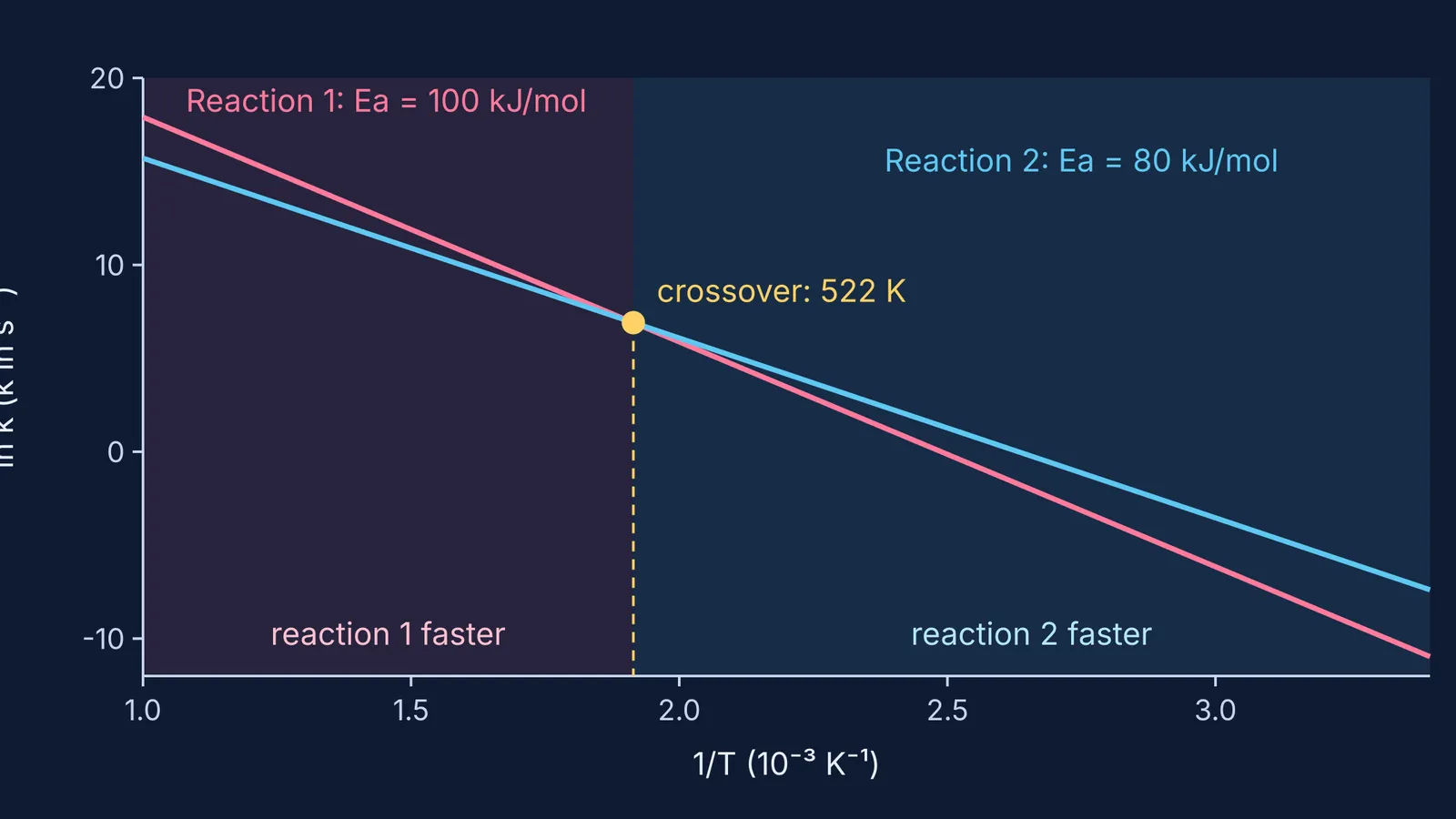
With two reactions you get two lines:
The high-Ea reaction has the steeper line (more negative slope) and, if a crossover exists, the higher intercept.
The two lines meet at 1/T(cross).
High temperature sits on the left of the plot, because 1/T is small there. To the left of the crossing point, the steep line is on top. To the right, the shallow line is on top.
Worked example: crossover temperature for two first-order reactions
Reaction 1 has A₁ = 10¹³ s⁻¹ and Ea₁ = 100 kJ/mol. Reaction 2 has A₂ = 10¹¹ s⁻¹ and Ea₂ = 80 kJ/mol. Both are first order. Find the crossover temperature and compare k₁/k₂ at 300 K and at 800 K.
Check a crossover exists. Reaction 1 has the higher Ea and the larger A. Yes, there is one.
Ea difference in J/mol. Ea₁ − Ea₂ = 100 000 − 80 000 = 20 000 J/mol. Keep R = 8.314 J mol⁻¹ K⁻¹, so the units match.
A ratio. A₁/A₂ = 10¹³/10¹¹ = 100, and ln 100 = 4.605.
Crossover. T = 20 000 / (8.314 × 4.605) = 20 000 / 38.29 ≈ 522 K. That is 1/T ≈ 1.91 × 10⁻³ K⁻¹.
Ratio at 300 K. ln(k₁/k₂) = 4.605 − 20 000/(8.314 × 300) = 4.605 − 8.019 = −3.41. So k₁/k₂ ≈ e^(−3.41) ≈ 0.033. Reaction 2 is about 30 times faster.
Ratio at 800 K. ln(k₁/k₂) = 4.605 − 20 000/(8.314 × 800) = 4.605 − 3.007 = 1.60. So k₁/k₂ ≈ 4.9. Now reaction 1 is about 5 times faster.
The same pair of reactions gives opposite answers to "which is faster?" depending on the temperature. A quick sanity check: at 522 K the ratio should come out as 1, and 4.605 − 20 000/(8.314 × 522) ≈ 0.00, so it does.
Why does heating favour the high-Ea path in parallel reactions?
Suppose one reactant A can form B (rate constant k₁) or C (rate constant k₂), both first order. For these parallel reactions, the product ratio [B]/[C] equals k₁/k₂ at all times, and the fraction of A that ends up as B is k₁/(k₁ + k₂). The fixed-temperature maths, including half-life and yields, is in parallel and consecutive reactions.
What that post does not cover is what happens when you change the temperature. Use the numbers from the worked example:
At 300 K, k₁/k₂ ≈ 0.033, so only about 3% of the product is B.
At 522 K, k₁/k₂ = 1, so B and C form in equal amounts.
At 800 K, k₁/k₂ ≈ 4.9, so about 83% of the product is B.
The general rule: heating shifts selectivity towards the path with the higher activation energy; cooling shifts it towards the lower one. Temperature is one of a chemist's main handles for choosing between two competing products. If you want to watch the two rate constants change as you drag the temperature, the Fermi Simulation Lab has interactive simulations for ideas that are easier to see than read.
What mistakes cost marks on crossover questions?
Saying "the higher-Ea reaction is always slower". It is slower only below the crossover.
Using log₁₀ without the factor 2.303.
Mixing kJ and J: Ea in kJ/mol with R = 8.314 J mol⁻¹ K⁻¹ gives an answer 1000 times too small.
Comparing A values with different units (different reaction orders).
Reading the Arrhenius plot the wrong way round, forgetting that small 1/T means high temperature.
Quick checklist
T(cross) = (Ea₁ − Ea₂)/(R ln(A₁/A₂)), with Ea in J/mol.
A crossover exists only if the high-Ea reaction also has the larger A.
Below T(cross), the low-Ea reaction is faster; above it, the high-Ea reaction is faster.
On an ln k against 1/T plot, the steeper line is on top at the left (high temperature).
In parallel reactions, [B]/[C] = k₁/k₂, so heating favours the high-Ea product.


