

On this page
If you are studying chemical kinetics for CBSE boards, JEE Main or NEET-UG, you meet the Arrhenius equation, k = A·e^(−Ea/RT), and most of the attention goes to Ea. Here is what the other letter, A, means and what it tells you about k at very high temperature.
What is the pre-exponential factor A in the Arrhenius equation?
In the NCERT Class 12 Chemistry chapter on chemical kinetics, A is called the Arrhenius factor or the frequency factor, and also the pre-exponential factor: a constant specific to a particular reaction. The name "pre-exponential" simply says where it sits, in front of the exponential term.
The same chapter states that the factor e^(−Ea/RT) corresponds to the fraction of molecules that have kinetic energy greater than Ea. So k splits into two questions: how often do molecules meet in a useful way (A), and what fraction of those meetings carry enough energy?
Why is A collision frequency times an orientation factor?
Collision theory, which NCERT credits to Max Trautz and William Lewis in 1916-18, makes this split concrete. NCERT defines collision frequency Z as the number of collisions per second per unit volume of the reaction mixture. For a bimolecular reaction, it writes Rate = Z_AB·e^(−Ea/RT) and concludes that A is related to collision frequency.
Not every collision leads to products, so NCERT adds a probability or steric factor P, because colliding molecules must be properly oriented: Rate = P·Z_AB·e^(−Ea/RT). Its picture is a hydroxide ion meeting CH3Br: with proper orientation the pair forms methanol; with improper orientation the molecules simply bounce back. The LibreTexts page on the Arrhenius equation/Kinetics/06%3A_Modeling_Reaction_Kinetics/6.02%3A_Temperature_Dependence_of_Reaction_Rates/6.2.03%3A_The_Arrhenius_Law/6.2.3.01%3A_Arrhenius_Equation) writes the same idea as A = Zρ, with Z the collision factor and ρ the steric factor.
What are the units of A?
An exponent is a pure number, so e^(−Ea/RT) has no units, and A carries exactly the units of k:
First-order reaction: k and A are both in s⁻¹.
Second-order reaction: k and A are both in L mol⁻¹ s⁻¹ (M⁻¹ s⁻¹).
Zero-order reaction: k and A are both in mol L⁻¹ s⁻¹.
The LibreTexts page/Kinetics/06%3A_Modeling_Reaction_Kinetics/6.02%3A_Temperature_Dependence_of_Reaction_Rates/6.2.03%3A_The_Arrhenius_Law/6.2.3.01%3A_Arrhenius_Equation) gives the first two; NCERT's Table 3.4 gives the zero-order unit. For more, see our guide to units of the rate constant and reaction order.
One small trap: NCERT Example 3.9 works out A = 1.61 for a reaction whose rate constants are given in s⁻¹, and prints the answer without a unit. In an exam, write A = 1.61 s⁻¹.
What happens to k as temperature becomes very large?
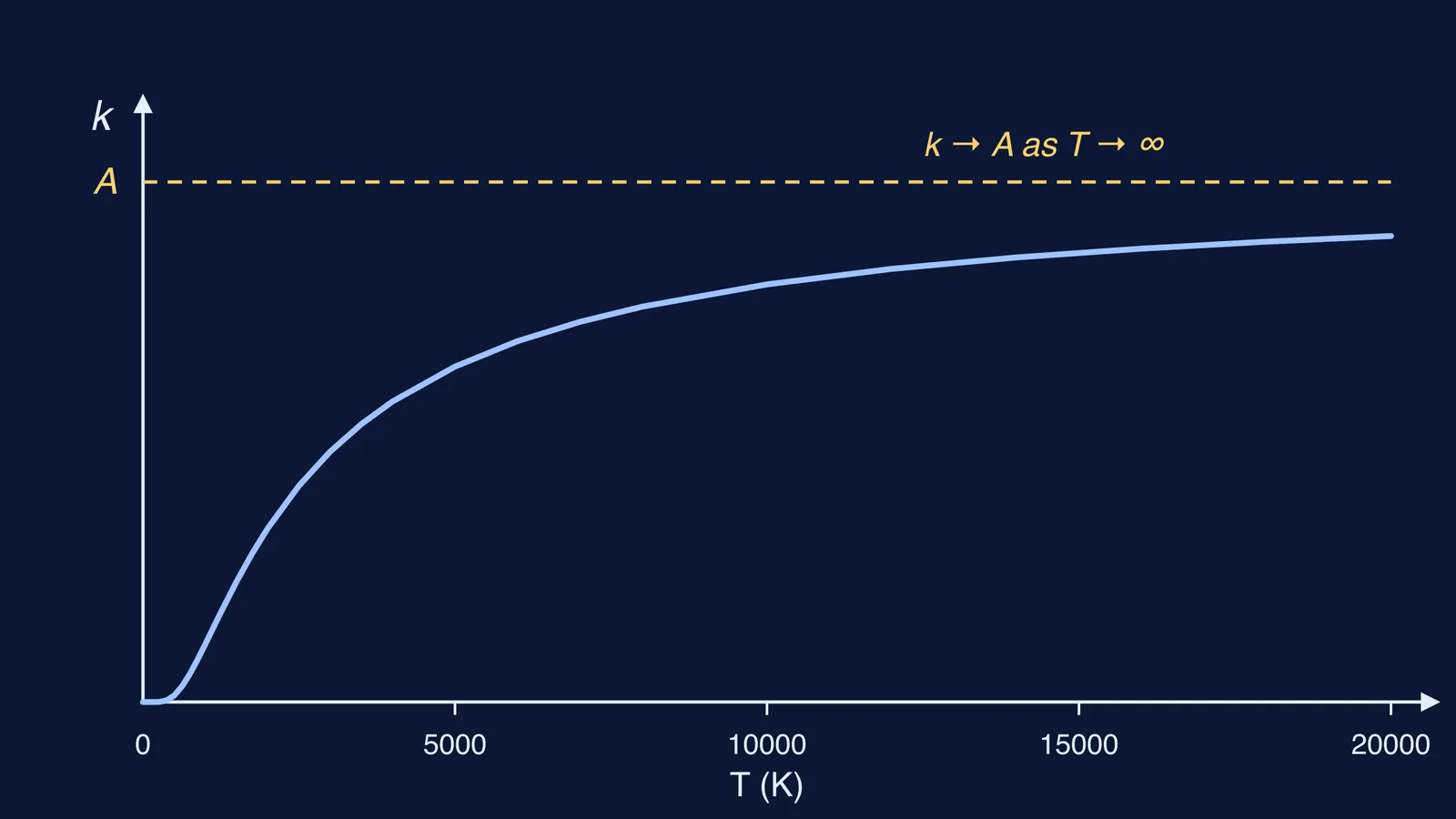
As T grows, Ea/RT shrinks towards zero, e^0 = 1, and k approaches A. The LibreTexts page/Kinetics/06%3A_Modeling_Reaction_Kinetics/6.02%3A_Temperature_Dependence_of_Reaction_Rates/6.2.03%3A_The_Arrhenius_Law/6.2.3.01%3A_Arrhenius_Equation) makes the same point: if the activation energy were zero, or every molecule had kinetic energy above Ea, the Arrhenius law would reduce to k = A. So, with A held constant, A is the ceiling on k.
To see k climb towards A, take NCERT Example 3.9, where k = 0.02 s⁻¹ at 500 K and 0.07 s⁻¹ at 700 K give Ea = 18230.8 J (per mole) and A = 1.61 s⁻¹. With R = 8.314 J K⁻¹ mol⁻¹, Ea/R is about 2193 K, so k = 1.61·e^(−2193/T):
300 K: e^(−7.31) ≈ 0.00067, so k ≈ 0.0011 s⁻¹
500 K: e^(−4.39) ≈ 0.0125, so k ≈ 0.020 s⁻¹ (matches the data)
700 K: e^(−3.13) ≈ 0.0436, so k ≈ 0.070 s⁻¹ (matches the data)
5,000 K: e^(−0.44) ≈ 0.645, so k ≈ 1.04 s⁻¹
50,000 K: e^(−0.044) ≈ 0.957, so k ≈ 1.54 s⁻¹
Even at 50,000 K, k has not reached 1.61 s⁻¹; for any positive Ea, it never passes A.
Two caveats. This is a mathematical limit, a way to read the equation rather than a lab prediction. And while NCERT treats A as constant, LibreTexts notes that because A is related to molecular collisions, it is temperature dependent; for exam problems, take A as constant.
How do you use A in exam questions?
Copy the units of k onto A. They are always the same.
Check that k is smaller than A. If your k comes out larger with a positive Ea, look for a sign error in the exponent.
On a plot of ln k against 1/T, NCERT gives the intercept as ln A and the slope as −Ea/R. Our walkthrough of finding activation energy from an Arrhenius plot shows the full method.
If a question asks for k at infinite temperature, or with Ea = 0, the answer is A.
The ratio k/A equals e^(−Ea/RT), the fraction of molecules with enough energy to react.
For more on the collision picture, see our explainer on collision theory and catalysts, with numbers. The Fermi Problem Library has worked problems with a step-by-step solver that explains the reasoning rather than printing an answer, which helps when you know the formula but pick the wrong method.


