

On this page
You learn that HX adds to an alkene with H going to the carbon that already has more hydrogens. Then a question gives CF₃CH=CH₂ + HCl, and the answer key says CF₃CH₂CH₂Cl. There is no peroxide and the reagent is HCl, yet the product is the "wrong" one. The rule did not break. The textbook wording of it was only ever a shortcut for a deeper rule about carbocation stability, and electron-withdrawing groups are exactly where the shortcut fails.
What does Markovnikov's rule really say?
Markovnikov stated his rule in 1869 from experiments on simple alkenes such as propene; the story is in how Markovnikov found his rule in 1869. Today we explain it with the mechanism of ionic addition:
H⁺ adds to one carbon of the C=C, leaving a carbocation on the other carbon. This step is slow.
X⁻ bonds to the carbocation. This step is fast.
Because step 1 is slow, the reaction goes faster through the more stable carbocation, and that cation decides the product. For propene the choice is between CH₃CH⁺CH₃ (secondary) and CH₃CH₂CH₂⁺ (primary). Alkyl groups push electron density toward a positive carbon by the inductive effect and hyperconjugation, so the secondary cation wins and you get 2-halopropane.
So the rule you should actually use is: add H⁺ so that the more stable carbocation forms. The "carbon with more hydrogens" wording only works when the groups on the alkene are electron-donating alkyl groups.
Why does CF₃CH=CH₂ add HCl the anti-Markovnikov way?
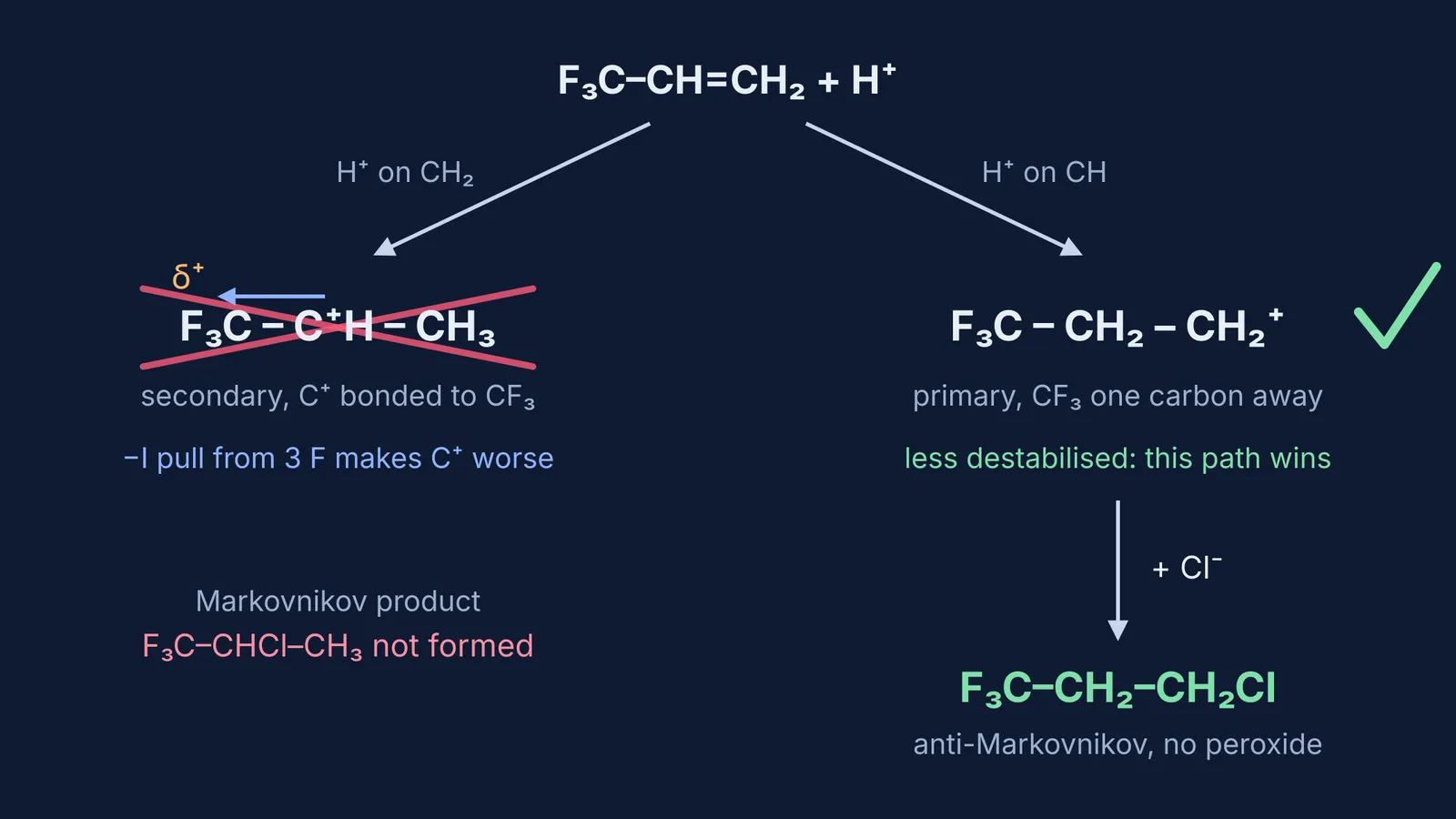
Run step 1 both ways for 3,3,3-trifluoropropene, CF₃CH=CH₂.
H⁺ on the CH₂ end gives CF₃–CH⁺–CH₃. It is secondary, but the positive carbon is bonded directly to CF₃. Three fluorine atoms pull electron density hard (a strong −I effect), which leaves the carbon of CF₃ itself δ⁺. A positive centre sitting next to a δ⁺ carbon is strongly destabilised.
H⁺ on the CH carbon gives CF₃–CH₂–CH₂⁺. Primary cations are normally poor, but here CF₃ is one carbon further away. Inductive effects fall off quickly with distance, so this cation is the less destabilised of the two.
The primary cation wins, and Cl⁻ ends up on the terminal carbon:
CF₃CH=CH₂ + HCl → CF₃CH₂CH₂Cl (3-chloro-1,1,1-trifluoropropane)
Two honest caveats. First, the reaction is slow. CF₃ pulls electron density out of the π bond, so the alkene is a poor partner for H⁺, and textbooks usually show it with a Lewis acid catalyst such as AlCl₃. Second, neither cation is good. The comparison tells you which path is less bad, and that is enough to predict the product.
How does HBr add to acrylic acid and acrylonitrile?
Acrylic acid, CH₂=CH–COOH, also gives the anti-Markovnikov product, but not through a simple primary carbocation. The most basic site in the molecule is the carbonyl oxygen, which is conjugated with the C=C.
H⁺ adds to the carbonyl oxygen. The positive charge spreads over the carbonyl carbon and, through the C=C, onto the β-carbon (the CH₂ end): CH₂=CH–C⁺(OH)₂ and ⁺CH₂–CH=C(OH)₂ are two resonance forms of the same ion.
Br⁻ attacks the β-carbon. This gives an enol, BrCH₂–CH=C(OH)₂.
The enol tautomerises. H moves to the α-carbon and C=O re-forms.
Overall: CH₂=CH–COOH + HBr → BrCH₂CH₂COOH (3-bromopropanoic acid).
This is a 1,4 (conjugate) addition. H ends up on the α-carbon and Br on the β-carbon. It is the same β-carbon preference you see in Michael addition, where enolates attack the beta carbon; here the nucleophile is simply a halide ion.
Acrylonitrile, CH₂=CH–CN, gives the same pattern: HBr adds to give BrCH₂CH₂CN (3-bromopropanenitrile), with Br on the β-carbon.
Why is vinyl chloride still Markovnikov?
Chlorine is electronegative too, so you might expect CH₂=CHCl to behave like CF₃CH=CH₂. It does not:
CH₂=CHCl + HCl → CH₃CHCl₂ (1,1-dichloroethane)
Compare the two cations. In CH₃–CH⁺–Cl the chlorine sits on the positive carbon itself, and one of its lone pairs can be shared with the empty p orbital: CH₃–CH⁺–Cl and CH₃–CH=Cl⁺ are resonance forms. This +M effect outweighs chlorine's −I effect when it comes to stabilising the cation. In ⁺CH₂–CH₂Cl the chlorine cannot share a lone pair with the cation and only pulls electrons away.
CF₃ has no lone pair on the carbon attached to the alkene, so it can only pull. That is the whole difference. Chlorine still slows the reaction compared with ethene, just as it deactivates a benzene ring while directing ortho and para.
Is this the same as the peroxide effect?
No. The Kharasch peroxide effect is a radical chain reaction. A bromine atom adds first, to give the more stable carbon radical, and it works in practice only with HBr. The reactions in this post are ionic. H⁺ adds first (to carbon, or to the carbonyl oxygen), no peroxide is involved, and they work with HCl as well as HBr. The outcome can look similar, but the mechanism is different. Never label CF₃CH₂CH₂Cl a "peroxide effect" product.
Worked example: predict four products
Question. Give the major product of each reaction with no peroxide present.
(a) CF₃CH=CH₂ + HCl, (b) CH₂=CH–COOH + HBr, (c) CH₂=CHCl + HCl, (d) CH₂=CH–N⁺(CH₃)₃ + HBr
Step 1: classify the group on the alkene.
Lone pair on the atom attached to the C=C (Cl, Br, OR, NR₂): it stabilises the cation next to it by resonance, so expect Markovnikov.
Strong −I and no lone pair on the attached atom (CF₃, CCl₃, N⁺R₃): it destabilises the cation next to it, so expect anti-Markovnikov.
C=O or C≡N conjugated with the C=C: expect conjugate addition, X on the β-carbon.
Step 2: apply it.
(a) CF₃ is strong −I with no lone pair. The cation forms away from CF₃. Product: CF₃CH₂CH₂Cl.
(b) COOH is conjugated. H⁺ goes to the carbonyl oxygen and Br⁻ attacks the β-carbon. Product: BrCH₂CH₂COOH.
(c) Cl has lone pairs. The cation CH₃CH⁺Cl is stabilised by resonance. Product: CH₃CHCl₂.
(d) In N⁺(CH₃)₃ the nitrogen has used all its electrons in four bonds, so there is no lone pair, and it already carries a positive charge. A carbocation next to it would put two positive charges side by side. H⁺ adds to the CH carbon instead, the cation forms on the far carbon, and Br⁻ adds there. Product: BrCH₂CH₂–N⁺(CH₃)₃.
Step 3: check the balance. In (d), CH₂=CH–N⁺(CH₃)₃ (C₅H₁₂N⁺) + HBr gives BrCH₂CH₂–N⁺(CH₃)₃ (C₅H₁₃BrN⁺). Atoms and the +1 charge match.
If you want more product-prediction questions where the obvious rule gives the wrong answer, the Fermi Problem Library has a step-by-step solver that explains the reasoning at each stage.
Quick checklist
Markovnikov's rule means: form the more stable carbocation.
CF₃CH=CH₂ + HCl gives CF₃CH₂CH₂Cl, because CF₃ destabilises the cation next to it. The reaction is slow.
Acrylic acid + HBr gives BrCH₂CH₂COOH by protonation at the carbonyl oxygen and Br⁻ attack at the β-carbon.
Vinyl chloride + HCl gives CH₃CHCl₂, because Cl's lone pair stabilises the adjacent cation.
CH₂=CH–N⁺(CH₃)₃ + HBr gives BrCH₂CH₂–N⁺(CH₃)₃.
None of these is the peroxide effect: they are ionic and work with HCl.


