

On this page
If you are in Class 11, you meet Markovnikov in the Hydrocarbons unit of the NCERT Chemistry textbook (Part II, Unit 9). The textbook calls him a Russian chemist who generalised in 1869, after studying many addition reactions, and gives you one example: propene and HBr. Behind that one line is a young chemist in Kazan, and a question about how he got there that historians have argued over.
Who was Vladimir Markovnikov?
Vladimir Vasil'evich Markovnikov (1837–1904) was a Russian chemist whose graduate research at Kazan Imperial University ran from 1860 to 1869, according to historian of chemistry David E. Lewis in Angewandte Chemie International Edition (2021). Lewis calls the rule that came out of that research one of organic chemistry's most enduring empirical rules.
His teacher at Kazan was Alexander Butlerov, and Markovnikov became Butlerov's teaching assistant in 1860, according to a Parkland College biography of Markovnikov. Butlerov's big idea was that a molecule's properties depend on how its atoms are joined. You can read how that idea explains why isomers exist, in our post on Butlerov's structure theory.
What did Markovnikov actually say in 1869?
The rule first appeared in the first volume of the Journal of the Russian Chemical Society, and it was noticed internationally only a year later, when it was published in German (Lewis, 2021). That German paper appeared in Justus Liebigs Annalen der Chemie, volume 153, in 1870, under a title about isomeric butyric acids, not alkenes.
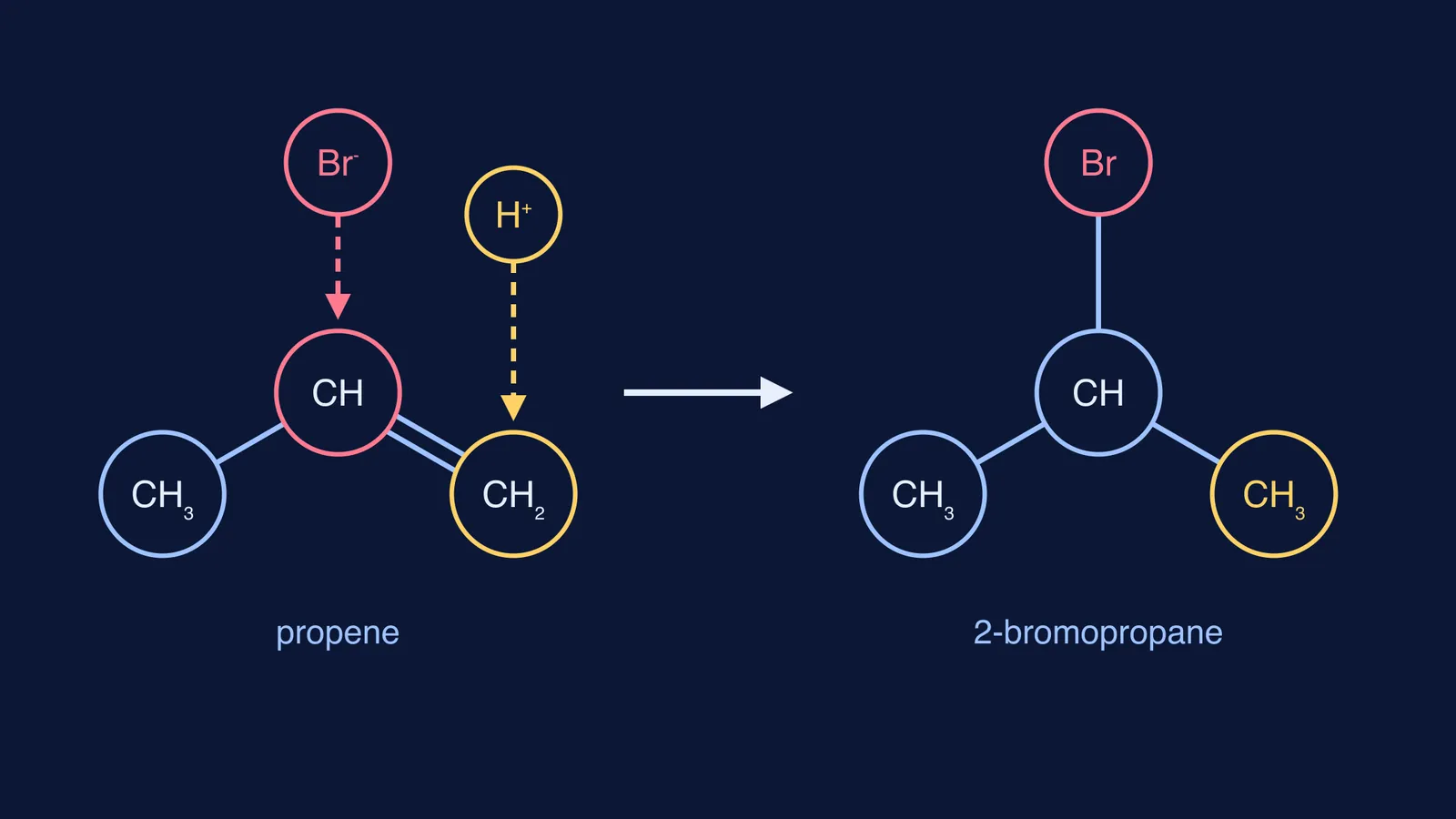
His wording was not the one in most modern books. Lewis notes that Markovnikov stated the rule in terms of the electronegative part of the adding reagent, not the hydrogen. NCERT still keeps his version: the negative part of the addendum attaches to the carbon atom with fewer hydrogen atoms (NCERT Class 11, Unit 9). Both say the same thing. If Br goes to the carbon with fewer hydrogens, H must go to the one with more.
Was Markovnikov's rule an inspired guess?
A 2006 article in the Journal of Chemical Education put that question in its title: Was Markovnikov's Rule an Inspired Guess?. Lewis went back to the Kazan dissertations and answered in his own title: no. In the dissertations, he writes, there is “a careful build-up of logic from which the rule itself, as defined by Markovnikov, emerges naturally” (Lewis, 2021).
Worth knowing for the exam hall: Markovnikov had no carbocations to reason with. He was finding a pattern in results. The matching rule for elimination came a few years later, and you can see how Zaitsev predicted the major alkene in 1875.
Why does hydrogen add to the carbon with more hydrogens?
The modern reason is the carbocation. NCERT sets it out for propene (Unit 9):
H⁺ from HBr attacks the double bond and can make either a primary carbocation (CH₃CH₂CH₂⁺) or a secondary one (CH₃CH⁺CH₃).
The secondary carbocation is more stable, so it forms faster and wins.
Br⁻ attacks that secondary carbon, giving 2-bromopropane as the major product.
Putting H on the CH₂ end is exactly what leaves the positive charge on the more substituted carbon. Counting hydrogens is a shortcut for finding the more stable carbocation.
If carbocation stability is shaky for you, the Fermi Concept Library has every concept in chemistry with its own lesson and its place in the map, so you can go back one step before going forward.
How do you apply Markovnikov's rule in exams?
Use this four-step check on any HX plus alkene question:
Is the alkene unsymmetrical? If not, there is only one product. But-2-ene with HBr simply gives 2-bromobutane (NCERT equation 9.41).
Count the hydrogens on each double-bond carbon. H goes to the carbon with more.
Confirm with the carbocation: the positive charge should end up on the more substituted carbon.
Look for peroxide. With HBr and a peroxide, addition goes the other way.
Worked example: 2-methylpropene, (CH₃)₂C=CH₂, with HCl. The CH₂ carbon has two hydrogens and the other has none, so H goes to CH₂ and Cl to the central carbon. The product is 2-chloro-2-methylpropane, through a tertiary carbocation. Step 3 agrees.
The exception in step 4 was observed by M. S. Kharasch and F. R. Mayo in 1933 at the University of Chicago, and it works with HBr but not HCl or HI (NCERT Class 11, Unit 9). Their first paper, on HBr adding to allyl bromide, is in the Journal of the American Chemical Society. NCERT's own Problem 9.12 tests exactly this: hex-1-ene with HBr gives 2-bromohexane without peroxide and 1-bromohexane with it. For why the radical route flips the result, read our explainer on the Kharasch peroxide effect and anti-Markovnikov addition.
To practise, try a few unsymmetrical alkenes in the Fermi Problem Library, where the step-by-step solver explains the reasoning rather than printing an answer. Check your carbocation at each step, not just the final product.


