

On this page
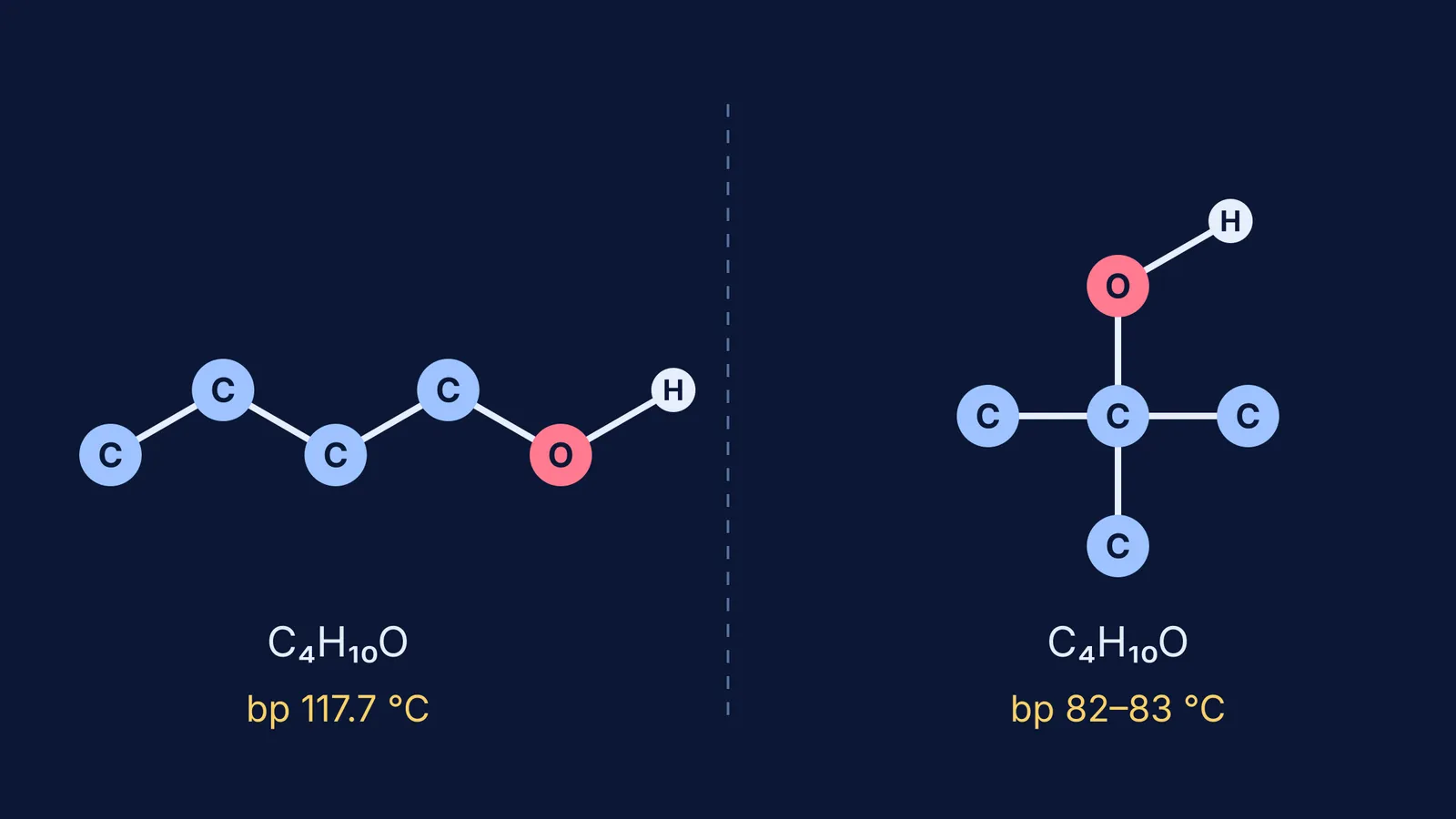
Two bottles in a lab can hold liquids with exactly the same molecular formula, C4H10O, and yet one (butan-1-ol) boils at 117.7 °C and the other (tert-butyl alcohol) at about 82 °C. Alexander Butlerov, a chemist at Kazan University, gave chemists the idea that explains this, and it is the idea you use every time you draw an isomer.
What did Butlerov say in 1861?
Butlerov presented his paper "Einiges über die chemische Structur der Körper" (On the chemical structure of substances) in 1861, and it was printed in the Zeitschrift für Chemie und Pharmacie, pages 549–60 (translated excerpt, Le Moyne College archive). A full English translation by Kluge and Larder appeared in the Journal of Chemical Education in 1971.
His definition takes one sentence. In Maurice Crosland's translation, Butlerov wrote: "I should like to indicate this chemical inter-relation or the manner in which the atoms are bound together in a compound by the term 'chemical structure'" (source).
His central claim is just as short: "the chemical properties of a substance depend on the inter-relation of its constituent elements" (source). Put simply, knowing which atoms are present is not enough. You also need to know which atom is joined to which.
Butlerov did not build this alone. Historian A. J. Rocke notes that in 1858 August Kekulé and Archibald Scott Couper independently published similar ideas about carbon's tetravalence and the ability of carbon atoms to link to each other, and that Butlerov's paper, read at Speyer three years later, "restated, clarified, and enlarged upon" them (Rocke, British Journal for the History of Science, 1981). For over a century, Rocke writes, chemists and historians have disputed the origins of structure theory.
How does chemical structure explain isomers?
Isomers are compounds with the same molecular formula but different structures. If you only know the formula, there is no way to say why C4H10O can belong to more than one liquid. It looks like a contradiction.
Butlerov's idea removes the contradiction. If properties depend on how the atoms are joined, then the same set of atoms joined in two ways gives two substances. Neither one is a mistake or an impurity.
Butlerov's own lab work helped the idea win. According to the Norwegian encyclopedia Store norske leksikon, his discovery of tertiary alcohols and other isomers contributed greatly to the rapid breakthrough of structure theory in the 1860s.
Worked example: three molecules with the formula C4H10O
Here is Butlerov's idea applied to real data. All three compounds below have four carbons, ten hydrogens and one oxygen.
Butan-1-ol, CH3CH2CH2CH2OH: a straight chain with OH on an end carbon. It boils at 117.7 °C (Wikipedia, 1-butanol).
tert-Butyl alcohol, (CH3)3COH: the OH sits on a central carbon bonded to three other carbons. It boils at 82–83 °C and melts at 25–26 °C, so on a cool day it can be a solid (Wikipedia, tert-butyl alcohol).
Diethyl ether, CH3CH2OCH2CH3: the oxygen sits between two carbons, with no O–H bond at all. It boils at 34.6 °C (Wikipedia, diethyl ether).
Now read the pattern the way Butlerov would. The two alcohols both have an O–H group, so their molecules can hydrogen bond with each other, and both boil far above the ether. Between the alcohols, the compact, branched shape of tert-butyl alcohol gives less surface contact between molecules than the long chain, so it boils lower. Same atoms, three structures, three sets of properties.
For more practice, our guides to the isomers of C3H8O: propanols and methoxyethane and hexane's five structural isomers use the same reasoning on other formulas.
How do you use Butlerov's idea in exam questions?
Many isomer questions in Class 11 chemistry, JEE Main and NEET-UG are Butlerov's question in disguise: how many different ways can these atoms be joined? Use this checklist.
Write the formula and count degrees of unsaturation first, so you know whether rings or double bonds are allowed.
List the possible carbon skeletons: longest chain first, then one branch, then two.
Place the functional group on each skeleton, then ask if a different functional group fits the same formula (an alcohol and an ether, an acid and an ester).
Apply the one-line test above to each new drawing to throw out duplicates.
Name every structure by IUPAC rules. Two drawings with the same correct name show the same structure.
Finally, link structure to a property: branching, hydrogen bonding or polarity explains the boiling point order.
If you're stuck on the idea itself, the Fermi Concept Library has a lesson for every concept in chemistry, with its place in the map. If you keep making the same counting slip, the Fermi Problem Library has worked problems with a step-by-step solver that explains the reasoning rather than printing an answer.
Branching is easier to understand when you can turn a molecule around, so read structural isomers of pentane in 3D next. Then try drawing every C4H10O isomer yourself. There are more than three.


