

On this page
The molecular formula C₅H₁₂ tells you exactly how many carbon and hydrogen atoms you have, but it does not tell you how they are connected. When atoms in a molecule can be linked in different sequences, they form structural isomers.
These isomers share the same molecular formula but have different 3D shapes, which gives them different physical properties. If you are learning organic chemistry, predicting these shapes and understanding how they affect boiling points is a core skill for any exam.
How many structural isomers of pentane are there?
There are exactly three structural isomers of pentane. You can predict them by taking the longest possible carbon chain and systematically shortening it to create branches.
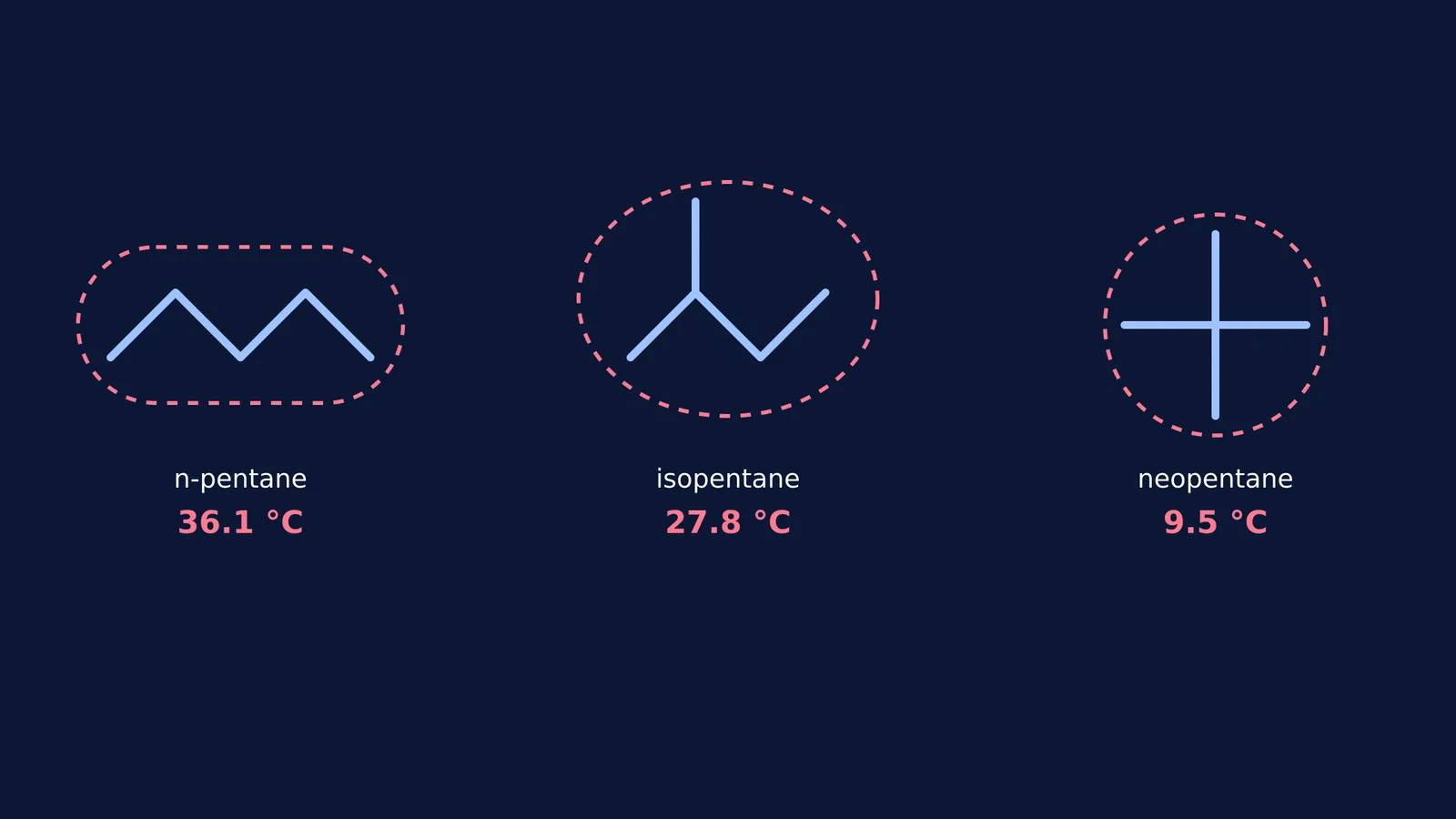
n-pentane (pentane): The unbranched isomer where all five carbon atoms sit in a continuous row.
Isopentane (2-methylbutane): A four-carbon chain with a one-carbon branch (a methyl group) attached to the second carbon.
Neopentane (2,2-dimethylpropane): A three-carbon chain with two methyl groups attached to the central carbon, forming a cross shape.
When you build these molecules using the Fermi Simulation Lab, you can see how the branching changes the overall shape of the molecule in 3D. The straight-chain n-pentane resembles a long cylinder or zig-zag, while the highly branched neopentane is almost perfectly spherical. You can see similar patterns when exploring the structures of smaller molecules like butane (see Structural isomers in Class 10: butane and pentane drawn out).
Why does branching affect boiling point?
The boiling point of a substance depends on how strongly its molecules are attracted to one another. For non-polar alkanes like the pentane isomers, the only intermolecular forces holding them together are London dispersion forces.
London dispersion forces rely on surface contact between molecules. These forces arise from temporary fluctuations in the electron clouds of the molecules. The more surface area a molecule has, the more contact it can make with its neighbours, and the stronger these temporary attractions become. Two cylinders can lie flat against each other over a large area, whereas two spheres can only touch at a single point.
n-pentane has an extended, cylindrical shape that provides a large surface area for contact. Its boiling point is 36.1 °C (Wikipedia).
Isopentane is slightly more compact due to its single branch, which reduces its surface area. Its boiling point drops to 27.8 °C (Wikipedia).
Neopentane is highly branched and nearly spherical, giving it the smallest possible surface area for a C₅H₁₂ molecule. Its boiling point is just 9.5 °C (Wikipedia).
The boiling point decreases as the degree of branching increases because the molecule becomes more compact, which reduces the surface area available for intermolecular attraction.
How do you predict physical states at room temperature?
Because boiling points are tied to molecular shape, you can use a molecule's 3D structure to predict its physical state. Standard room temperature is typically taken as 25 °C (Wikipedia).
n-pentane (36.1 °C) boils above room temperature, so it remains a liquid on a standard day.
Isopentane (27.8 °C) also boils slightly above room temperature, meaning it is also a liquid.
Neopentane (9.5 °C) boils well below room temperature, meaning it has already turned into a gas at 25 °C.
If you understand this trend, you can predict properties for other molecules too. For example, comparing the straight-chain isomers of alcohols and ethers requires similar reasoning about intermolecular forces and 3D shape (read more in C4H10O isomers: telling the four alcohols and three ethers apart).
A checklist for comparing boiling points
When you face an exam question asking you to rank the boiling points of a group of isomers, use this step-by-step approach:
Draw the structures: Sketch out each isomer to see the carbon skeleton.
Count the branches: Identify the longest chain and count how many methyl (or other) branches it has.
Compare shapes: The straightest chain has the most surface area; the most branched chain is the most spherical.
Rank by dispersion forces: More surface area equals stronger London dispersion forces.
Assign boiling points: The strongest forces require the most energy to break, so the straight chain has the highest boiling point, and the most branched chain has the lowest.
This simple rule of branching applies reliably across all non-polar alkanes, helping you turn a complex structural formula into a straightforward prediction.


