

On this page
If you are counting the isomers of C₆H₁₄ for a Class 11 test or JEE Main, the answer is five. The hard part is not finding them but stopping at five. An answer of six or seven usually means the same molecule has been drawn twice, once straight and once bent.
How many structural isomers does hexane have?
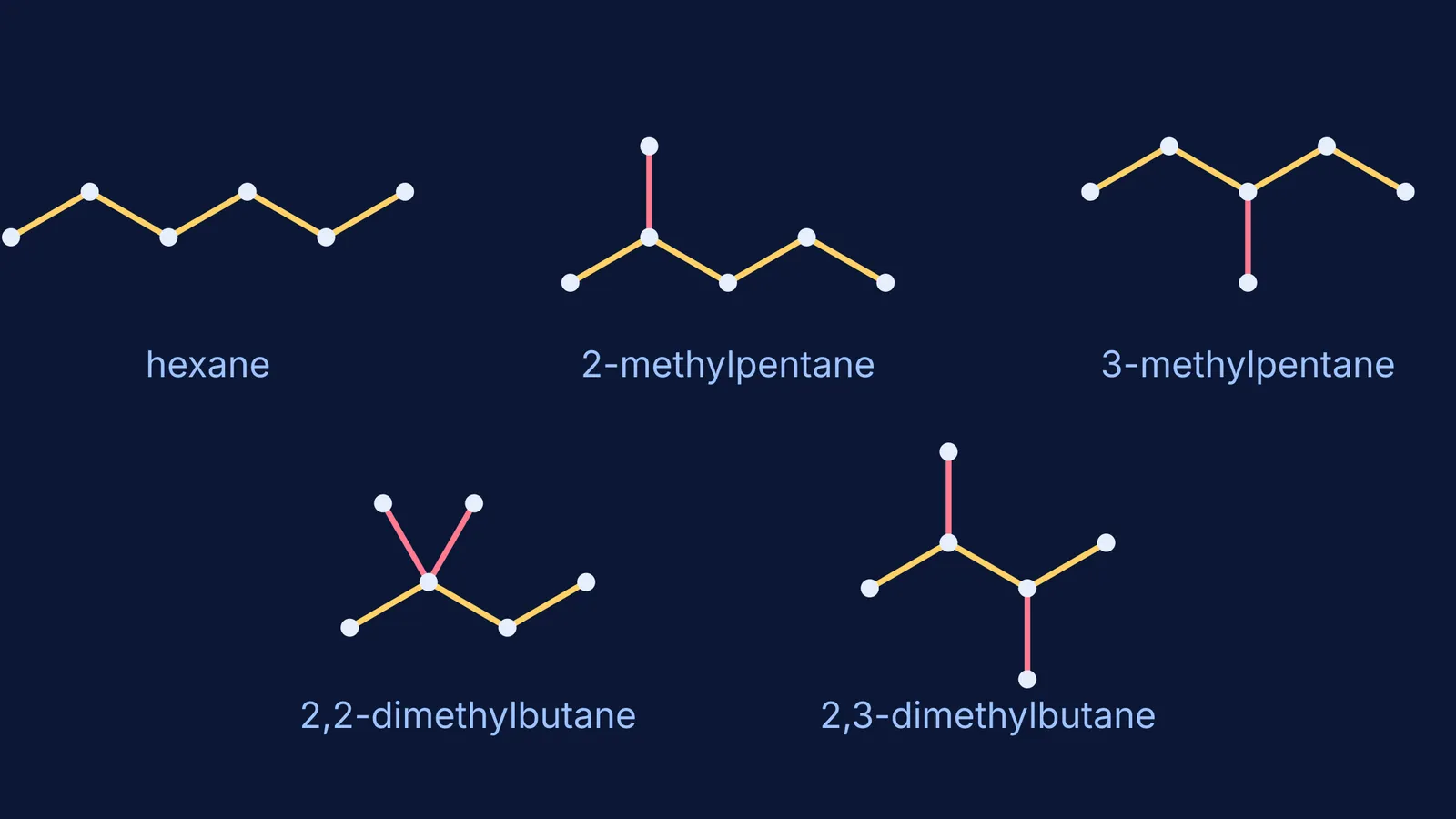
C₆H₁₄ has five structural isomers, the term for six carbons in the standard count of alkanes that ignores stereoisomers (OEIS A000602). Each name below is the IUPAC name PubChem lists for that structure, and each record gives the formula C₆H₁₄:
hexane: six carbons in a row
2-methylpentane: a methyl on the second carbon of a five-carbon chain
3-methylpentane: a methyl on the middle carbon of a five-carbon chain
2,2-dimethylbutane: two methyls on the same carbon of a four-carbon chain
2,3-dimethylbutane: one methyl on each middle carbon of a four-carbon chain
The same sequence gives 2 isomers for butane, 3 for pentane and 9 for heptane (OEIS A000602). If you have already seen butane and pentane isomers drawn out, hexane is the next step up, and the method below works for all of them.
How do you draw all five without missing one?
Work from the longest chain down. Leave out the hydrogens while you draw; at the end they just fill each carbon up to four bonds.
Step 1: six carbons in a row. One structure: hexane.
Step 2: five in a row, one carbon left over. The spare carbon becomes a methyl group. Number the chain C1 to C5. On C1 it only lengthens the chain back to hexane. On C2 you get 2-methylpentane. On C3, the middle, you get 3-methylpentane. On C4 it is just C2 counted from the other end. Two new structures.
Step 3: four in a row, two carbons left over. Use them as two methyls or as one ethyl. Two methyls on the same carbon, C2, give 2,2-dimethylbutane. Methyls on C2 and C3 give 2,3-dimethylbutane. An ethyl on C2 makes a five-carbon chain that runs through the ethyl group, so it is 3-methylpentane again. Two new structures.
Step 4: three in a row, three carbons left over. Only the middle carbon can carry branches, and any branch longer than a methyl stretches the main chain past three. Two methyls there give C₅H₁₂, not C₆H₁₄. Nothing new appears, so stop.
Count: 1 + 2 + 2 = 5.
Why do bent chains create duplicates?
A skeletal drawing is not a fixed shape. Atoms can rotate about single C–C bonds, so a chain drawn with a kink, an L-shape or a U-turn is still the same chain. Here are the false extras to watch for on a C₆H₁₄ answer:
A six-carbon chain drawn with a right-angle bend: still hexane.
"1-methylpentane": a methyl on the end carbon extends the chain, so this is hexane.
"4-methylpentane": number from the other end and it is 2-methylpentane.
"1,1-dimethylbutane": the longest chain passes through one of the methyls and has five carbons, so this is 2-methylpentane.
"2-ethylbutane": the longest chain runs through the ethyl group and has five carbons, so this is 3-methylpentane.
"3,3-dimethylbutane": number from the other end for lower locants and it is 2,2-dimethylbutane.
Every one of these wrong names breaks one of two rules: the parent chain must be the longest one, and the locants must be as low as possible. Our guide to IUPAC naming rules and the common slips covers both in more detail.
How can you check your answer quickly?
Run this on every structure before you add it to your list:
Trace the longest chain with your pencil, around corners, and write its length.
Number it from the end that gives the branches the lowest numbers.
Write the name.
Compare it with the names already on your list. Same name means same molecule, so cross it out.
The names also predict something you can measure. More branching makes the molecule more compact, and the boiling point generally falls with it: hexane boils at 68.7 °C and 2,2-dimethylbutane at 49.7 °C (Wikipedia: Hexane). That is useful when a question asks you to rank isomers by boiling point.
That next step is covered in our guide to counting monochlorination products of alkanes.
If you keep drawing duplicates, the problem is usually the method, not the chemistry. The Fermi Problem Library has worked problems with a step-by-step solver that explains the reasoning rather than printing an answer, so you can follow each step instead of just checking the final count. For the naming rules themselves, the Fermi Concept Library gives each concept its own lesson and its place in the map.
Tonight, draw all five from memory, then try heptane's nine the same way.


