

On this page
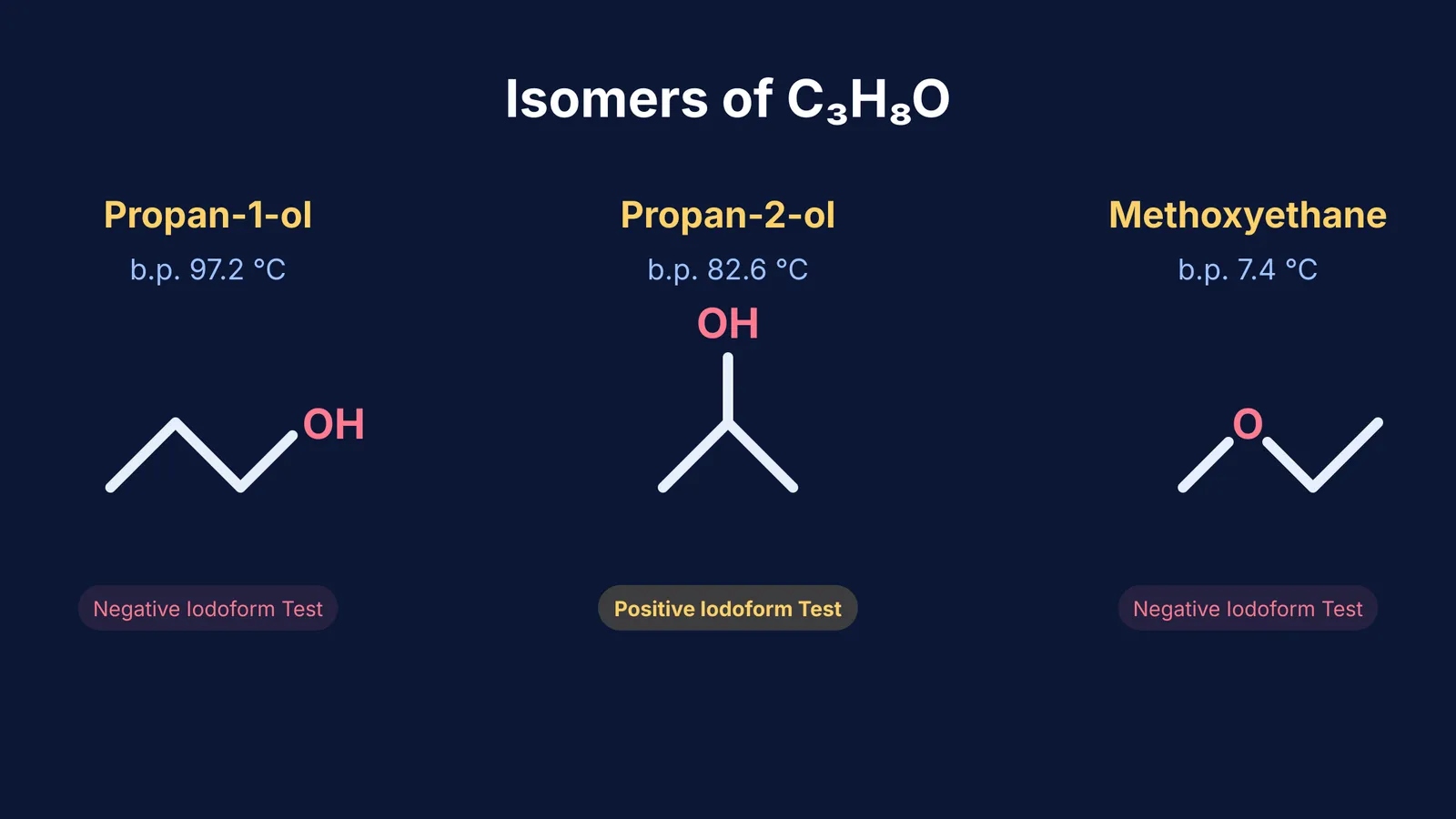
In organic chemistry, molecules with the same chemical formula can behave entirely differently depending on how their atoms are connected. The formula C₃H₈O is a classic example that appears frequently in exams like JEE and NEET. It gives rise to three distinct structural isomers: propan-1-ol, propan-2-ol and methoxyethane.
Two of these are alcohols and one is an ether. These structural differences mean they have vastly different boiling points and react differently in laboratory tests.
Why do their boiling points differ so much?
The boiling point of a compound is determined by the strength of the intermolecular forces holding its molecules together. When comparing the C₃H₈O isomers, the key difference is hydrogen bonding.
Propan-1-ol is a primary alcohol with a boiling point of 97.2 °C (PubChem, CID 1031). Because the −OH group is at the end of the unbranched carbon chain, the molecules can pack closely together. This allows for strong intermolecular hydrogen bonding and maximum van der Waals forces, making it the hardest of the three to boil.
Propan-2-ol, commonly known as isopropanol, is a secondary alcohol and boils at 82.6 °C (PubChem, CID 3776). It also forms hydrogen bonds, but the −OH group is attached to the central carbon. This branching slightly hinders how closely the molecules can approach each other, weakening the van der Waals forces compared to its straight-chain counterpart.
Methoxyethane is an ether and has a boiling point of just 7.4 °C (PubChem, CID 10903). Unlike the alcohols, its oxygen atom is bonded to two carbons (−O−) and not to a hydrogen atom. Without an O−H bond, methoxyethane molecules cannot form hydrogen bonds with each other. They rely solely on weaker dipole-dipole interactions, which is why methoxyethane boils near room temperature and is often handled as a gas.
Which C3H8O isomer gives the iodoform test?
The iodoform test is a staple of practical chemistry used to identify specific structural features in organic molecules. When treated with iodine (I₂) and sodium hydroxide (NaOH), a compound will produce a pale yellow precipitate of iodoform (CHI₃) only if it contains a methyl ketone group (CH₃−C=O) or a secondary alcohol group (CH₃−CH(OH)−) that can be oxidised to a methyl ketone.
Among the isomers of C₃H₈O, only propan-2-ol gives a positive iodoform test.
Because propan-2-ol contains the necessary CH₃−CH(OH)− structure, the iodine and NaOH mixture first oxidises it to propanone (acetone), which then undergoes halogenation and cleavage to form the yellow iodoform solid. Propan-1-ol lacks this terminal methyl group adjacent to the hydroxyl-bearing carbon, and methoxyethane is an ether that does not undergo this oxidation at all.
How do you distinguish them in the lab?
If you are handed three unlabelled flasks containing these structural isomers in Class 10 or Class 12 practicals, distinguishing them is straightforward if you know what to look for.
Here is a practical checklist to tell them apart:
Check the physical state: If one of the samples is a gas at room temperature (or boils in your hand), it is methoxyethane. Ethers are highly volatile.
Perform the iodoform test: Add iodine and sodium hydroxide to the remaining two liquids and warm them gently. The one that yields a cloudy yellow precipitate is propan-2-ol.
By elimination: The remaining liquid, which has the highest boiling point and gives no yellow precipitate in the iodoform test, is propan-1-ol.
These simple, distinguishing features are often tested together in multi-step reaction questions, asking you to identify compounds A, B and C from their empirical formula and test results. To master these sequences, check out our guide on compounds that give the iodoform test.
How does Fermi help you master organic chemistry?
Organic chemistry is not about memorising every boiling point; it is about understanding the underlying forces and reaction mechanisms. When you are stuck on a question about why one isomer reacts while another does not, reading a static solution often isn't enough.
This is where the Fermi Concept Library steps in. Instead of just giving you the answer, Fermi's AI tutor works out what you already know and builds a plan for the session, helping you understand the requirements for the iodoform test or visualise how branching affects intermolecular forces.


