

On this page
If you know the aldol reaction, you know that an enolate is a carbon nucleophile. Now put that enolate next to an enone, a ketone with a C=C double bond right beside the carbonyl. The enolate has two places it could attack, and which one it picks decides the product you draw in the exam.
What is a Michael addition?
A Michael addition is the 1,4 (conjugate) addition of an enolate to an α,β-unsaturated carbonyl compound, as the LibreTexts organic chemistry text (Wade)_Complete_and_Semesters_I_and_II/Map%3A_Organic_Chemistry_(Wade)/23%3A_Alpha_Substitutions_and_Condensations_of_Carbonyl_Compounds/23.10%3A_Conjugate_Additions-_The_Michael_Reaction) defines it. The nucleophile is the Michael donor and the unsaturated carbonyl compound is the Michael acceptor. The same text names the reaction after the American chemist Arthur Michael (1853-1942).
Michael's 1887 paper in the Journal für Praktische Chemie described adding the sodium salts of acetoacetic ester and malonic ester to esters of unsaturated acids (Michael, 1887).
Why does the beta carbon act as an electrophile?
In an α,β-unsaturated carbonyl, the electronegative oxygen pulls electron density away from the β carbon, making it more electrophilic than a typical alkene carbon (LibreTexts, Morsch et al./19%3A_Aldehydes_and_Ketones-_Nucleophilic_Addition_Reactions/19.13%3A_Conjugate_Nucleophilic_Addition_to__-unsaturated_Aldehydes_and_Ketones)).
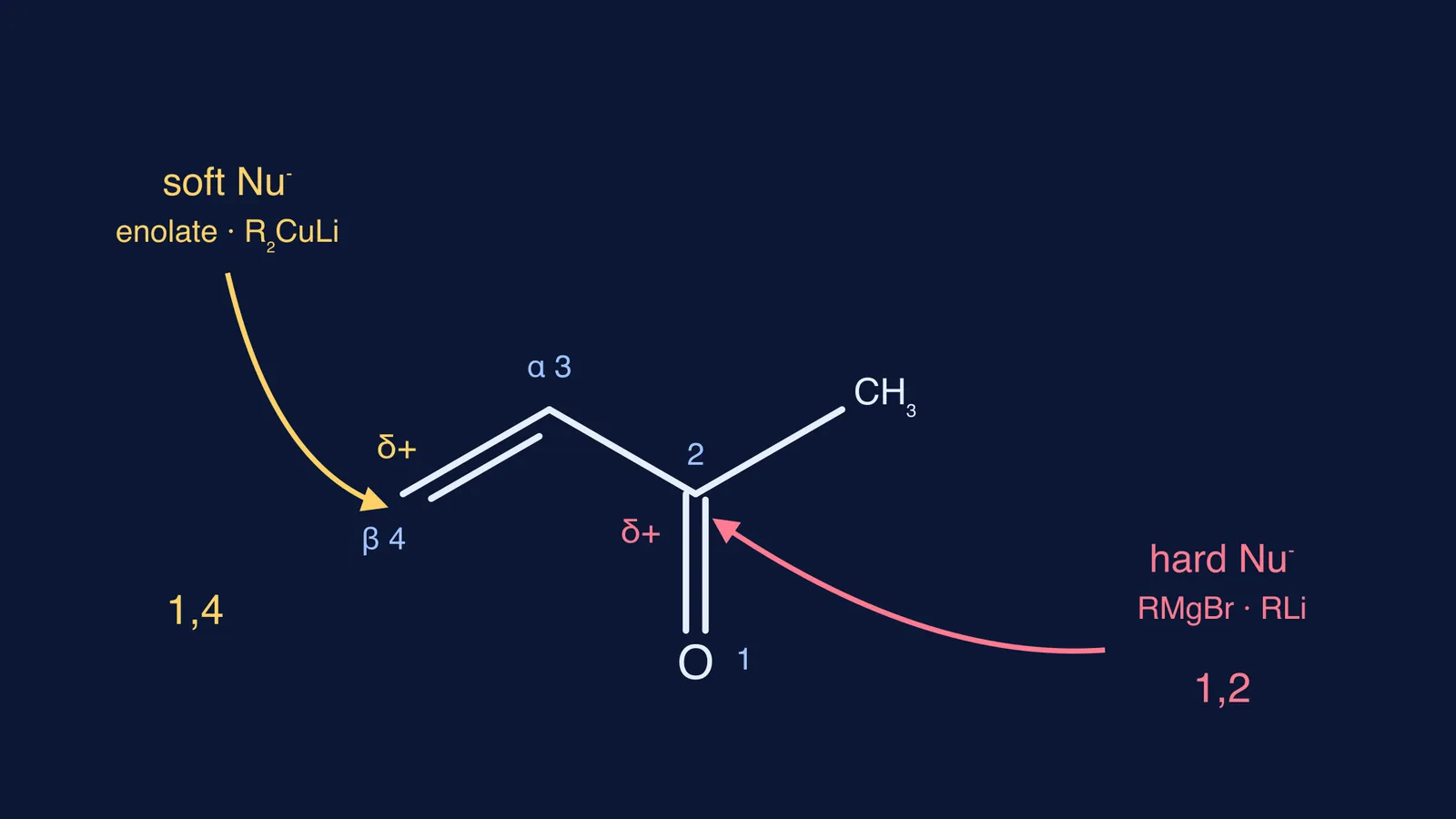
Draw one resonance form to see it. Push the C=O electrons onto oxygen, then push the C=C electrons towards the carbonyl carbon. You end with O⁻ on one end and a positive charge on the β carbon. So an enone has two electrophilic sites: the carbonyl carbon and the β carbon.
How is 1,4 addition different from 1,2 addition?
The numbers count atoms from the oxygen: O is 1, the carbonyl carbon is 2, the α carbon is 3 and the β carbon is 4.
1,2 addition: the nucleophile adds to the carbonyl carbon and hydrogen ends up on the oxygen. The C=C survives and the C=O is gone.
1,4 addition: the nucleophile adds to the β carbon. The enolate formed is protonated to an enol, which tautomerises back to the carbonyl. Net result: nucleophile on the β carbon, hydrogen on the α carbon, the C=O survives and the C=C is gone.
Which path wins depends mostly on the nucleophile. With strong bases such as Grignard reagents, both additions are irreversible, so the reaction is under kinetic control and the fast 1,2 attack usually dominates. With weak bases such as water, alcohols or amines, 1,2 addition is usually reversible, so the reaction is under thermodynamic control and the 1,4 product usually dominates because it keeps the stable carbonyl group (LibreTexts, Morsch et al./19%3A_Aldehydes_and_Ketones-_Nucleophilic_Addition_Reactions/19.13%3A_Conjugate_Nucleophilic_Addition_to__-unsaturated_Aldehydes_and_Ketones)).
The same source lists LiAlH₄, Grignard and organolithium reagents as giving 1,2 products, and hydroxide, alcohols, thiols, primary and secondary amines, cyanide and HBr as giving 1,4 products. It also shows Gilman reagents (lithium diorganocopper) adding 1,4 to α,β-unsaturated ketones.
Why are enolates called soft nucleophiles?
The words hard and soft come from Ralph Pearson's 1963 paper Hard and Soft Acids and Bases in the Journal of the American Chemical Society. In the usual textbook picture, a hard nucleophile carries concentrated charge and strikes where the positive charge is largest, the carbonyl carbon. A soft nucleophile has its charge spread out and prefers the far end of the conjugated system, the β carbon.
An enolate shares its charge between carbon and oxygen, and a malonate enolate spreads it over two carbonyl groups. Treat hard and soft as a rule of thumb, not a law: amines and alcohols give 1,4 products mainly because their 1,2 addition is reversible.
Worked example: diethyl malonate and methyl vinyl ketone
Take diethyl malonate, CH₂(CO₂Et)₂, with sodium ethoxide, and methyl vinyl ketone (but-3-en-2-one), CH₂=CH-CO-CH₃.
Ethoxide removes a hydrogen from the CH₂ between the two ester groups. The enolate is stabilised by both carbonyls.
The enolate carbon attacks the terminal CH₂ of the enone, which is the β carbon. The C=C electrons shift to make a new enolate on the ketone.
That enolate takes a proton from ethanol, and the enol tautomerises to the ketone.
Product: (EtO₂C)₂CH-CH₂-CH₂-CO-CH₃, diethyl 2-(3-oxobutyl)propanedioate. Check it: the new C-C bond is at the β carbon, the ketone is intact and the C=C has gone. Count from an ester carbonyl carbon to the ketone carbonyl carbon and you get five atoms, so this is a 1,5-dicarbonyl, the signature of a Michael product.
Now swap the nucleophile on the same enone:
CH₃MgBr attacks the carbonyl carbon (1,2): after workup you get CH₂=CH-C(OH)(CH₃)₂, 2-methylbut-3-en-2-ol.
(CH₃)₂CuLi attacks the β carbon (1,4): after workup you get CH₃-CH₂-CH₂-CO-CH₃, pentan-2-one.
A three-question check before you draw the product
Is the C=C directly conjugated with the C=O? If not, there is no β carbon to attack.
Is the nucleophile a strong base that adds to the C=O fast and irreversibly (LiAlH₄, RMgBr, RLi), or an enolate, R₂CuLi, amine, thiol or cyanide?
Does your product keep the right group: the C=C for 1,2, the C=O for 1,4?
If you keep drawing the wrong product, the Fermi Problem Library has worked problems with a step-by-step solver that explains the reasoning rather than printing an answer. If resonance or enolate formation feels shaky, the Fermi Concept Library gives each chemistry concept its own lesson.
Try the three questions on the next enone you meet, before you look at the answer key.


