

On this page
Put a little water in an evacuated flask and close it. Some of it evaporates, and the pressure rises. Now push a piston in and halve the volume. Boyle's law says the pressure should double. If there is still liquid in the flask, it does not change at all. The key exam question is simple: would all the water evaporate or not?
Why does the pressure stay the same when you compress the vapour?
When liquid water and water vapour sit together in a closed flask, they reach a dynamic equilibrium: H₂O(l) ⇌ H₂O(g). Molecules leave the liquid as fast as they return to it. The pressure of the vapour at that point is the vapour pressure, and it depends only on temperature. It does not depend on the volume of the flask or on how much liquid is present.
So when you squeeze the flask, the vapour is briefly above its vapour pressure. Molecules now hit the liquid surface more often than they leave it, so some vapour condenses. Condensation continues until the pressure falls back to the vapour pressure. The vapour gets less in amount, not more crowded.
Think of it as an equilibrium with K = p(H₂O). A pure liquid does not appear in K, so the only thing the system can hold fixed is the vapour's partial pressure. The same logic for solids is set out in why solids and pure liquids drop out of K. The idea that vapour settles at a fixed pressure in a closed vessel is introduced in physical equilibrium examples and what stays constant in each. This post adds what happens when the volume changes.
Will all the water evaporate in a closed flask?
This is the question examiners actually ask. Use this test:
Pretend all the water has turned to vapour.
Work out the pressure it would exert with the ideal gas law, p = nRT/V.
Compare that pressure with the vapour pressure at that temperature.
If the calculated pressure is below the vapour pressure, all the water evaporates and your answer stands. If it is above, it cannot all evaporate. The pressure is then the vapour pressure, and the extra water stays as liquid.
In every step, ignore the volume of the liquid itself. A fraction of a gram of water is a fraction of a millilitre. State that assumption in your answer.
Worked example: 0.18 g and 0.36 g of water in a 10 L flask
Data: an evacuated flask of 10.0 L at 298 K (25 °C). The vapour pressure of water at 298 K is about 3.17 kPa (23.8 mmHg). Take M(H₂O) = 18.0 g/mol and R = 8.314 J/(mol·K). Note that 1 kPa × 1 L = 1 J.
Case A: 0.18 g of water
Moles: n = 0.18/18.0 ≈ 0.0100 mol.
Pressure if all of it were vapour: p = nRT/V = 0.0100 × 8.314 × 298 / 10.0 ≈ 2.48 kPa.
Compare: 2.48 kPa is less than 3.17 kPa.
So all the water evaporates, and the pressure in the flask is 2.48 kPa. There is no liquid, and the vapour is not saturated.
Case B: 0.36 g of water
Moles: n = 0.36/18.0 ≈ 0.0200 mol.
Pressure if all of it were vapour: p ≈ 4.96 kPa.
Compare: 4.96 kPa is more than 3.17 kPa, so not all of it can evaporate.
The vapour stops at 3.17 kPa. The most vapour the flask can hold is n = pV/RT = 3.17 × 10.0 / (8.314 × 298) ≈ 0.0128 mol, which is about 0.230 g.
The rest, 0.36 − 0.230 ≈ 0.13 g, stays as liquid. The pressure is 3.17 kPa.
Notice that doubling the water did not double the pressure. Once the flask is saturated, adding more water only adds more liquid.
What happens if you halve the volume of the flask?
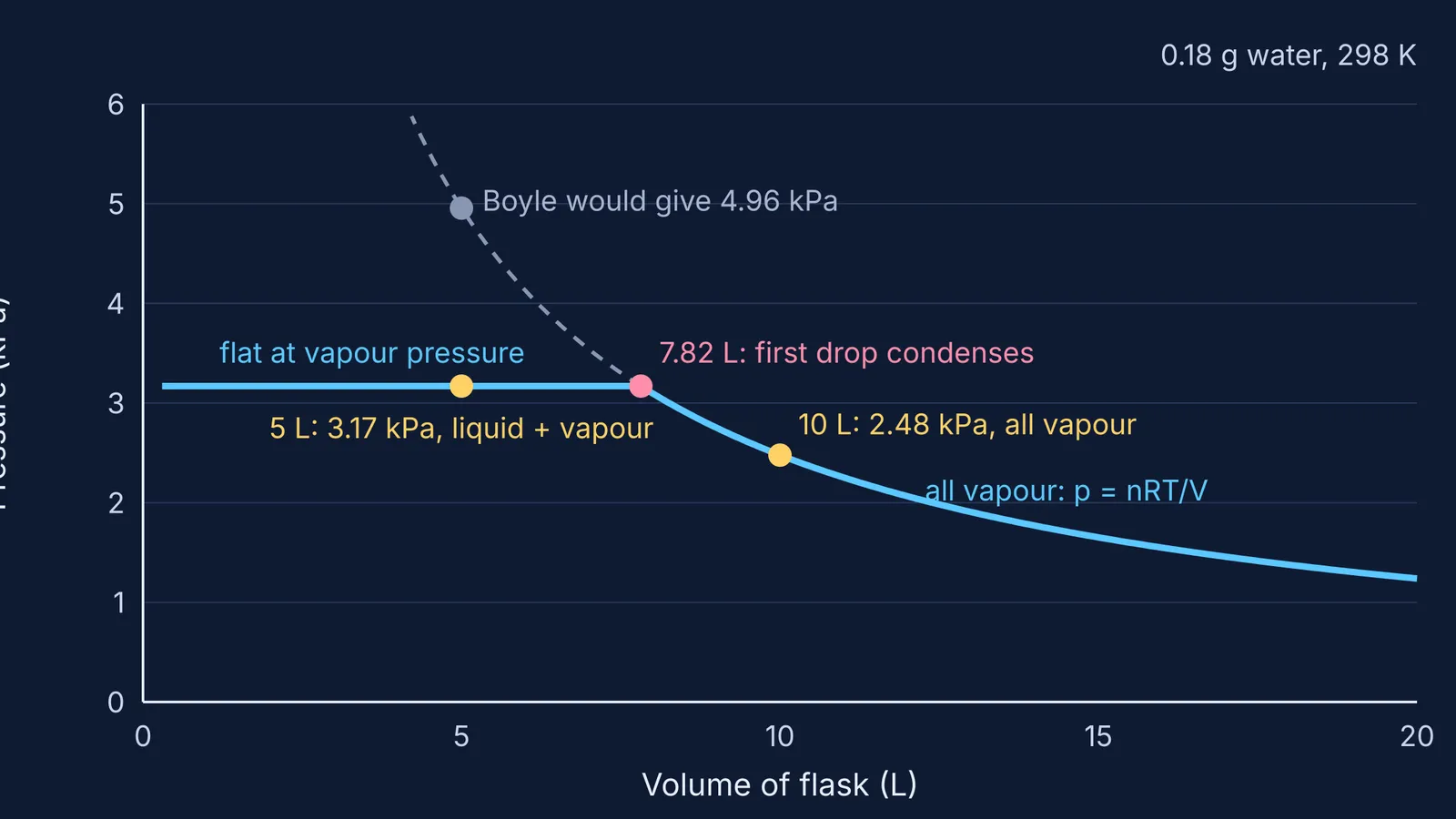
Go back to Case A, the flask with 0.18 g of water, all of it vapour at 2.48 kPa. Now compress it slowly to 5.0 L at constant temperature.
Boyle's law would predict 2 × 2.48 ≈ 4.96 kPa. That is above 3.17 kPa, so Boyle's law cannot hold all the way.
Find where condensation starts: the vapour reaches 3.17 kPa when V = nRT/p = 0.0100 × 8.314 × 298 / 3.17 ≈ 7.82 L. Down to 7.82 L the pressure rises as Boyle's law says.
Below 7.82 L, liquid forms and the pressure stays at 3.17 kPa.
At 5.0 L, the vapour left is n = 3.17 × 5.0 / (8.314 × 298) ≈ 0.0064 mol.
Condensed: 0.0100 − 0.0064 ≈ 0.0036 mol, about 0.065 g of liquid.
The reverse also works. Take the Case B flask (0.36 g, 3.17 kPa) and expand it. Liquid keeps evaporating and the pressure stays at 3.17 kPa until the last drop is gone, at V = 0.0200 × 8.314 × 298 / 3.17 ≈ 15.6 L. After that, the pressure falls as Boyle's law says.
On a pressure–volume graph, Case A is a falling Boyle curve that meets a flat line at the vapour pressure. The flat line means liquid and vapour are both present.
Does the rule change if air is also in the flask?
Partly. Suppose the 10.0 L flask holds dry air at 100 kPa and you add 0.36 g of water at 298 K. The partial pressure of water still settles at 3.17 kPa, so about 0.13 g still stays liquid. But the total pressure is 100 + 3.17 ≈ 103.2 kPa.
Now halve the volume. The air does follow Boyle's law, so its partial pressure goes to 200 kPa. Water vapour stays at 3.17 kPa and more of it condenses. The total becomes about 203.2 kPa. So the statement "the pressure does not rise" is true only for the water's own partial pressure. Subtracting water vapour from a total pressure is the same idea used in gas collected over water and how to correct for water vapour.
Why do some answers use a different vapour pressure?
Because vapour pressure changes fast with temperature. At 298 K it is about 3.17 kPa, but at 300 K it is already about 3.54 kPa, more than 10% higher for a 2 K rise. Always use the value given for the stated temperature. If a question says 300 K, do not reuse 3.17 kPa. Values in different tables also differ slightly in the last digit, so treat them as approximate.
If you want to practise more "does it all evaporate" problems, the Fermi Problem Library has a step-by-step solver that explains the reasoning at each stage.
Quick checklist
With liquid and vapour together, the vapour pressure depends only on temperature.
Compressing a saturated vapour condenses it; the pressure stays flat.
Test first: pretend all the water evaporates, find p = nRT/V, compare with the vapour pressure.
Below the vapour pressure: all vapour, use p = nRT/V. Above it: p is the vapour pressure, and the rest is liquid.
Find the onset of condensation with V = nRT/p(vapour).
Neglect the volume of the liquid, and say so.
With air present, only the water's partial pressure is fixed; the total still changes.
Use the vapour pressure for the exact temperature given.


