

On this page
When you make hydrogen from zinc and acid, or oxygen from potassium chlorate, and bubble it into an upturned tube of water, the gas you trap is not pure. Water evaporates into it, so two gases share the pressure inside the tube. Every gas-over-water question starts by taking out the water's share.
Why do you subtract the vapour pressure of water?
Dalton's law of partial pressures says the total pressure of a gas mixture is the sum of the pressures each gas would exert on its own. For a wet gas that gives P(total) = P(gas) + p(H₂O), so P(gas) = P(total) − p(H₂O), as the LibreTexts chapter on gas collection by water displacement/14%3A_The_Behavior_of_Gases/14.13%3A_Gas_Collection_by_Water_Displacement) sets out.
P(total) is the atmospheric pressure from the barometer, as long as the water level inside the tube matches the level outside. Purdue's general chemistry lab notes explain that the water level adjusts until the pressures inside and outside the container are the same, and that the vapour pressure of water depends on temperature. If the level inside is higher than outside, the gas is below atmospheric pressure, so raise or lower the tube until the levels match before you read the volume.
What is the vapour pressure of water at lab temperatures?
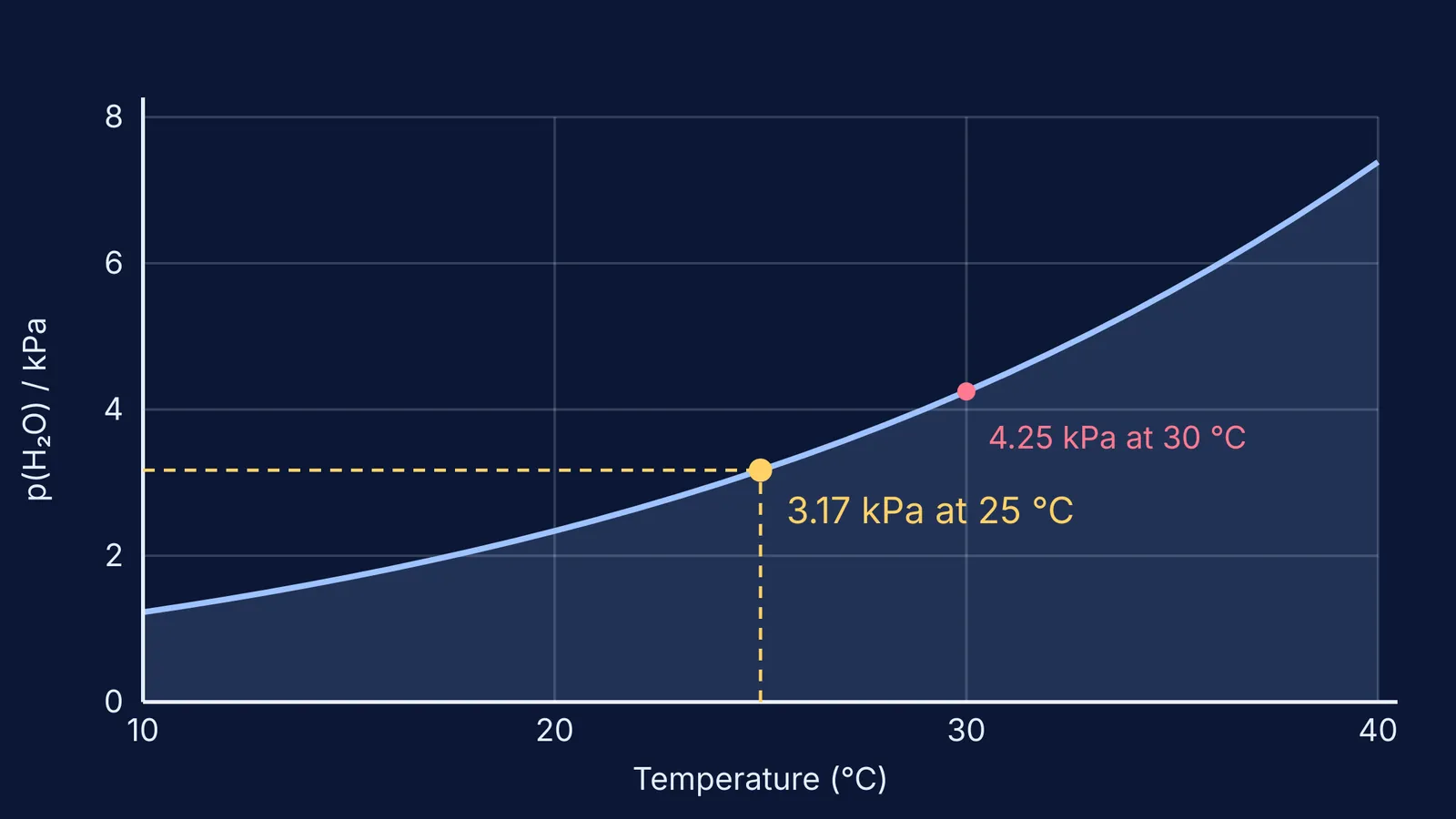
According to the NIST Chemistry WebBook, which uses the IAPWS-95 formulation for water, the vapour pressure of water is:
1.71 kPa at 15 °C
2.34 kPa at 20 °C
3.17 kPa at 25 °C
4.25 kPa at 30 °C
Many textbooks give the same data in mmHg; the LibreTexts table lists 23.76 mmHg at 25 °C. At 25 °C the correction is about 3% of a 100 kPa barometer reading: small, but enough to change an answer given to three significant figures.
How do you find moles of gas collected over water?
Problem 1. A student reacts zinc with dilute hydrochloric acid and collects 245 mL of hydrogen over water at 25 °C. The barometer reads 100.8 kPa and the water levels are equal. How many moles of H₂ were collected?
Find p(H₂O) at 25 °C: 3.17 kPa, from the NIST water data.
Subtract: P(H₂) = 100.8 − 3.17 = 97.63 kPa = 97 630 Pa.
Convert to SI: V = 245 mL = 2.45 × 10⁻⁴ m³, and T = 298.15 K.
Use n = PV/RT with R = 8.314 J mol⁻¹ K⁻¹ (the NIST value of the molar gas constant is 8.314 462 618... J mol⁻¹ K⁻¹, an exact defined value). n = (97 630 × 2.45 × 10⁻⁴) ÷ (8.314 × 298.15) = 23.92 ÷ 2479 = 9.65 × 10⁻³ mol.
If you skip the correction and use 100.8 kPa, you get 9.96 × 10⁻³ mol, about 3% too high.
How do you find the dry volume of the gas?
Problem 2. Oxygen from heating potassium chlorate is collected over water: 380 mL at 30 °C, with the barometer at 99.5 kPa. What volume would the dry oxygen occupy (a) at the same temperature and pressure, and (b) at 0 °C and 100 kPa?
Find p(H₂O) at 30 °C: 4.25 kPa, from the NIST water data.
Subtract: P(O₂) = 99.5 − 4.25 = 95.25 kPa.
Part (a), Boyle's law at constant temperature: V(dry) = 380 × 95.25 ÷ 99.5 = 364 mL.
Part (b), combined gas law: V = 380 × (95.25 ÷ 100) × (273.15 ÷ 303.15) = 326 mL.
The ratio P(gas) ÷ P(total) is the fraction of the wet volume that belongs to your gas. Here it is 0.957, so about 4% of what you collected was water vapour.
What mistakes cost marks in these problems?
Before your final answer, check:
Did you subtract p(H₂O) from the pressure, not the volume?
Is the vapour pressure for the temperature in the question?
Are the barometer reading and the vapour pressure in the same unit before you subtract?
Is the temperature in kelvin?
At the same temperature and pressure, is your dry volume smaller than the wet volume? It must be.
Many slips here are unit and mole errors, the ones covered in our guide to common mole concept errors. For more practice with PV = nRT itself, work through these ideal gas law problems. If you want the partial-pressure idea from another angle, see how mole fractions set the average molar mass of a gas mixture.
If your answer keeps disagreeing with the key, the Fermi Problem Library has worked problems with a step-by-step solver that explains the reasoning rather than printing an answer, so you can find the line where yours went wrong. If partial pressure itself still feels shaky, the Fermi Concept Library gives each chemistry concept its own lesson and its place in the map.
Next time you are in the lab, write down the water temperature next to the barometer reading. That one number is the correction.


