

On this page
Cool pure water and it freezes at 0 °C, and the temperature sits there until all of it has turned to ice. Cool a urea solution and something different happens. Ice starts to form at a lower temperature, but the temperature does not sit still. It keeps falling as more ice forms. The reason is simple, and it lets you calculate exactly how much ice you have at any temperature.
Why does a solution keep freezing at lower and lower temperatures?
When a dilute aqueous solution freezes, the solid that separates is pure ice. The solute stays behind in the liquid. So every gram of ice that forms takes a gram of water out of the solution and leaves the same amount of solute in less water.
That makes the remaining solution more concentrated. A more concentrated solution has a larger depression in freezing point, ΔTf = Kf × m. So the liquid left behind now freezes at a lower temperature. To freeze more of it, you have to cool it further. Freezing and cooling go on together instead of one after the other.
The onset of freezing is what you use to find a molar mass, as in how to find molar mass from depression in freezing point. Here we follow what happens after that first crystal appears.
How do you calculate how much ice has formed?
At any temperature below the starting freezing point, the remaining liquid must be exactly the solution that freezes at that temperature. That gives a three-step method:
Find the molality the remaining liquid must have: m = ΔT/Kf, where ΔT is how far below 0 °C you are.
The solute has not moved, so the water still in the liquid is: mass of water = moles of solute / m.
Ice formed = original water − water still in the liquid.
The key point is that m refers to the water left in the liquid, not the water you started with. Using the original water mass is the most common error.
Worked example: urea solution cooled to −4.00 °C
A solution contains 6.00 g of urea, CO(NH₂)₂, in 100 g of water. Take M(urea) = 60.0 g/mol and Kf(water) = 1.86 K kg/mol. Urea is a non-electrolyte, so i = 1. The solution is cooled to −4.00 °C. How much ice has formed?
Moles of urea. n = 6.00/60.0 = 0.100 mol.
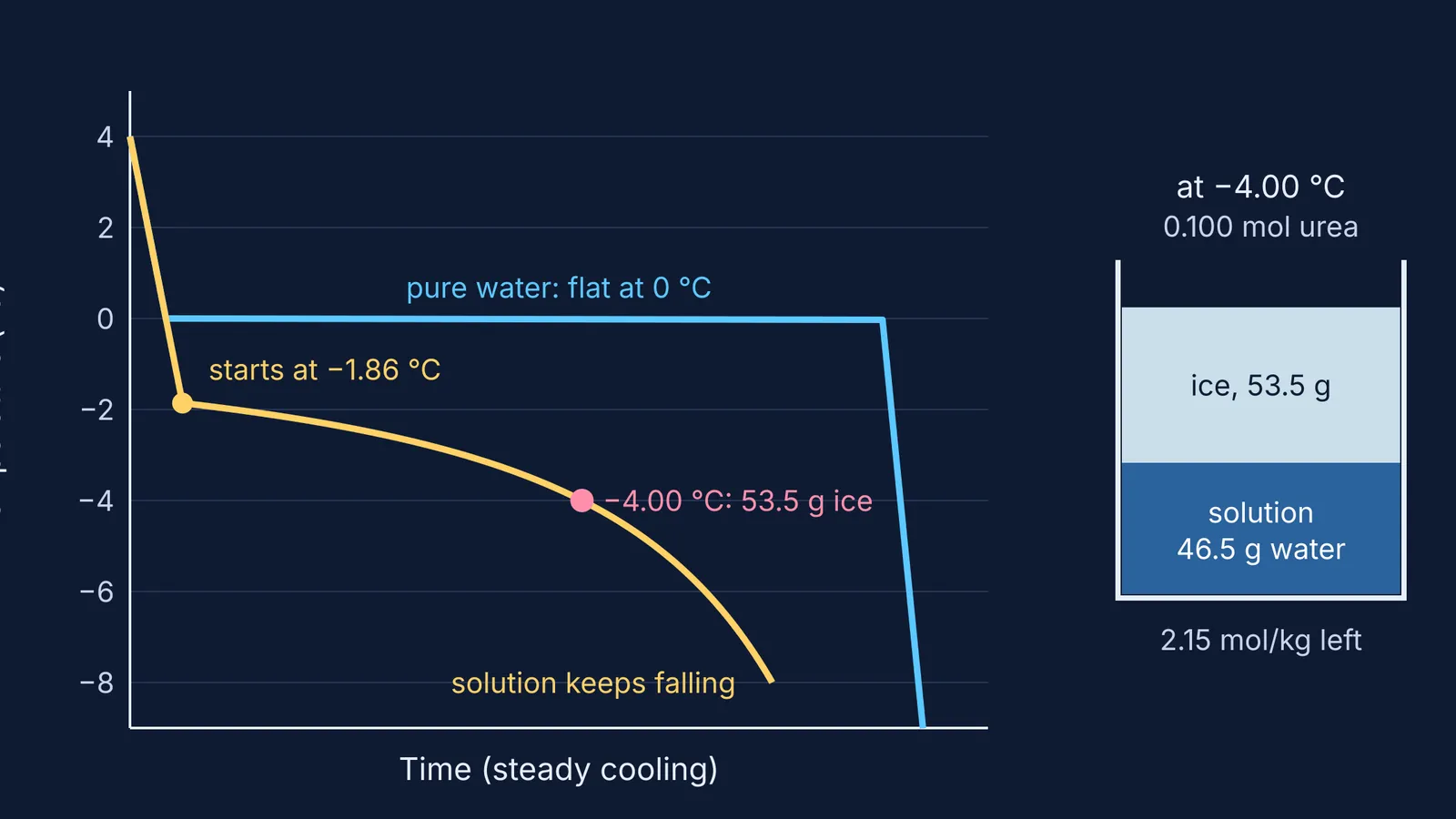
Where freezing starts. m = 0.100 mol / 0.100 kg = 1.00 mol/kg. ΔTf = 1.86 × 1.00 = 1.86 K. Ice first appears at −1.86 °C.
Molality needed at −4.00 °C. m = 4.00/1.86 ≈ 2.15 mol/kg.
Water left in the liquid. 0.100 mol / 2.15 mol/kg ≈ 0.0465 kg = 46.5 g.
Ice formed. 100 − 46.5 = 53.5 g.
So more than half the water has frozen out by −4.00 °C, even though freezing started only 2.14 °C higher.
Check it the other way. 0.100 mol in 0.0465 kg is 2.15 mol/kg, and 1.86 × 2.15 ≈ 4.00 K. The remaining liquid freezes at −4.00 °C, which matches.
You can turn this into one formula. If ΔT₀ is the depression at the start and ΔT is the depression now, the fraction of the water that has frozen is 1 − ΔT₀/ΔT. For this solution, half the water is ice when ΔT = 2 × 1.86 = 3.72 K, at −3.72 °C.
How accurate is this calculation?
It is an approximation, and you should know where it stops working.
ΔTf = Kf × m is a dilute-solution law. At 1 mol/kg it is fair. At 2.15 mol/kg it is noticeably less reliable, so treat 53.5 g as an estimate. Real urea solutions deviate somewhat at this strength.
The solute must stay dissolved. The method assumes only ice comes out. If you keep cooling, the liquid eventually becomes so concentrated that the solute itself starts to crystallise, together with ice. That point is called the eutectic, and below it the whole mixture freezes solid. Everything here applies above the eutectic.
Solutions often supercool. In a real experiment the liquid may dip below the freezing point before the first crystal forms, then warm back up. The method above describes the equilibrium amounts.
For an electrolyte, multiply by the van 't Hoff factor: m = ΔT/(i × Kf). The rest of the method is the same.
Why does a solution's cooling curve slope instead of going flat?
For pure water, the cooling curve has a flat plateau at 0 °C. All the heat you remove comes from water turning into ice, and the freezing point never changes. The same flat region is what you read in the naphthalene cooling curve practical.
For the urea solution, the curve breaks at −1.86 °C and then slopes downward. Near the start, a small temperature drop freezes a lot of water, so the curve falls slowly. The first degree below −1.86 °C freezes about 35 g of water, but the degree from −3 to −4 °C freezes only about 15.5 g, so later the curve falls faster. The hero graph shows both curves, computed for steady cooling with this mass balance.
Where does this show up outside the exam hall?
Freeze-concentration of fruit juice. Partly freeze the juice and remove the ice, which is mostly water. The liquid left is a concentrated juice, made without boiling.
Salt on ice. Salt dissolves in the thin film of water on ice and makes brine. If the brine's freezing point is below the road's temperature, the ice it touches melts into it. Melting dilutes the brine, and it stops only when the brine's freezing point equals the temperature. The everyday picture is in how salt melts ice.
Antifreeze. How much ethylene glycol stops radiator water freezing asks how much solute prevents freezing. This post answers the opposite question: how much freezes once it starts.
To see the full set of ideas behind ΔTf, i and molality in one place, the Concept Library covers colligative properties topic by topic.
Quick checklist
The ice that forms from a dilute solution is pure water; the solute stays in the liquid.
Freezing makes the liquid more concentrated, so its freezing point keeps falling.
At temperature T: m(liquid) = ΔT/(i × Kf).
Water left = moles of solute / m. Ice = original water − water left.
Fraction frozen = 1 − ΔT₀/ΔT.
Use the remaining water, not the original water, in the molality.
The answer is approximate at high molality and holds only above the eutectic.


