

On this page
Water is an excellent coolant because of its high specific heat capacity, but it freezes at 0 °C. When water freezes, it expands, which can crack a car's radiator or engine block. Adding a solute lowers the freezing point, a colligative property known as freezing point depression. Ethylene glycol (C₂H₆O₂) is the most common antifreeze used for this purpose.
How much ethylene glycol stops radiator water freezing?
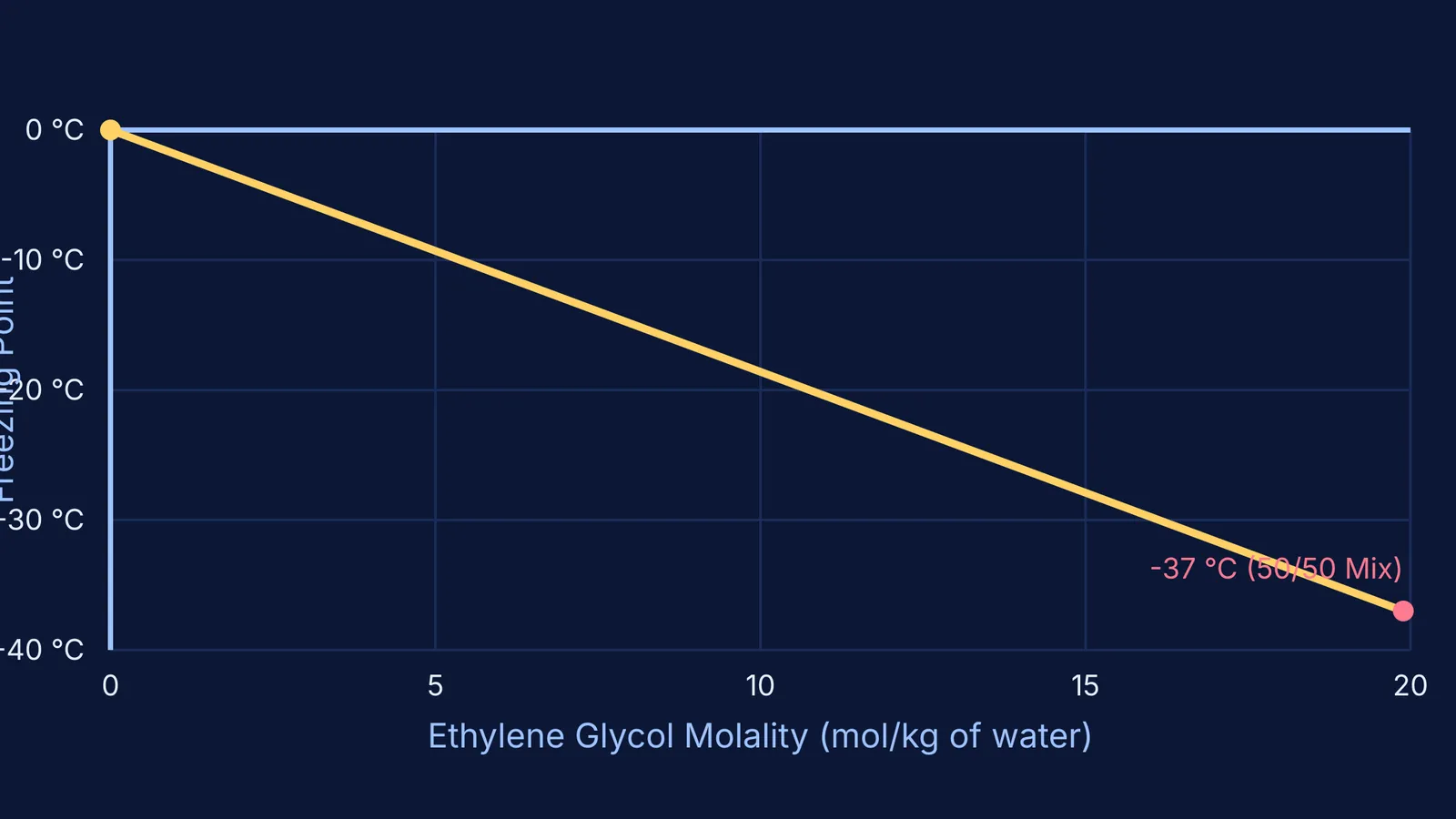
The standard automotive recommendation is a 50/50 mixture of ethylene glycol and distilled water, which protects the engine down to approximately -37 °C 1. But why do we need such a massive amount of solute? Why not just add a pinch of salt?
The answer lies in the colligative nature of the solution. Colligative properties are a fascinating area of physical chemistry because they depend on the ratio of solute to solvent particles, rather than the chemical identity of the solute itself. This means that if you dissolve sugar, salt, or antifreeze in water, the freezing point will drop in direct proportion to the number of particles created in the solution. However, we choose ethylene glycol over salt because salt is highly corrosive and would quickly destroy the metal components inside a car's cooling system. Ethylene glycol, on the other hand, is non-corrosive and actually helps lubricate the water pump while preventing rust. The freezing point depression depends strictly on the number of solute particles per kilogram of solvent (its molality), not on what the particles are.
How do we calculate the mass using the freezing point formula?
We can use the freezing point depression formula to see exactly why a 50/50 mix is necessary to reach -37 °C. The formula is:
ΔTf = i × Kf × m
ΔTf is the change in freezing point. To go from 0 °C to -37 °C, ΔTf = 37 °C.
i is the van't Hoff factor. Ethylene glycol is a non-electrolyte (it does not dissociate into ions), so i = 1 2/Physical_Properties_of_Matter/Solutions_and_Mixtures/Colligative_Properties/Freezing_Point_Depression).
Kf is the cryoscopic constant for water, which is 1.86 °C kg/mol 3/Physical_Properties_of_Matter/Solutions_and_Mixtures/Colligative_Properties/Freezing_Point_Depression).
m is the molality of the solution in mol/kg.
Let us find the required molality:
37 = 1 × 1.86 × m
m = 37 / 1.86 ≈ 19.89 mol/kg
To lower the freezing point to -37 °C, the solution must have 19.89 moles of ethylene glycol dissolved in every 1 kg (which is 1 litre) of pure water.
Why is the required mass so large?
Unlike a strong electrolyte such as sodium chloride, which breaks into two ions (i = 2) and provides twice the depression per mole, ethylene glycol stays intact as single molecules. To find the actual mass of ethylene glycol required, we multiply the number of moles by its molar mass (C₂H₆O₂ has a molar mass of 62.07 g/mol 4):
Mass = 19.89 mol × 62.07 g/mol ≈ 1,234.6 g
This means you must add approximately 1.23 kg of ethylene glycol to every 1 kg of water to reach the -37 °C target. Because the density of liquid ethylene glycol is slightly higher than water, 1.23 kg equates to just over a litre of the liquid. This perfectly aligns with the industry standard of using roughly equal volumes—a 50/50 mix—to protect the radiator.
Pure ethylene glycol actually freezes at around -13 °C 5, which is surprisingly higher than the freezing point of its water mixtures. The lowest possible freezing point is reached at a concentration of approximately 68% ethylene glycol, known as the eutectic point, where the mixture can remain liquid down to -50 °C or lower. Once you surpass this eutectic point, the solvent and solute roles effectively swap, and adding more ethylene glycol actually drives the freezing point back up. This is why pouring 100% antifreeze directly into a radiator without water is a dangerous mistake in cold climates.
Exploring the extremes with AI
When preparing for exams like the JEE or NEET, colligative properties often feature in numeric questions. You can use the Fermi Concept Library to fill any concept gaps about how different solutes affect boiling and freezing points. For instance, try calculating how much NaCl would be needed for the same temperature drop, and then explain why saltwater is used to clear icy roads but never inside a car engine.
If you want to understand the physical principles behind these changes, these resources will help:


