

On this page
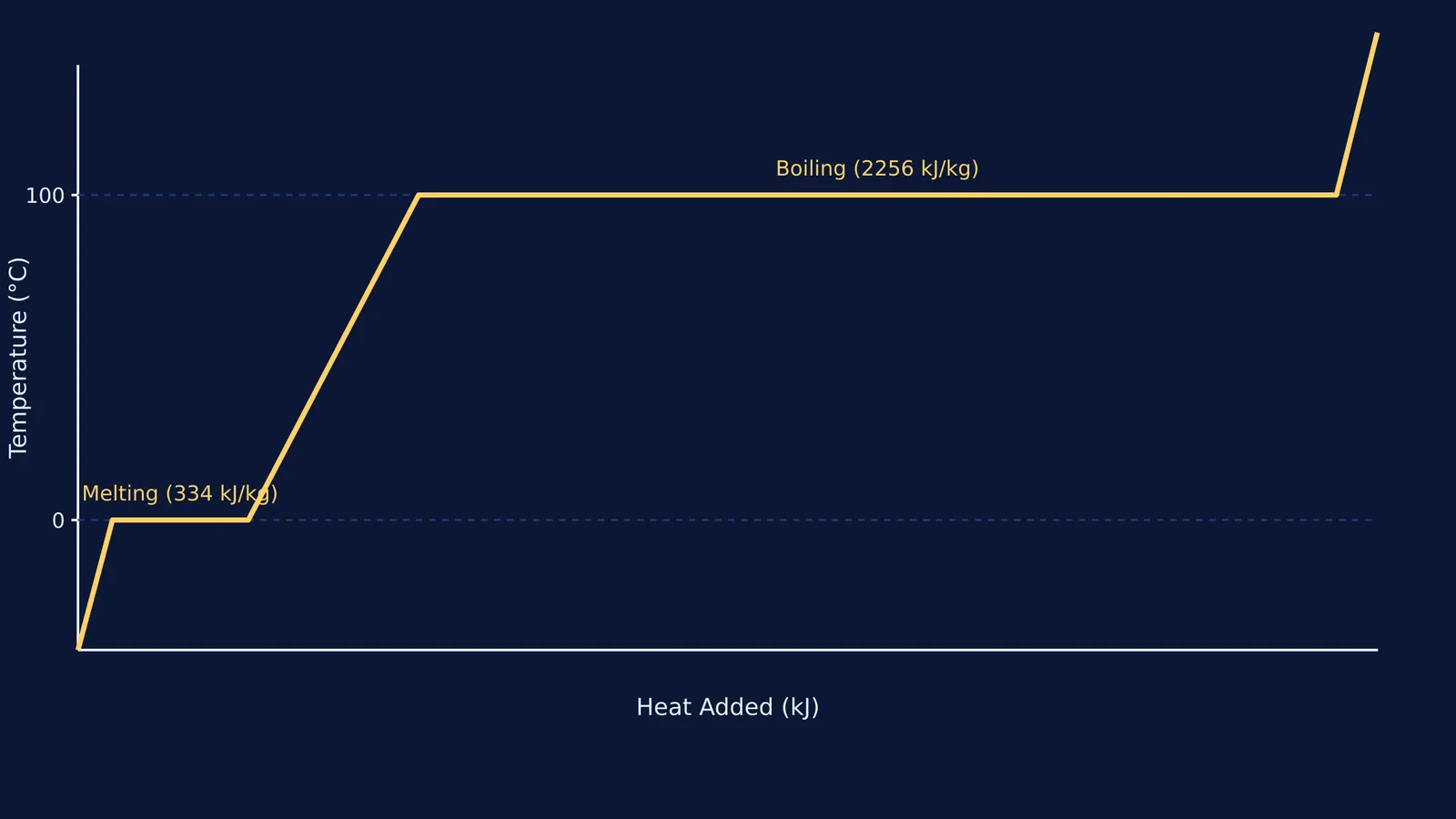
If you place a block of ice in a pan over a steady flame and monitor it with a thermometer, you will notice something surprising. The temperature rises steadily until it hits 0 °C, and then it simply stops. Even though the burner is constantly adding heat, the thermometer stays stuck at 0 °C until every last sliver of ice has melted.
This flat line on a heating curve can feel counterintuitive when you are first studying thermodynamics. If heat is constantly flowing into the pan, why is the temperature not going up? The answer lies in understanding the difference between the heat you add and the temperature you measure.
Why does temperature stay constant during melting and boiling?
To understand the flat thermometer, we have to zoom in on the molecules. Temperature is not a measure of total heat; it is only a measure of the average kinetic energy of the molecules in a substance. When molecules move, vibrate or rotate faster, the temperature goes up.
However, heat energy can do two different things. It can make molecules move faster (increasing kinetic energy), or it can pull molecules apart against their mutual attraction (increasing potential energy).
In a solid like ice, water molecules are locked into a rigid, crystal structure by strong intermolecular bonds. When the ice reaches its melting point, the kinetic energy is high enough that the molecules are ready to break free from this rigid structure.
From that moment on, every joule of heat added goes directly into breaking those bonds, increasing the potential energy of the system rather than the kinetic energy. Because the kinetic energy stops rising, the temperature stays absolutely constant. Only when all the ice has turned to liquid water can the added heat go back to making the molecules move faster. The exact same principle applies at the boiling point, where liquid molecules are completely separated into a gas.
Where does the added heat go if the temperature stays constant?
The heat that goes into breaking bonds during a phase change is called latent heat (from the Latin *latere*, meaning "to lie hidden"). It is "hidden" because it does not show up as a temperature change on a thermometer.
Scientists measure this hidden energy in joules per kilogram (J/kg). According to OpenStax *University Physics*, the latent heat of fusion (melting) for water is 334 kJ/kg. This means it takes 334,000 joules of energy just to melt one kilogram of ice at 0 °C into liquid water at 0 °C.
The energy required to boil water is even more staggering. The latent heat of vaporization for water is 2256 kJ/kg, as OpenStax outlines. Boiling takes nearly seven times as much energy as melting because converting a liquid to a gas requires completely overcoming all intermolecular forces to spread the molecules far apart.
If the difference between kinetic and potential energy during a phase change feels abstract, the Fermi Concept Library has every concept in physics, chemistry, biology, mathematics and computing, each with its own lesson and its place in the map.
How do you solve heating curve problems?
When you are asked to calculate the total heat (Q) required to turn ice at a negative temperature into steam, you must break the problem into steps. You cannot use a single formula because the heat does different jobs at different times.
Here is a practical checklist for setting up your calculation:
Identify the slopes (Temperature changes): For sections where the phase is stable (e.g., warming solid ice from −10 °C to 0 °C), the heat increases kinetic energy. Use the specific heat formula: Q = mcΔT.
Identify the plateaus (Phase changes): For the flat sections where the temperature is constant (melting or boiling), the heat increases potential energy. Use the latent heat formula: Q = mL, where L is either the latent heat of fusion or vaporization.
Sum the steps: Add the energy required for each individual step to find the total heat.
If you are staring at a multi-step thermodynamics problem and are not sure which formula applies to which section, Fermi's AI tutor can work out what you already know and build a plan for the session, so you sit down to a clear next step.
Connecting phase changes to your syllabus
Understanding latent heat helps you answer several classic exam questions. It explains why a steam burn at 100 °C is much more severe than a boiling water burn at 100 °C—the steam releases its massive latent heat of vaporization into your skin as it condenses. It also explains why farmers sometimes spray their crops with water before a hard freeze; as the water freezes, it releases its latent heat of fusion, protecting the plants from dropping below 0 °C.
You can read more about how to read these graphs in our guide to temperature-time graphs during heating, review the broader states of matter in Matter in our surroundings: states, evaporation and latent heat, or walk through the calculations in calorimetry and heat transfer.


