

On this page
Most students first encounter solutions in a beaker: table salt or sugar stirred into water until the crystals vanish. But in chemistry, solutions are not limited to liquids. According to the IUPAC Compendium of Chemical Terminology, a solution is a liquid or solid phase containing more than one substance, where one substance is treated as the solvent and the others as solutes. In gaseous systems, mixtures of non-reacting gases also behave as a single homogeneous phase.
As the NCERT Class 12 Chemistry textbook notes in its chapter on Solutions, a binary solution contains two components. The component present in the largest quantity is the solvent, which determines the physical state of the solution. The solute is the component dissolved within it. Because solute particles disperse as individual atoms, ions, or molecules under 1 nm in diameter, true solutions never scatter visible light and do not settle. Understanding this single-phase requirement is essential before tackling calculations for mixing and diluting solutions to find final molarity.
What are the nine combinations of solute and solvent?
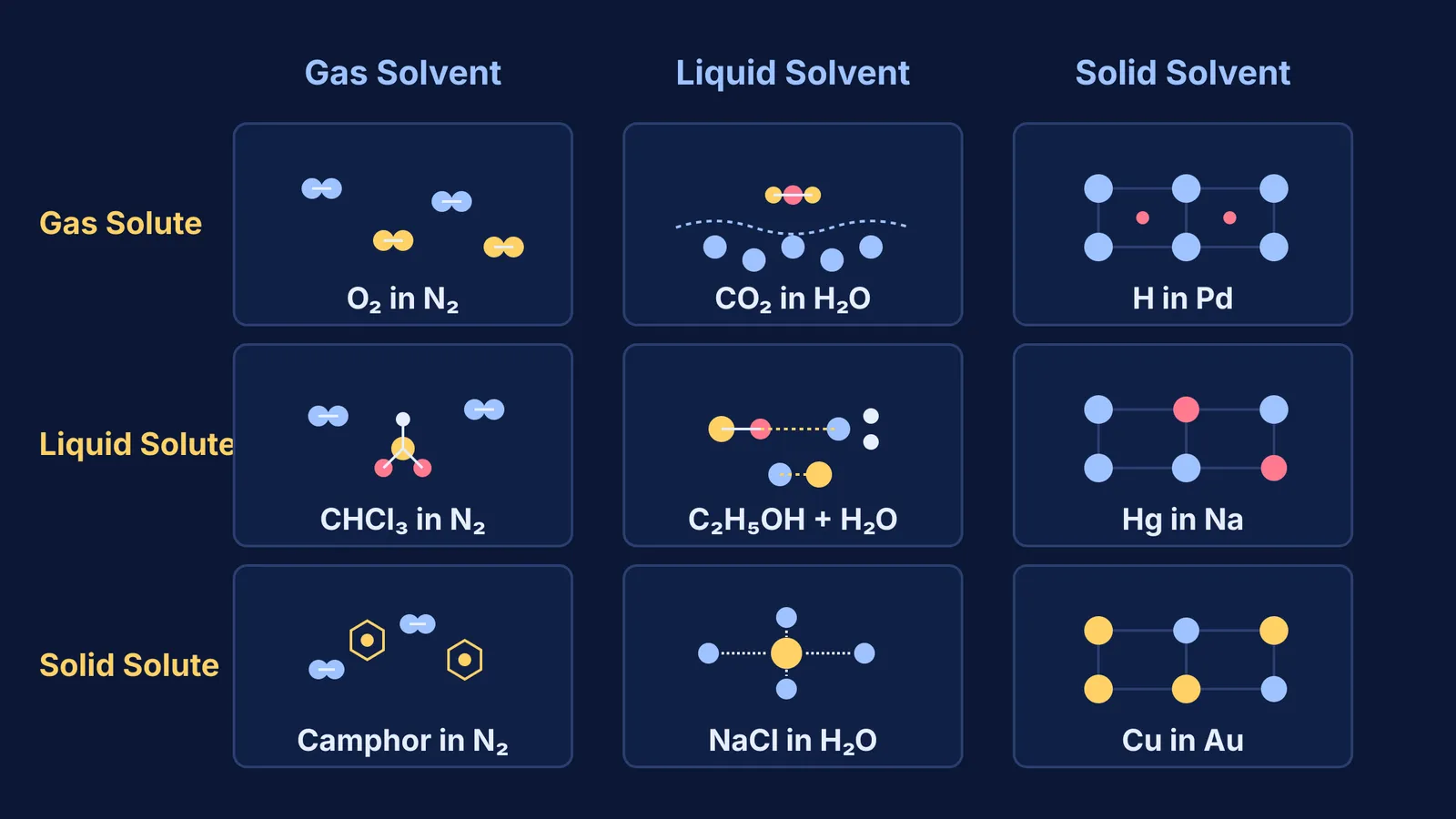
Because matter commonly exists as a gas, liquid, or solid, solute and solvent pair in nine possible combinations. The NCERT Class 12 Chemistry curriculum groups these by the physical state of the solvent:
Gaseous solutions (solvent is a gas):
Gas in gas: Air (oxygen mixed in nitrogen). All gases mix completely in all proportions, a property central to finding the average molar mass of a gas mixture.
Liquid in gas: Chloroform vapour mixed with nitrogen gas, or humidity in air.
Solid in gas: Camphor vapour in nitrogen gas, or sublimed iodine in air.
Liquid solutions (solvent is a liquid):
Gas in liquid: Carbon dioxide in water (soda water) or oxygen dissolved in water, which sustains aquatic life. In 1803, William Henry demonstrated in the Philosophical Transactions of the Royal Society of London that dissolved gas mass is directly proportional to its partial pressure.
Liquid in liquid: Ethanol dissolved in water.
Solid in liquid: Glucose or salt in water, used for studying colligative properties like finding molar mass from osmotic pressure.
Solid solutions (solvent is a solid):
Gas in solid: Hydrogen gas dissolved in palladium metal.
Liquid in solid: Amalgam of liquid mercury with solid sodium.
Solid in solid: Copper dissolved in gold (such as 22-carat gold containing copper alloyed into gold), or zinc in copper (brass).
How do solid solutions like amalgams and alloys form?
Solid solutions form when two substances mix at the atomic scale into a uniform solid phase. In alloys, metals are melted together and cooled into a homogeneous crystal lattice.
In a 1934 paper in the Philosophical Transactions of the Royal Society of London, William Hume-Rothery, Gilbert W. Mabbott, and K. M. Channel Evans outlined the rules for substitutional solid solutions. Beyond the 15% size factor, extensive solubility requires both metals to share the same crystal lattice and similar electronegativities. Copper (radius 0.128 nm) and nickel (radius 0.125 nm) differ by only 2.3%, forming complete solid solutions across all ratios.
Amalgams represent liquid-in-solid solutions. When liquid mercury touches solid sodium or dental silver alloys, it diffuses into the solid lattice. In sodium amalgam (Na-Hg), solid sodium acts as the solvent host while mercury acts as the solute, producing a solid reducing agent.
Why is hydrogen in palladium considered a solution?
A gas dissolving into a solid metal appears counter-intuitive, but it represents an interstitial solid solution. In 1866, Thomas Graham showed in the Philosophical Transactions of the Royal Society of London that palladium absorbs several hundred times its own volume of hydrogen gas, a process he called occlusion.
On the palladium surface, diatomic H₂ dissociates into individual hydrogen atoms that diffuse into the interstitial voids of the face-centred cubic palladium lattice. Because hydrogen disperses homogeneously without forming a separate compound, the system behaves as a gas-in-solid solution.
To explore how crystal structures, lattice voids, and phase equilibria connect, the Fermi Concept Library maps every concept across physical chemistry, showing each topic in the wider knowledge map.
How can you tell a true solution from a colloid in exams?
Examiners in CBSE, JEE Main, and NEET-UG frequently test whether students can distinguish true solutions from colloids. Mistaking smoke or fog for a gas solution is a common pitfall. The NCERT Class 12 Chemistry textbook explicitly separates true solutions from colloidal dispersions based on particle size and phase homogeneity.
Use this three-step decision framework:
Identify the solvent: The component in greater quantity defines whether the solution is gaseous, liquid, or solid.
Check particle size: True solutions disperse as individual particles below 1 nm. Camphor vapour in nitrogen is a true solution because camphor exists as separate molecules. In contrast, smoke consists of solid aggregates measuring 1 nm to 1000 nm suspended in air, making it a colloidal aerosol.
Test for light scattering: True solutions do not show the Tyndall effect. If a light beam remains visible through the mixture, as in fog or milk, the system is a two-phase colloid.
When solving multi-step physical chemistry problems, the Fermi Problem Library provides worked problems with a step-by-step solver that explains the reasoning rather than printing an answer.


