

On this page
When a winter storm hits and roads freeze over, maintenance crews spread tons of salt to keep cars from sliding. But how does scattering dry white crystals over frozen water turn it back into a liquid when the air is still well below zero? It is a practical example of a phenomenon called freezing point depression, where adding a solute to a solvent lowers the temperature at which it freezes.
Whether you are studying for a chemistry exam or just trying to clear your driveway, the rules of solutions and phase changes apply. Here is the science behind why salt melts ice and how you can run a salt on ice freezing point depression simulation to see the numbers in action.
Why does salt melt ice?
To understand why salt works, look at how water freezes. In pure water, as the temperature drops to 0°C (32°F), the molecules slow down and lock into a rigid, structured lattice, forming solid ice. However, there is always a microscopic layer of liquid water on the surface of ice. When rock salt (sodium chloride, NaCl) is spread on the road, it dissolves into this thin layer of water to create a saltwater solution called brine.
Once the salt is dissolved, it separates into sodium and chloride ions. These charged ions act like tiny obstacles. They physically get in the way of the water molecules, disrupting the lattice and making it much harder for the water to pack into solid ice.
Because the water molecules struggle to bond together, the temperature has to drop much further for the liquid to freeze. This is why brine can stay liquid at temperatures where pure water would be solid rock.
How much salt is needed?
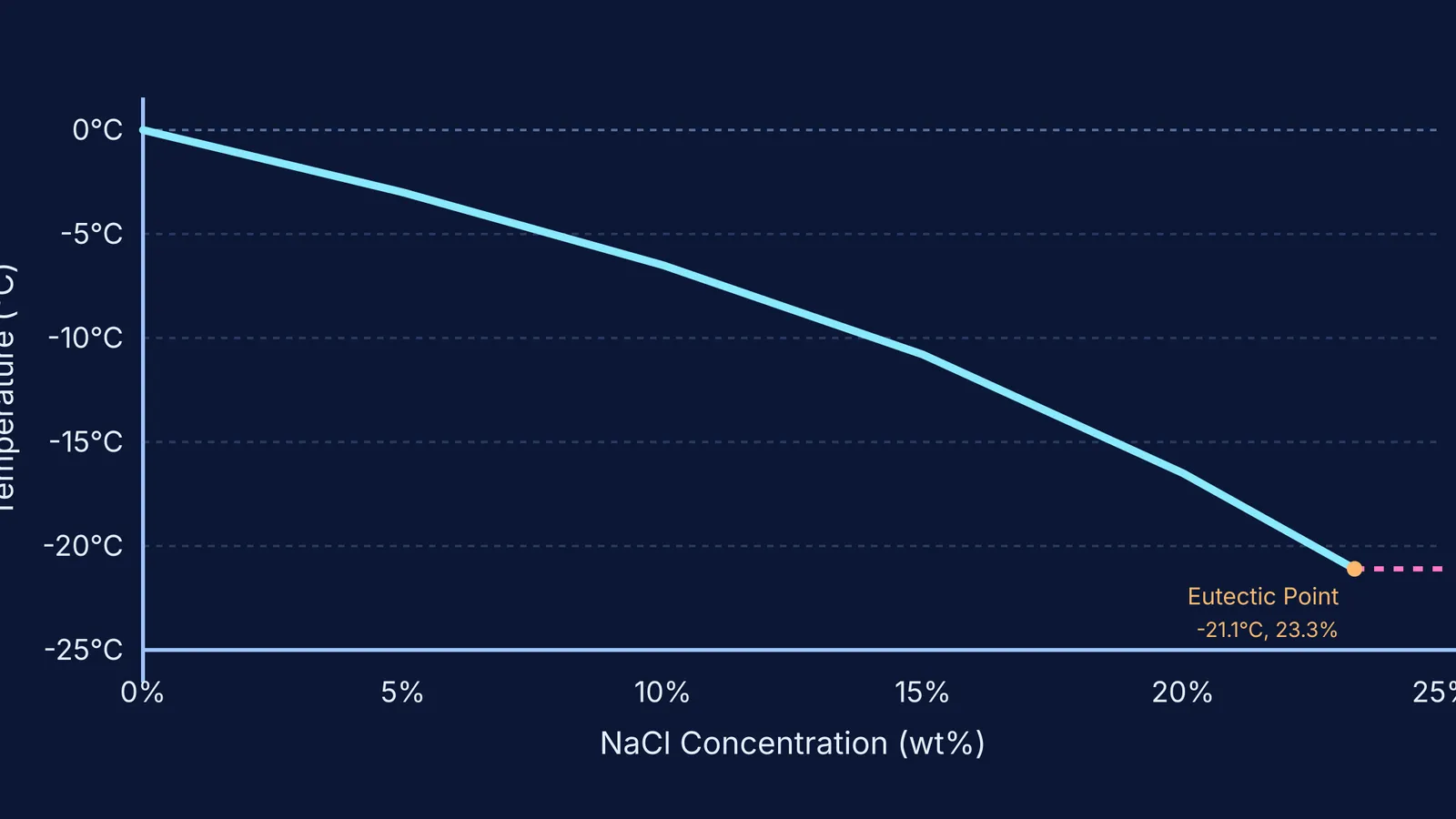
The more salt you dissolve in the water, the more ions you have in the way, and the lower the freezing point becomes. However, sodium chloride has a limit. The lowest temperature at which salt water can stay liquid is called the eutectic point. For salt and water, this happens at -21.1°C (-6°F) with a mixture that is 23.3% salt by weight (Wikipedia). Below this temperature, adding more salt will not help, and road crews must switch to sand for traction or use different chemicals like calcium chloride, which works down to -52°C (-62°F) (Wikipedia).
While salt is an effective de-icer, it does have a cost. Heavy salt runoff can contaminate groundwater and harm aquatic life in nearby streams, leading authorities to balance safety with environmental impact (Wikipedia). The chloride ions also accelerate the rusting of cars and degrade the steel reinforcements inside concrete bridges. For these reasons, cities actively measure the bare minimum concentration needed for the day's temperature forecast, rather than simply dumping endless salt.
Worked Example: Calculating the temperature drop
Let's calculate the temperature drop for a 10% salt solution by using the freezing point depression formula (Wikipedia). Suppose you have 100 grams of a 10% NaCl by weight solution. This means you have 10 g of NaCl and 90 g of water (which is 0.090 kg).
Find the moles of salt: The molar mass of NaCl is 58.44 g/mol.
Moles = 10 g / 58.44 g/mol = 0.171 moles.
Calculate the molality (m): Molality is moles of solute per kilogram of solvent.
m = 0.171 moles / 0.090 kg = 1.9 mol/kg.
Determine the particles (i): Salt (NaCl) splits into two ions in water (Na⁺ and Cl⁻), so the van 't Hoff factor i is 2.
Apply the freezing point depression constant (Kf): For water, Kf is 1.86 °C·kg/mol.
Solve for ΔTf:
ΔTf = i × Kf × m ΔTf = 2 × 1.86 × 1.9 = 7.1 °C.
This theoretical calculation predicts the freezing point should drop by about 7°C, bringing it down to -7°C. In reality, it freezes at a slightly warmer temperature because highly concentrated ions begin to interact and pair up, making the effective number of particles slightly less than a perfect 2. This is exactly the kind of nuance you can observe when comparing theoretical math to real-world data.
How can you test it yourself?
If you want to understand how concentration affects the freezing point without waiting for a snowstorm, you can test it directly.
You can set up an experiment in the Fermi Simulation Lab. In an interactive workspace, you can virtually add different amounts of salt to water and watch the freezing point drop in real time. It is a great way to practise mixing and diluting solutions and map out the curve all the way to the eutectic point. Fermi's AI tutor can also guide you through the calculations, helping you verify that your predicted freezing point matches the simulation.
The same rules of colligative properties apply to finding molar mass from osmotic pressure or predicting boiling points. By graphing the results yourself, you turn a textbook rule into a measurable pattern. Knowing why rates double every 10 °C or why ice melts when salted builds a solid foundation for physical chemistry.


