

On this page
Nitrogen trichloride is an oily yellow liquid that can explode when it is warmed or struck. Nitrogen triiodide, in the form usually made in labs, goes off when you touch it with a feather. Yet nitrogen trifluoride is a stable gas that is sold in cylinders and used to clean equipment in chip factories. All three have the same pyramidal NX₃ shape. The difference is an energy account you can settle with a few bond enthalpies.
What do NF₃, NCl₃ and NI₃ decompose into?
Each nitrogen trihalide can break down into its elements:
2NX₃ → N₂ + 3X₂
The product side always contains N₂, held together by a triple bond of about 945 kJ/mol, one of the strongest bonds in chemistry. So the real question is simple. Does NX₃ sit above or below its elements on an energy scale?
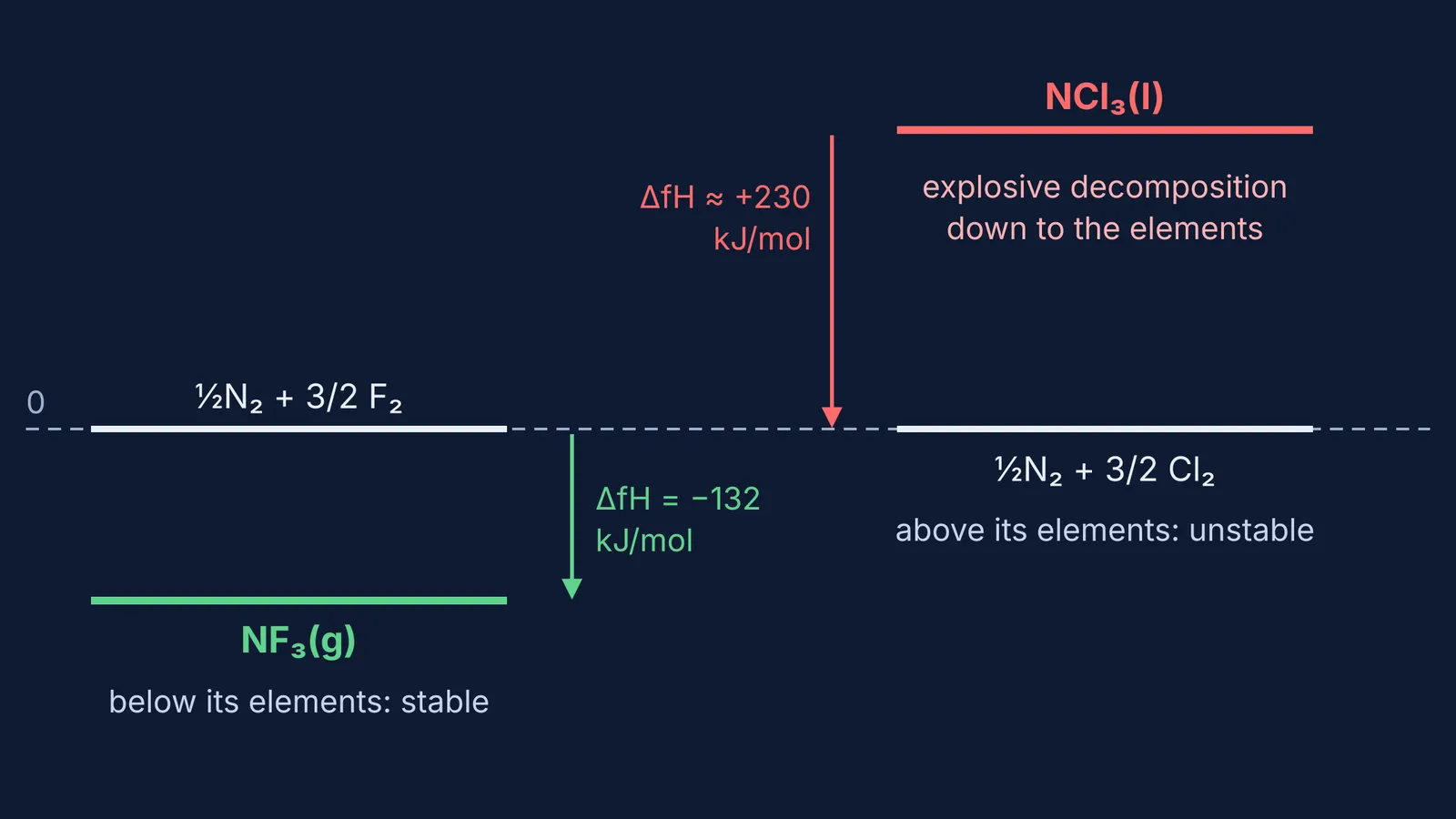
That is exactly what the standard enthalpy of formation, ΔfH, measures. If ΔfH is negative, the compound lies below its elements and decomposition would be uphill. If ΔfH is positive, decomposition releases that much heat per mole. For NCl₃ the measured value is about +230 kJ/mol for the liquid, so 2NCl₃(l) → N₂(g) + 3Cl₂(g) releases about 460 kJ and turns two moles of liquid into four moles of gas. Heat plus a sudden burst of gas is what an explosion is.
How do you estimate ΔfH of NF₃ and NCl₃ from bond enthalpies?
The method, and its limits, are covered in estimating reaction enthalpy from bond enthalpies. Here it is applied to both molecules. Average bond enthalpies (kJ/mol, approximate, tables differ by a few percent): N≡N 945, F–F 158, Cl–Cl 242, N–F 283, N–Cl 200.
Worked example: NF₃
Write the formation reaction for one mole: ½N₂(g) + 3/2 F₂(g) → NF₃(g).
Bonds broken: ½ × 945 = 472.5, and 3/2 × 158 = 237. Total = 709.5 kJ.
Bonds formed: 3 N–F = 3 × 283 = 849 kJ.
ΔfH ≈ (bonds broken) − (bonds formed) = 709.5 − 849 ≈ −140 kJ/mol.
Compare: the measured value for NF₃(g) is −132 kJ/mol. The estimate is close.
Worked example: NCl₃
Formation reaction: ½N₂(g) + 3/2 Cl₂(g) → NCl₃.
Bonds broken: 472.5 + 3/2 × 242 = 472.5 + 363 = 835.5 kJ.
Bonds formed: 3 × 200 = 600 kJ.
ΔfH ≈ 835.5 − 600 ≈ +236 kJ/mol.
Compare: the measured value is about +230 kJ/mol, and it refers to liquid NCl₃. The bond enthalpy estimate is really for the gas, and the gas lies a little higher than the liquid, so treat the match as approximate.
The gap between the two answers is about 375 kJ/mol. One fluorine-for-chlorine swap turns a stable compound into an explosive.
Why does fluorine win twice?
Split the 375 kJ/mol gap into its two parts and you see that fluorine helps on both sides of the account.
Cheaper to break. F–F (158) is much weaker than Cl–Cl (242). Breaking 3/2 mol of X–X costs 126 kJ less for fluorine. The reason, lone pair repulsion in a very short bond, is explained in why the F–F bond is weaker than Cl–Cl.
More paid back. N–F (283) is much stronger than N–Cl (200). Forming three N–X bonds returns 249 kJ more for fluorine.
126 + 249 = 375 kJ/mol, which is exactly the difference between −140 and +236.
Why is the N–F bond so much stronger than N–Cl?
Two reasons. First, size: nitrogen and fluorine are both small second-period atoms whose 2p orbitals overlap well, giving a short, strong bond. Chlorine bonds with its larger, more diffuse 3p orbitals, and the overlap with nitrogen's 2p is poorer. Second, polarity: fluorine (Pauling electronegativity 4.0) is far more electronegative than nitrogen (3.0), and a polar bond gets extra stabilisation. Nitrogen and chlorine have almost the same electronegativity (both about 3.0), so the N–Cl bond gets no such bonus.
Why is nitrogen triiodide even worse?
Iodine makes every term worse. The N–I bond is weaker still, because iodine's 5p orbitals are large and overlap badly with nitrogen's small 2p, and there is no polarity bonus. Three bulky iodine atoms also crowd a small nitrogen. NI₃ is strongly endothermic and is a touch-sensitive explosive.
Pure NI₃ is very hard to isolate. What you get from iodine and concentrated ammonia is the ammonia adduct, NI₃·NH₃, a dark solid that is fairly safe while wet and detonates on the lightest touch once dry, releasing a cloud of purple iodine vapour. One commonly written equation is:
8NI₃·NH₃ → 5N₂ + 6NH₄I + 9I₂
Check it: N is 16 on both sides, H is 24, I is 24. This is a demonstration you read about, not one you make.
If NF₃ is stable, is it also unreactive?
Two different ideas are at work. ΔfH is about thermodynamics: whether the compound is downhill or uphill from its elements. How fast it reacts is kinetics.
NF₃ is stable in both senses at room temperature. It does not hydrolyse in water, unlike NCl₃, whose reaction with water is compared with that of PCl₃ in why NCl₃ and PCl₃ give different products on hydrolysis. NCl₃ is thermodynamically unstable, and only a small barrier holds it back, so heat, a shock, strong light or contact with organic matter can set it off.
The same bookkeeping explains why PCl₃ is an ordinary stable liquid (ΔfH about −320 kJ/mol). Phosphorus exists as P₄ with P–P single bonds, so there is no huge triple-bond prize waiting on the product side, and the P–Cl bond is strong.
If you want to practise more bond enthalpy estimates like these, the Fermi Problem Library has a step-by-step solver that explains the reasoning at each stage.
What should you remember for the exam?
All NX₃ decompose to N₂ + X₂, and N≡N (about 945 kJ/mol) is a huge energy prize.
ΔfH(NF₃, g) is −132 kJ/mol: below its elements, stable.
ΔfH(NCl₃, l) is about +230 kJ/mol: above its elements, explosive.
Bond enthalpy estimates give about −140 and +236 kJ/mol; call them approximate.
Fluorine wins twice: weak F–F to break, strong N–F to form.
NI₃ is usually made as NI₃·NH₃ and is a touch-sensitive explosive.
Thermodynamic instability tells you the direction; kinetics tells you how easily it is triggered.


