

On this page
You know that pH = pKa at the midpoint of a titration, where half the acid is ionised. But what about pH 2, or pH 7.4? A small rearrangement of the Henderson–Hasselbalch equation gives the fraction ionised at any pH in one line. It is the tool behind questions on drug absorption, indicator colours and amino acid charges, and it needs no ICE table.
What is the formula for the fraction of a weak acid ionised?
For a weak acid HA ⇌ H⁺ + A⁻, Henderson–Hasselbalch says:
pH = pKa + log([A⁻]/[HA])
Rearrange it to get the ratio of ionised to un-ionised acid:
[A⁻]/[HA] = 10^(pH − pKa)
The fraction ionised is [A⁻] divided by the total, [HA] + [A⁻]. Divide top and bottom by [A⁻]:
fraction ionised = [A⁻]/([HA] + [A⁻]) = 1/(1 + 10^(pKa − pH))
The un-ionised fraction is 1 minus this, or 1/(1 + 10^(pH − pKa)).
This is the same equation used in the Henderson–Hasselbalch story of buffer pH, only turned around. Instead of finding pH from a ratio, you find the ratio, and then the fraction, from the pH.
When can you use it?
The formula assumes the pH is fixed by something else: a buffer, blood, stomach acid, or a solution whose pH you are told. Then the acid simply adjusts to that pH. If the weak acid is alone in water, its own ionisation sets the pH, and you must use Ka = cα²/(1 − α) instead. Mixing the two methods is a common source of wrong answers.
How does the fraction change with each pH unit?
The ratio [A⁻]/[HA] changes tenfold for every pH unit away from pKa. That gives a short table you can learn:
pH = pKa: ratio 1:1, 50% ionised
pH = pKa + 1: ratio 10:1, about 91% ionised
pH = pKa + 2: ratio 100:1, about 99% ionised
pH = pKa + 3: ratio 1000:1, about 99.9% ionised
pH = pKa − 1: about 9% ionised
pH = pKa − 2: about 1% ionised
So the switch from mostly neutral to mostly ionised happens within about 2 pH units on either side of pKa. Far from pKa, the acid is almost entirely in one form. The 50% point is the one covered in why pH equals pKa at the half-equivalence point; this formula extends it to every other pH.
How do you find the fraction of a base that is protonated?
For a base, use the pKa of its conjugate acid, BH⁺ ⇌ B + H⁺. The same rearrangement gives:
[BH⁺]/[B] = 10^(pKa − pH)
fraction protonated = 1/(1 + 10^(pH − pKa))
Notice the sign has flipped. A base is mostly protonated (charged) when the pH is below the pKa of its conjugate acid, while an acid is mostly ionised (charged) when the pH is above its pKa. A quick way to remember it: low pH means plenty of H⁺, so everything that can carry an H⁺ does.
If you are given pKb, convert first: pKa of BH⁺ = 14 − pKb at 25 °C.
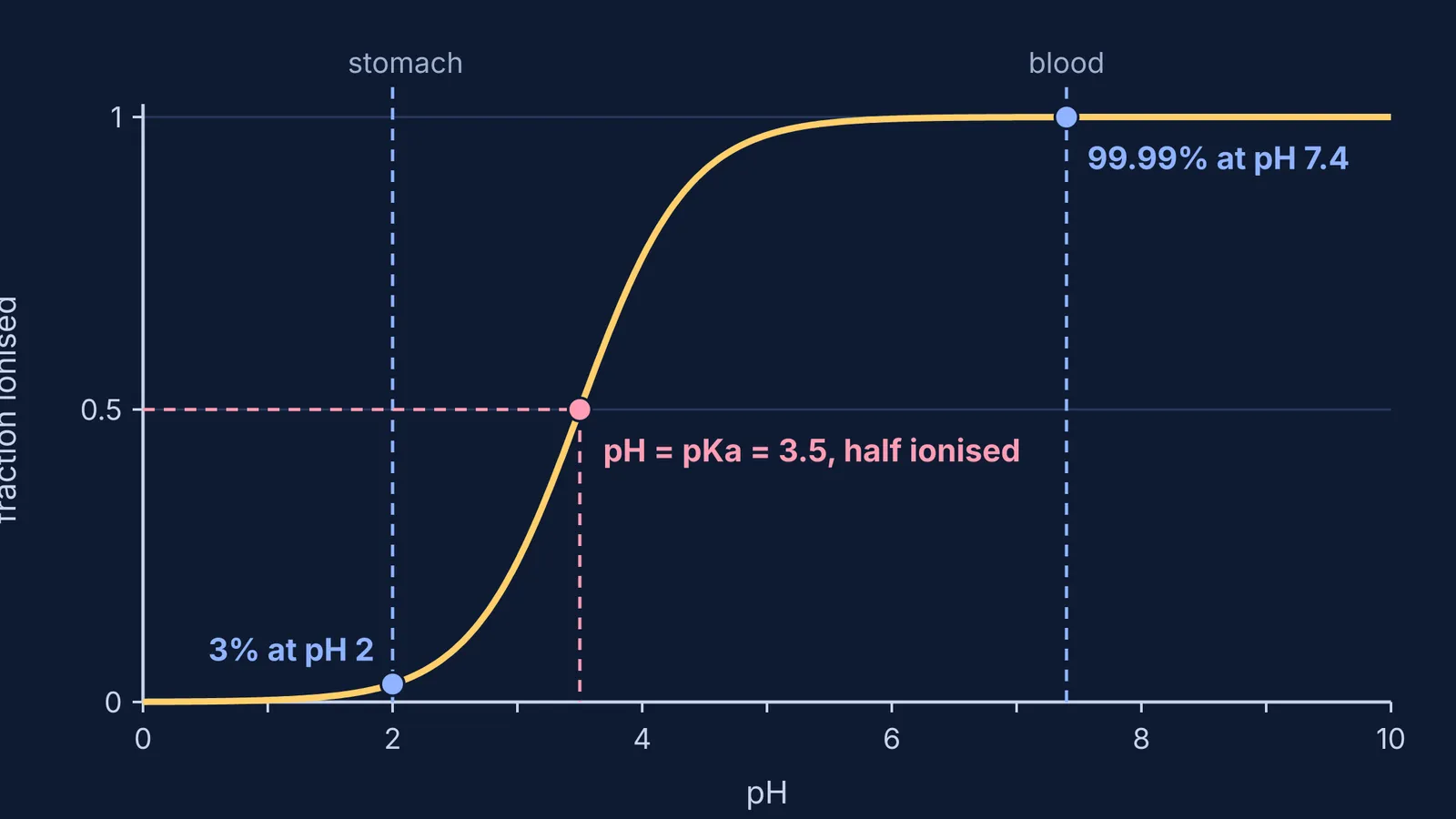
Worked example: how much aspirin is ionised in the stomach and in blood?
Aspirin (acetylsalicylic acid) is a carboxylic acid. Its pKa is quoted between 3.4 and 3.5; we use pKa = 3.5. Take stomach pH as 2 and blood pH as 7.4.
In the stomach (pH 2):
pKa − pH = 3.5 − 2 = 1.5
10^1.5 = 31.6
Fraction ionised = 1/(1 + 31.6) = 1/32.6 = 0.031
So only about 3% is ionised. About 97% is neutral aspirin.
In blood (pH 7.4):
pKa − pH = 3.5 − 7.4 = −3.9
10^(−3.9) = 1.26 × 10⁻⁴
Fraction ionised = 1/(1 + 0.000126) = 0.99987
So more than 99.9% is ionised. The ratio of ionised to neutral aspirin is 10^3.9, about 7900 to 1.
Why does this matter for absorption?
Cell membranes are made of lipids. The neutral molecule passes through them much more easily than the charged ion. In the stomach most aspirin is neutral, so it can cross the stomach lining. Once in blood it becomes almost fully ionised and does not easily cross back.
Be careful not to overstate this. The pH argument explains why aspirin can be absorbed from the stomach. In practice much of it is absorbed in the small intestine, where it is mostly ionised, because the intestine has a far larger surface area. The fraction formula tells you which form dominates; it does not tell you the whole rate.
Worked example: how much of an amine is protonated at pH 7.4?
Take an amine whose conjugate acid has pKa = 10.6, close to the value for methylamine. What fraction is protonated in blood at pH 7.4?
Use the base formula: fraction protonated = 1/(1 + 10^(pH − pKa)).
pH − pKa = 7.4 − 10.6 = −3.2
10^(−3.2) = 6.3 × 10⁻⁴
Fraction protonated = 1/(1 + 0.00063) = 0.99937
So about 99.94% is present as RNH₃⁺. Only about 1 molecule in 1600 is the neutral amine. That small neutral fraction is still the form that crosses membranes.
If you want to practise more of these, the Fermi Problem Library has a step-by-step solver that explains the reasoning behind each step.
Which pKa should you use for blood bicarbonate?
Be careful here. The familiar 20:1 ratio of HCO₃⁻ to dissolved CO₂ in blood comes from pH = 6.1 + log(ratio), so the ratio is 10^(7.4 − 6.1) = 10^1.3 ≈ 20. The 6.1 is an apparent pKa that counts all the dissolved CO₂, not just H₂CO₃. Carbonic acid's own pKa₁ of about 6.35 refers to a different equilibrium; with it you would get about 11:1. Do not mix the two. The full picture is in how the bicarbonate buffer keeps blood pH at 7.4.
Quick checklist
Acid: fraction ionised = 1/(1 + 10^(pKa − pH)).
Base: fraction protonated = 1/(1 + 10^(pH − pKa)), using pKa of BH⁺.
50% at pH = pKa; each pH unit changes the ratio tenfold.
Two pH units from pKa means about 99% in one form.
Use it only when the pH is fixed by a buffer or body fluid.
State the pKa you used when sources differ.
Neutral forms cross membranes; charged forms mostly do not.


