

On this page
When you look at an insulated flask of ice and water, or a sealed bottle of liquid and vapour, nothing appears to move. To the naked eye, the system looks static. Yet at the molecular scale, molecules continuously cross phase boundaries. Understanding these systems is essential for physical chemistry in CBSE, JEE Main, and NEET-UG. Unlike chemical equilibria, where bonds break and form to create new substances, physical equilibria involve changes of state or dissolution while chemical identities remain unchanged.
Why is physical equilibrium called dynamic?
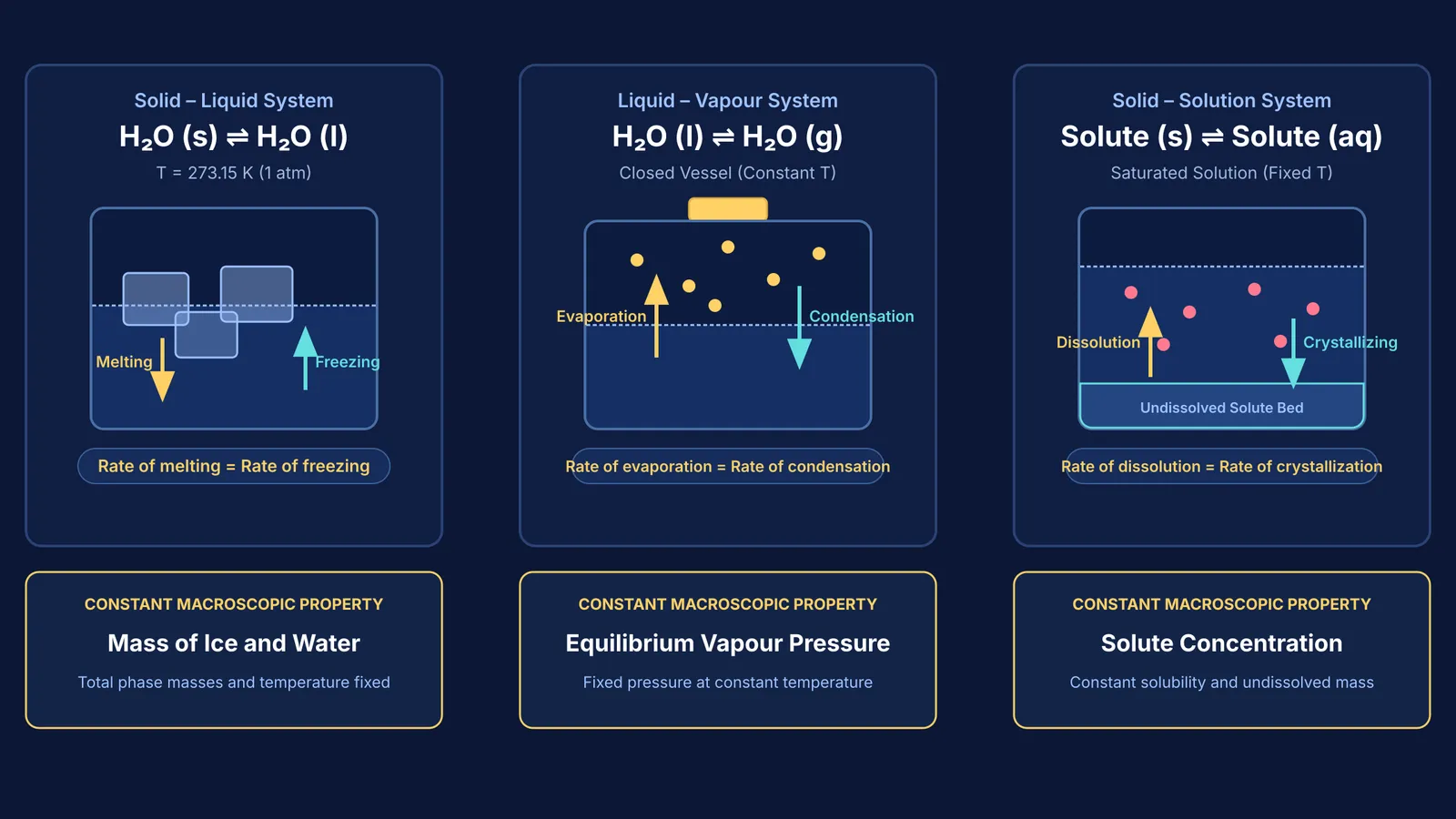
Physical equilibrium is dynamic because opposing physical processes occur simultaneously at identical rates. According to OpenStax Chemistry 2e Section 13.1, equilibrium is never a state of frozen molecular motion; instead, the rate of forward phase change equals the rate of reverse phase change.
Because these rates balance, macroscopic properties remain constant. The mass of each phase, the gas pressure, temperature, and dissolved concentration do not change. If you find these opposing rates difficult to picture, the Fermi Simulation Lab provides interactive simulations for the ideas that are easier to see than to read.
What stays constant in an ice-water mixture at the melting point?
In pure ice and liquid water inside an insulated container at standard atmospheric pressure (1 atm), solid-liquid equilibrium establishes at 273.15 K (0 °C). As explained in OpenStax Chemistry 2e Section 10.3, the normal melting point is the temperature at which solid and liquid phases coexist in dynamic equilibrium: Ice(s) ⇌ Water(l)
At 273.15 K under 1 atm, the rate of melting equals the rate of freezing. Water molecules in the ice lattice break free into the liquid state, while an equal number of liquid molecules lock into the solid grid every second.
What stays constant:
Total mass of ice and liquid water.
Temperature of the mixture, locked at 273.15 K while both phases coexist.
Volume of each phase over time.
Because pure ice and water maintain constant densities, their activities do not alter the equilibrium position, as discussed in our guide on heterogeneous equilibria and pure solids.
Why does water vapour reach a fixed pressure in a closed vessel?
When liquid water is placed in a closed vessel at constant temperature, molecules at the surface with sufficient kinetic energy escape as vapour. As gaseous molecules accumulate, they strike the liquid surface and condense.
Initially, evaporation is faster than condensation. As vapour density rises, condensation speeds up until both rates match: Water(l) ⇌ Water vapour(g)
According to thermodynamic data from the NIST Chemistry WebBook, the vapour exerts a constant value called equilibrium vapour pressure. At water's normal boiling point of 373.17 K, this pressure reaches 1.013 bar (1 atm).
What stays constant:
Equilibrium vapour pressure at that specific temperature.
Total amounts of liquid water and water vapour.
Rates of evaporation and condensation.
How does a saturated solution maintain dissolution equilibrium?
When a solid solute dissolves in water, particles leave the crystal lattice and enter the solvent. As dissolved solute builds up, particles collide with undissolved solid and recrystallise: Solute(solid) ⇌ Solute(dissolved)
According to OpenStax Chemistry 2e Section 11.3, a solution is saturated when solute concentration equals its solubility at that temperature. Adding more solute does not increase concentration; excess solid settles while dynamic exchange continues. For sparingly soluble salts, quantitative limits are determined by the solubility product and precipitation limits. When gases dissolve in liquids, an analogous equilibrium is described by Henry's law and gas solubility.
What stays constant:
Solute concentration (solubility) in the solvent.
Mass of undissolved solid solute.
Solution colour intensity and electrical conductivity.
How can you test if a physical system has reached equilibrium?
To determine whether a physical system has reached dynamic equilibrium, use this four-step diagnostic framework:
Verify closed boundaries: Confirm that matter cannot enter or leave, and that temperature is constant.
Monitor macroscopic properties: Check that pressure, concentration, density, and temperature do not drift.
Test dynamic exchange with tracers: Adding an isotopic tracer reveals that particles continue crossing phase boundaries at equal rates, proving the process has not stopped.
Check reversibility from both directions: Equilibrium must be reachable from either side, such as dissolving solute into solvent or cooling a hot solution until excess solute crystallises out.
To explore these equilibrium principles further, the Fermi Concept Library covers every concept in physics, chemistry, biology, mathematics and computing with its own lesson, while the Fermi Problem Library offers worked problems with a step-by-step solver that explains the reasoning rather than printing an answer.


