

On this page
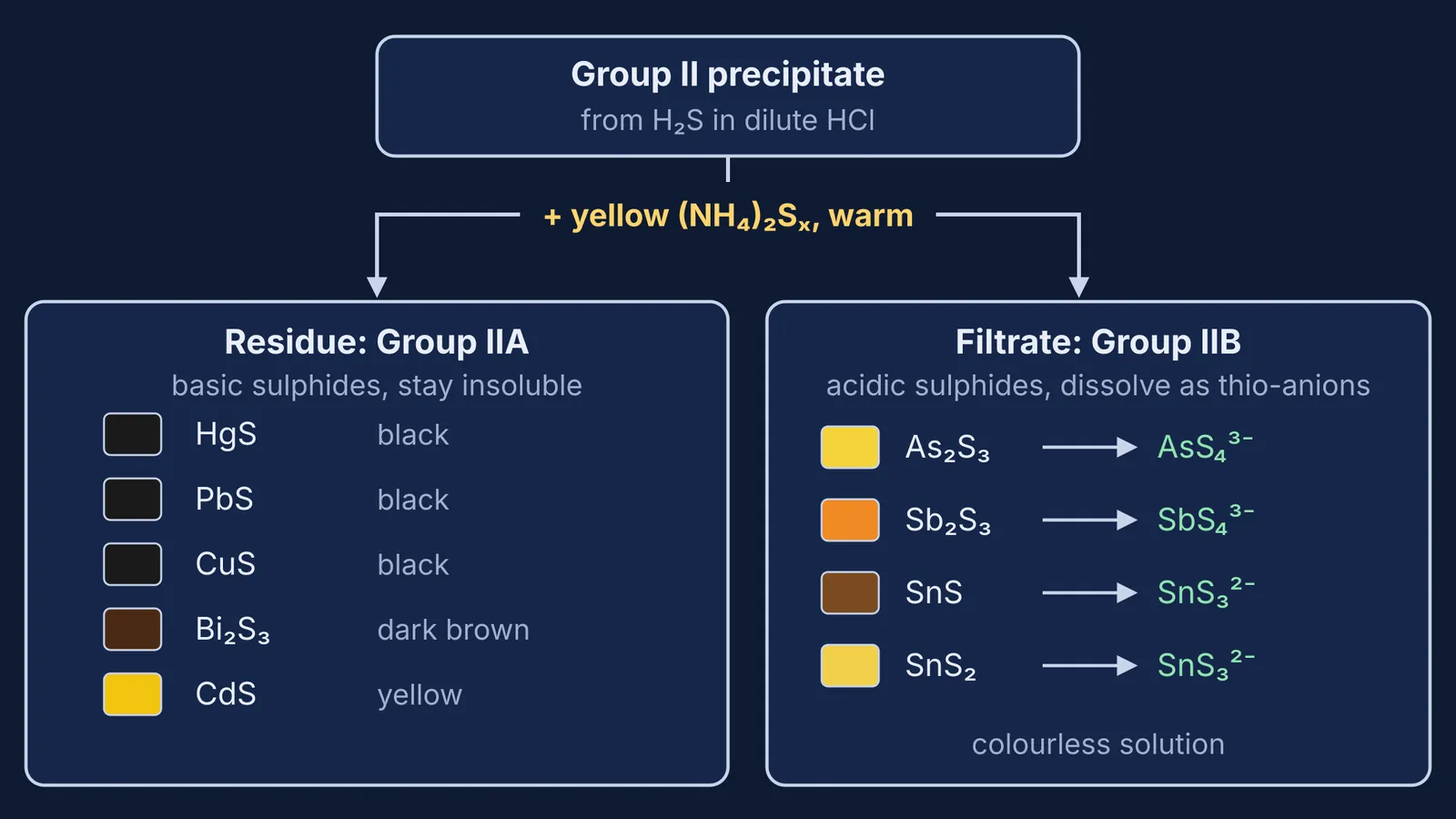
After you pass H₂S through an acidified salt solution, the Group II precipitate can hold up to eight cations: Hg²⁺, Pb²⁺, Bi³⁺, Cu²⁺, Cd²⁺, As³⁺, Sb³⁺ and tin. One reagent splits them into two sub-groups before you test any single ion. That reagent is yellow ammonium sulphide, and the split is called Group IIA (the copper group) and Group IIB (the arsenic group). This post explains what the reagent does, why it has to be the yellow kind, and how to write the answer for a mixture.
Why the sulphides come down in acid in the first place, and why Group IV cations do not, is covered in why H₂S is passed in acidic medium for Group 2. Here we start from the precipitate already on the filter paper.
What is the difference between Group IIA and Group IIB?
The difference is chemical, not just a list to memorise. It is the same difference as between basic and acidic oxides.
Group IIA (copper group): HgS, PbS, Bi₂S₃, CuS, CdS. These are basic sulphides. They do not react with a sulphide ion, so they stay as a residue.
Group IIB (arsenic group): As₂S₃, Sb₂S₃, SnS₂ (and SnS after oxidation). These are acidic sulphides. They behave like "thio-anhydrides" and take up S²⁻ to form soluble thio-salts.
Compare it with oxides. CO₂ is an acidic oxide, so it reacts with O²⁻ to give CO₃²⁻. As₂S₃ is an acidic sulphide, so it reacts with S²⁻ to give a thio-anion. Swap oxygen for sulphur and the logic is the same. The elements in IIB (As, Sb, Sn) sit close to the metal–non-metal border, which is why their sulphides are acidic.
What does yellow ammonium sulphide do to the Group II precipitate?
Yellow ammonium sulphide is ammonium polysulphide, (NH₄)₂Sₓ. It forms when colourless (NH₄)₂S dissolves extra sulphur, and the polysulphide chains give it the yellow colour. Textbooks usually write it as (NH₄)₂S₂ in equations.
It does two jobs at once. It supplies sulphide ions, and it is a mild oxidising agent, because the S–S links can take up electrons. When you warm the Group II precipitate with it:
As₂S₃ + 3(NH₄)₂S₂ → 2(NH₄)₃AsS₄ + S (thioarsenate)
Sb₂S₃ + 3(NH₄)₂S₂ → 2(NH₄)₃SbS₄ + S (thioantimonate)
SnS + (NH₄)₂S₂ → (NH₄)₂SnS₃ (thiostannate)
SnS₂ + (NH₄)₂S → (NH₄)₂SnS₃
Check the first one. As goes from +3 to +5, so two As atoms lose 4 electrons. Of the six S atoms in the three S₂²⁻ ions (each at −1), five go to −2 (gaining 5 electrons) and one goes to 0 (losing 1). The net gain is 4 electrons, which matches. Atoms balance too: 2 As, 9 S, 6 N and 24 H on each side.
The black, brown and yellow IIA sulphides do not react and stay on the filter paper.
Why must the ammonium sulphide be yellow and not colourless?
Because of tin(II). Plain (NH₄)₂S dissolves As₂S₃, Sb₂S₃ and SnS₂, which are all acidic enough. It does not dissolve brown SnS.
The reason is the oxidation state. SnS is the sulphide of Sn(II), which is more basic, like SnO compared with SnO₂. The polysulphide oxidises Sn(II) to Sn(IV), and the Sn(IV) sulphide then dissolves as SnS₃²⁻. Without that oxidation, SnS would stay in the residue with CuS and PbS. You would then report tin as missing and get a muddy brown IIA residue that confuses the copper and bismuth tests.
So the rule is: use yellow ammonium sulphide whenever tin(II) might be present, which in an unknown means always.
How do you get the Group IIB sulphides back from the filtrate?
Acidify the filtrate with dilute HCl. The thio-anions decompose and the sulphides precipitate again, now in their higher oxidation states:
2AsS₄³⁻ + 6H⁺ → As₂S₅ + 3H₂S (yellow)
2SbS₄³⁻ + 6H⁺ → Sb₂S₅ + 3H₂S (orange)
SnS₃²⁻ + 2H⁺ → SnS₂ + H₂S (yellow)
The excess polysulphide also breaks down: Sₓ²⁻ + 2H⁺ → H₂S + (x − 1)S. This gives a milky white or pale yellow deposit of sulphur. That deposit is not a Group IIB sulphide. It is the most common false positive in this step. A true IIB precipitate is a clear yellow or orange and settles as a solid; colloidal sulphur stays cloudy and pale.
How do you analyse a mixture of Cu²⁺ and Sn²⁺? A worked example
Question: A solution contains Cu²⁺ and Sn²⁺. Show how you would separate and confirm both, starting from Group II.
Precipitate Group II. Add dilute HCl (no Group I precipitate forms) and pass H₂S. A dark precipitate forms: Cu²⁺ + H₂S → CuS + 2H⁺ (black) and Sn²⁺ + H₂S → SnS + 2H⁺ (brown).
Split with yellow ammonium sulphide. Wash the precipitate and warm it with yellow (NH₄)₂Sₓ. SnS is oxidised and dissolves as SnS₃²⁻. Black CuS stays behind. Filter.
Residue (IIA): confirm copper. Dissolve the black residue in hot dilute HNO₃: 3CuS + 8HNO₃ → 3Cu(NO₃)₂ + 2NO + 3S + 4H₂O. Add excess NH₃ to part of the blue solution: a deep blue colour of [Cu(NH₃)₄]²⁺ confirms Cu²⁺. To another part, after acidifying with acetic acid, add K₄[Fe(CN)₆]: a chocolate-brown precipitate of Cu₂[Fe(CN)₆] also confirms it. Both tests are explained in confirmatory tests for copper ions with ammonia and ferrocyanide.
Filtrate (IIB): confirm tin. Acidify with dilute HCl. A yellow precipitate of SnS₂ forms. Dissolve it in concentrated HCl, then reduce the Sn(IV) to Sn(II) with iron filings. Add HgCl₂ solution: a white silky precipitate of Hg₂Cl₂ appears, which turns grey as more Sn²⁺ reduces it to mercury. 2HgCl₂ + SnCl₂ → Hg₂Cl₂ + SnCl₄, then Hg₂Cl₂ + SnCl₂ → 2Hg + SnCl₄.
Answer, in one line: CuS stays insoluble in yellow ammonium sulphide (IIA), while SnS is oxidised and dissolves as thiostannate (IIB); each is then confirmed separately.
Notice the electron bookkeeping in step 3. Sulphur goes from −2 to 0 (3 S lose 6 electrons), and nitrogen goes from +5 to +2 (2 N gain 6 electrons). Examiners like asking for this equation.
If you want to practise more salt-analysis flowcharts and check each step, the Fermi Problem Library has a step-by-step solver that explains the reasoning, not just the final ion. For predicting colours before you test, see salt analysis precipitate colours.
What questions do exams ask about the 2A/2B split?
Which sulphide dissolves in yellow ammonium sulphide? As₂S₃, Sb₂S₃, SnS and SnS₂. Not CuS (except slightly), PbS, HgS, Bi₂S₃ or CdS.
Why yellow, not colourless? It oxidises SnS to the Sn(IV) state so it can dissolve.
What is the formula of the soluble species? (NH₄)₃AsS₄, (NH₄)₃SbS₄ and (NH₄)₂SnS₃.
Which yellow sulphide stays in IIA? CdS. Do not confuse it with yellow As₂S₃ or SnS₂, which go to IIB.
Quick checklist
Group IIA: HgS, PbS, Bi₂S₃, CuS, CdS. Basic sulphides, insoluble in (NH₄)₂Sₓ.
Group IIB: As₂S₃, Sb₂S₃, SnS, SnS₂. Acidic sulphides, dissolve as thio-salts.
Yellow (NH₄)₂Sₓ is needed to oxidise Sn(II) to Sn(IV).
Acidify the filtrate to get IIB sulphides back; ignore pale colloidal sulphur.
CdS is yellow but belongs to IIA.
Confirm Cu²⁺ with NH₃ or K₄[Fe(CN)₆], and tin with HgCl₂.


