

On this page
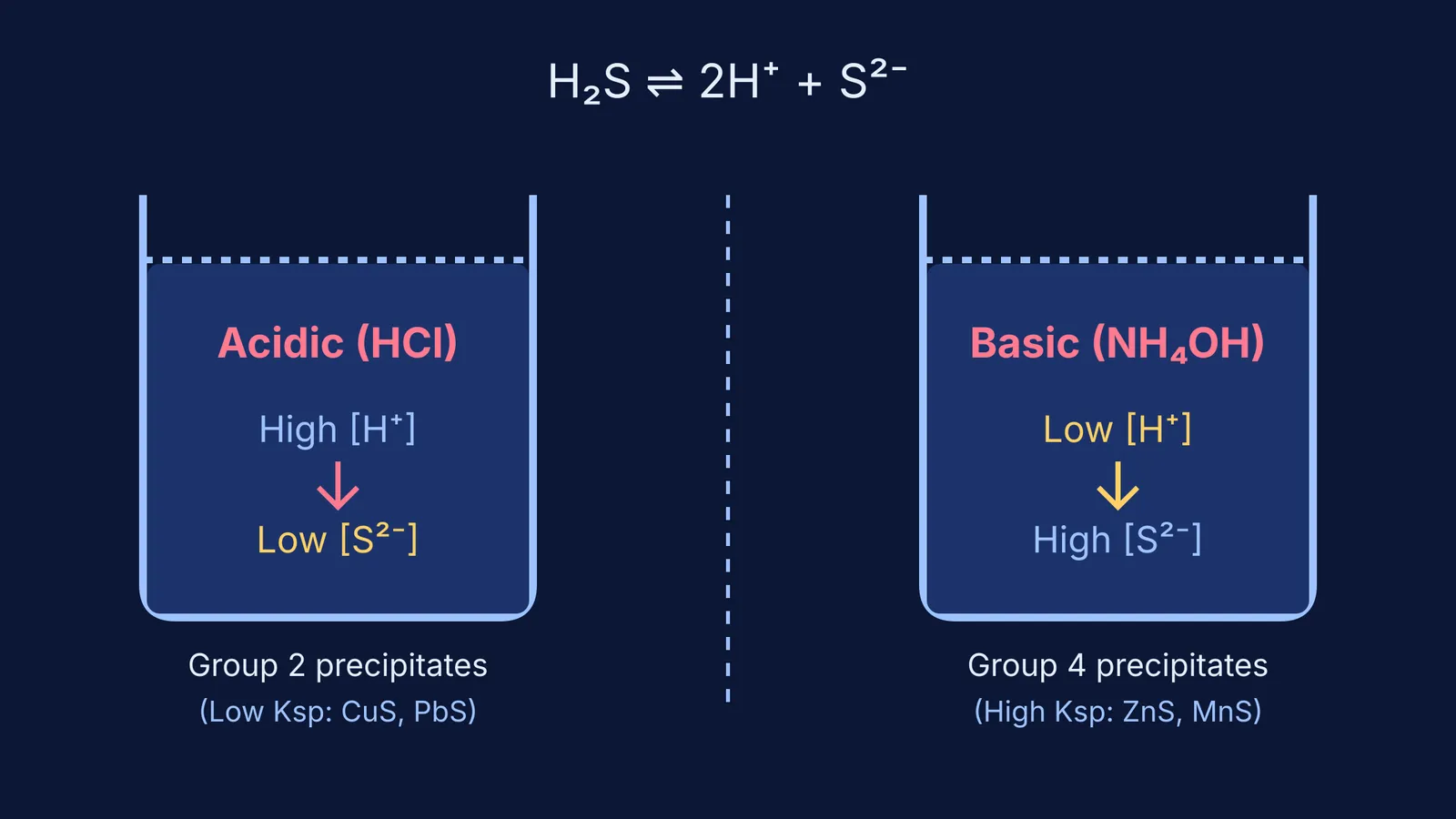
In qualitative inorganic analysis, passing hydrogen sulphide (H₂S) in an acidic medium relies on the common ion effect to keep the sulphide concentration low. This low concentration ensures that only the highly insoluble Group 2 sulphides precipitate, while the more soluble Group 4 cations remain dissolved for later analysis.
What is the common ion effect?
Hydrogen sulphide is a weak diprotic acid. In water, it dissociates slightly to give hydrogen ions (H⁺) and sulphide ions (S²⁻):
H₂S ⇌ 2H⁺ + S²⁻
The common ion effect is a consequence of Le Chatelier's principle. If you add a strong electrolyte that shares an ion with a weak electrolyte, the equilibrium shifts to suppress the dissociation of the weak electrolyte. In salt analysis, we use this effect to strictly control the concentration of S²⁻ ions in the solution [[1]](https://en.wikipedia.org/wiki/Qualitative_inorganic_analysis).
If the S²⁻ concentration is too high, cations from multiple groups will precipitate together, making it impossible to identify them step-by-step. If it is too low, nothing will precipitate.
Why is H₂S passed in acidic medium for Group 2?
Group 2 cations (such as Cu²⁺, Pb²⁺, Hg²⁺, Cd²⁺ and Bi³⁺) form extremely insoluble sulphides. Their solubility product (Ksp) values are very low.
Before passing H₂S for Group 2 analysis, we add dilute hydrochloric acid (HCl). HCl is a strong acid that dissociates completely, flooding the solution with H⁺ ions. Because H⁺ is a common ion in the H₂S equilibrium, this high concentration pushes the H₂S dissociation reaction to the left.
The result is a heavily suppressed ionisation, leaving a very low S²⁻ concentration. However, because Group 2 sulphides have such low solubility products, even this tiny amount of S²⁻ is enough to exceed their Ksp and precipitate them as solids [[1]](https://en.wikipedia.org/wiki/Qualitative_inorganic_analysis).
Group 4 cations (such as Zn²⁺, Mn²⁺, Ni²⁺ and Co²⁺) also form sulphides, but their Ksp values are relatively high. The low sulphide concentration in the acidic medium is not enough to precipitate them, so they remain dissolved and pass safely to the next stage of analysis.
Why use an ammoniacal medium for Group 4?
By the time you reach Group 4, the Group 2 cations have already been filtered out. Now, we want to precipitate the Group 4 cations (Zn²⁺, Mn²⁺, Ni²⁺, Co²⁺) as sulphides. Because these have higher solubility products, they demand a much higher concentration of S²⁻ ions.
To achieve this, the medium is made alkaline by adding ammonium hydroxide (NH₄OH), often buffered with ammonium chloride (NH₄Cl) to a pH of around 9 [[1]](https://en.wikipedia.org/wiki/Qualitative_inorganic_analysis).
The NH₄OH provides hydroxide ions (OH⁻). These immediately react with the H⁺ ions from the H₂S to form water:
H⁺ + OH⁻ ⇌ H₂O
By constantly removing H⁺ from the system, the alkaline medium shifts the H₂S equilibrium forcefully to the right. The H₂S dissociates much more, producing a high concentration of S²⁻ ions. This elevated sulphide level easily exceeds the higher Ksp of Group 4 sulphides, causing them to precipitate as solids.
Using a step-by-step approach to equilibrium
Understanding how Ksp and the common ion effect work together is essential for mastering chemical equilibrium. A common mistake is treating ionic equilibrium as memorised rules rather than a balancing act of concentrations.
If you struggle to set up equilibrium equations or balance Ksp calculations, you can work through the core rules in the Fermi Concept Library. When you tackle numericals on ionic products, the Fermi Problem Library provides a step-by-step solver that explains the reasoning rather than printing an answer, helping you map the shifts in equilibrium step-by-step.
See these related concepts to build your intuition for equilibrium:


