

On this page
In qualitative inorganic salt analysis, identifying copper(II) ions (Cu²⁺) relies on two signature reactions: the formation of an intense deep blue solution upon adding excess ammonia, and a dense chocolate-brown precipitate upon reaction with potassium ferrocyanide. While both tests are standard in laboratory curricula, students often memorize them as isolated colour changes without understanding the underlying coordination chemistry and equilibrium shifts.
Why does excess ammonia turn copper solutions deep blue?
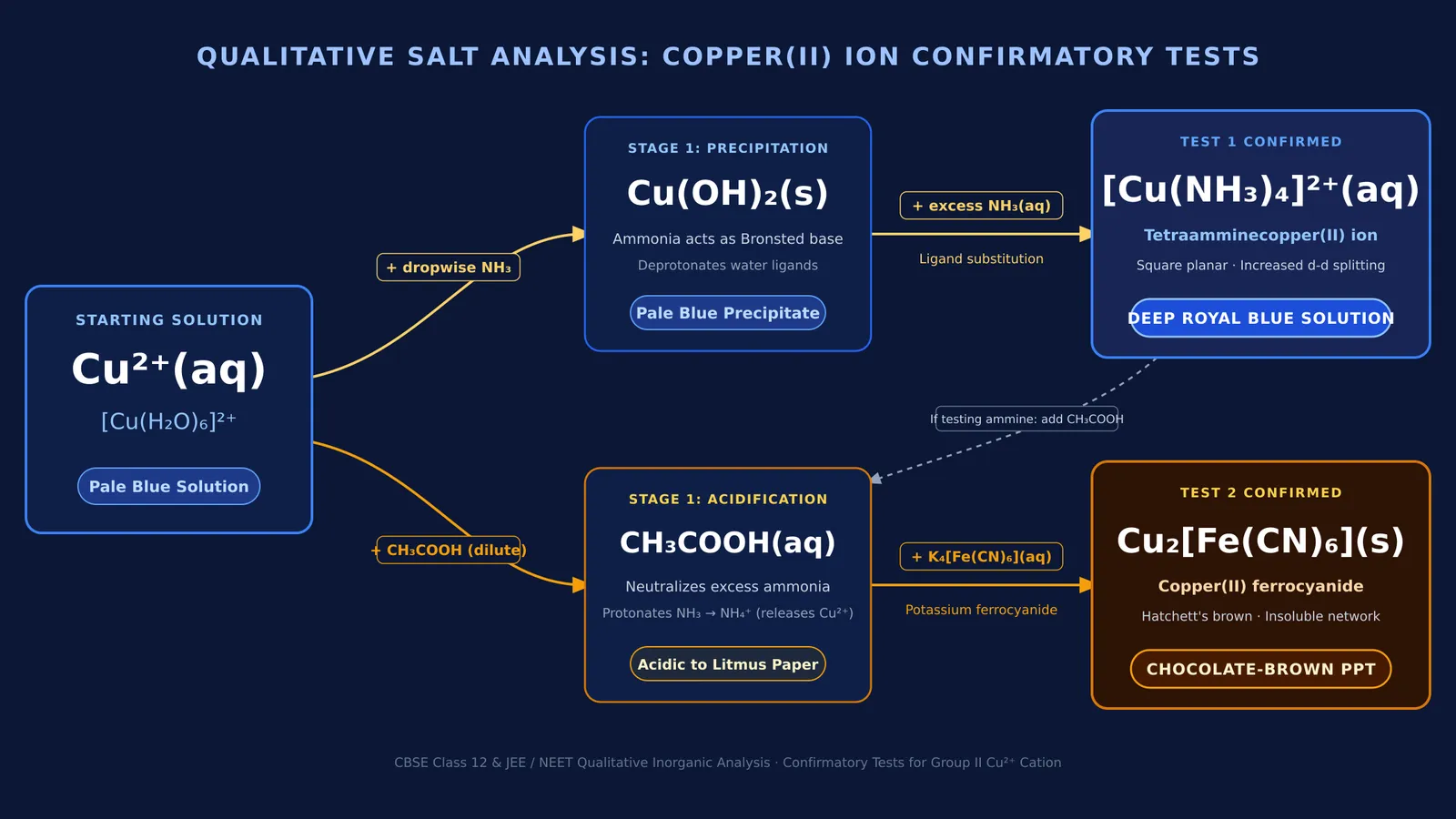
In an aqueous salt solution, copper(II) exists as the pale blue hydrated complex ion hexaaquacopper(II), [Cu(H₂O)₆]²⁺. When you add aqueous ammonia dropwise, ammonia initially functions as a Bronsted-Lowry base. It removes protons from two water ligands surrounding the copper ion, precipitating neutral copper(II) hydroxide as a light blue solid:
Cu²⁺(aq) + 2NH₃(aq) + 2H₂O(l) → Cu(OH)₂(s) + 2NH₄⁺(aq)
When you continue adding aqueous ammonia in excess, ammonia begins acting as a neutral Lewis base ligand rather than a Bronsted-Lowry base. Ammonia is a stronger field ligand than water, and four ammonia molecules coordinate directly with the central copper ion, displacing water ligands and dissolving the precipitate. This produces the soluble tetraamminecopper(II) complex cation, [Cu(NH₃)₄]²⁺, catalogued in PubChem compound CID 61847.
As documented in the Chemguide transition metal series, this ligand substitution changes the crystal field splitting of the metal's 3d orbitals. The energy gap between split d-orbitals increases, shifting light absorption from the red edge into the yellow-orange region of the spectrum and transmitting the deep royal blue colour that defines this confirmatory test. Understanding how valence electrons behave in coordination complexes connects directly with the rules for transition metal ion electron configurations.
The Fermi Concept Library maps every concept in physics, chemistry, biology, mathematics and computing, each with its own lesson and its place in the map.
How does potassium ferrocyanide confirm copper with a chocolate-brown precipitate?
The most sensitive confirmatory test for copper(II) is the addition of potassium ferrocyanide, K₄[Fe(CN)₆], chemically known as potassium hexacyanoferrate(II). When potassium ferrocyanide solution reacts with uncomplexed copper(II) ions in a slightly acidic or neutral solution, a double displacement reaction takes place immediately:
2Cu²⁺(aq) + [Fe(CN)₆]⁴⁻(aq) → Cu₂Fe(CN)₆
The product, copper(II) ferrocyanide, is an insoluble coordination compound catalogued under PubChem compound CID 3081430. Historically known as Hatchett's brown, this solid has an extremely low solubility product in water and appears as a characteristic reddish-brown or chocolate-brown precipitate.
This test provides unambiguous confirmation because other common Group II cations do not produce this colour. For instance, cadmium ions precipitate as white cadmium ferrocyanide, allowing clear visual differentiation. The differing behaviour of transition metal ions compared to closed-shell cations is discussed further in our examination of why zinc is not classified as a typical transition element.
Why must you add acetic acid before potassium ferrocyanide?
A common failure mode in practical salt analysis occurs when students add potassium ferrocyanide directly to the deep blue tetraamminecopper(II) solution. If the solution remains alkaline with excess ammonia, no chocolate-brown precipitate appears, leading to a false-negative result.
Copper(II) ferrocyanide is soluble in excess aqueous ammonia because ammonia competes aggressively for the copper ion to reform the tetraammine complex. Furthermore, free Cu²⁺ ions are sequestered inside the stable [Cu(NH₃)₄]²⁺ complex. To allow the chocolate-brown precipitate to form, you must neutralize the excess ammonia by adding dilute acetic acid (CH₃COOH):
[Cu(NH₃)₄]²⁺(aq) + 4CH₃COOH(aq) → Cu²⁺(aq) + 4NH₄⁺(aq) + 4CH₃COO⁻(aq)
Acetic acid protonates the coordinated ammonia molecules into ammonium ions (NH₄⁺), destroying the ammine complex and releasing free hydrated Cu²⁺ ions into solution. Acetic acid is deliberately chosen over strong mineral acids like nitric acid or hydrochloric acid. Concentrated nitric acid is an oxidizing agent that oxidizes hexacyanoferrate(II) into hexacyanoferrate(III), spoiling the reaction, while strong hydrochloric acid can introduce competing chloro complexes. This balance between weak acids and weak bases illustrates the principles of conjugate acid-base pairs.
In a diagnostic study published in the Journal of Research in Science Teaching, researchers evaluated 915 secondary chemistry students across 11 schools and found test facility indices as low as 0.17 for qualitative analysis items. The study revealed that students frequently treated qualitative analysis as a memorized recipe book, struggling to explain whether an observation was caused by precipitation, acid-base neutralization, or complex ion formation.
The Fermi Problem Library provides worked problems with a step-by-step solver that explains the reasoning rather than printing an answer.
What is the step-by-step lab protocol for copper ion confirmation?
To ensure reliable results during laboratory examinations, follow this sequence:
Divide the acidic solution containing dissolved Group II cations into two portions after dissolving the initial black copper sulfide precipitate in dilute nitric acid.
For the ammonia test: add dilute aqueous ammonia dropwise to the first portion. Note the pale blue precipitate of copper(II) hydroxide. Continue adding ammonia with gentle swirling until the precipitate dissolves completely into an intense, transparent deep royal-blue solution.
For the ferrocyanide test: take the second portion, or take a sample of the deep blue solution and add dilute acetic acid dropwise until blue litmus paper turns red and the deep blue shade softens to pale blue.
Add a few drops of freshly prepared potassium ferrocyanide solution to the acidified mixture.
Observe the immediate formation of the flocculent chocolate-brown precipitate of copper(II) ferrocyanide settling at the base of the test tube.


