

On this page
Before your Class 12 chemistry practical, guess each colour, run the test, then check against the lab manual. Every colour below comes from the NCERT Class 12 laboratory manual, Unit 7: Systematic Qualitative Analysis.
Why do precipitate colours matter in salt analysis?
Qualitative analysis of inorganic salts means identifying the cations and anions present in a salt, and the NCERT manual lists the reactions to watch for, such as a precipitate forming, a change in colour and a gas being given off. The same manual names the two principles behind the whole scheme: the solubility product and the common ion effect. A precipitate forms when the ionic product of a salt exceeds its solubility product; see our salt solubility simulation for saturation, Ksp and the common ion.
In CBSE's 2026-27 chemistry curriculum, salt analysis carries 8 of the 30 practical marks in Class XII, and the syllabus lists 13 cations to identify. A colour is a clue, not proof: every group precipitate is followed by a confirmatory test.
What colour is each cation's precipitate?
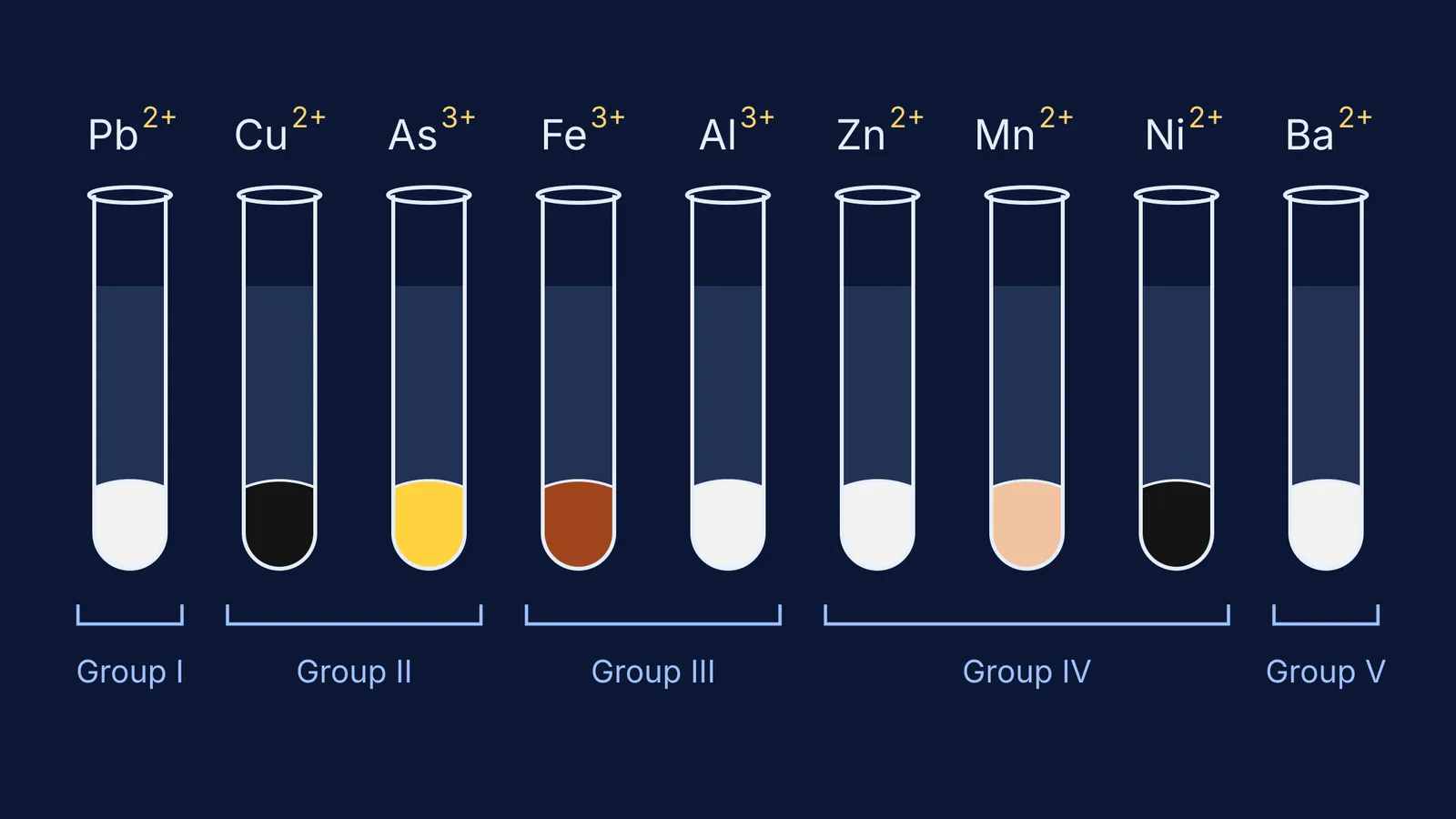
Here is the NCERT scheme as a predict-and-check list, group by group (NCERT lab manual, Tables 7.11 to 7.16):
Group zero, NH₄⁺: heat with NaOH; the ammonia gives a brown precipitate with Nessler's reagent.
Group I, Pb²⁺: white precipitate with dilute HCl. Confirm with potassium iodide (yellow PbI₂) or potassium chromate (yellow PbCrO₄).
Group II, H₂S in dilute HCl: black for Cu²⁺ or Pb²⁺, yellow for As³⁺. Cu²⁺ gives a deep blue solution with excess ammonia, then a chocolate-brown precipitate with potassium ferrocyanide.
Group III, NH₄OH with NH₄Cl: reddish-brown Fe(OH)₃ for Fe³⁺, gelatinous white Al(OH)₃ for Al³⁺. Fe³⁺ confirms as Prussian blue with potassium ferrocyanide and blood red with potassium thiocyanate; Al³⁺ gives a blue floating mass, the lake test.
Group IV, H₂S with NH₄OH: white ZnS for Zn²⁺, flesh-coloured MnS for Mn²⁺, black for Ni²⁺ or Co²⁺. Ni²⁺ gives a bright red precipitate with dimethylglyoxime; Co²⁺ gives a yellow precipitate with potassium nitrite.
Group V, (NH₄)₂CO₃ with NH₄OH: white carbonates of Ba²⁺, Sr²⁺ and Ca²⁺. Then yellow BaCrO₄, white SrSO₄ or white calcium oxalate, with flame colours grassy green (Ba), crimson red (Sr) and brick red (Ca).
Group VI, Mg²⁺: white crystalline magnesium ammonium phosphate with disodium hydrogen phosphate.
How do you predict a precipitate colour before the test?
Rule three columns in your notebook: Prediction, What I saw, What the manual says. Fill the first before each reagent goes in. A worked example with a blue salt, following the NCERT manual.
Look at the salt. Table 7.6 links blue to Cu²⁺ (and lists blue among the colours for Co²⁺ too), so copper is your working guess. Flame test prediction: green with a blue centre.
Add dilute HCl. Prediction: no precipitate, because Pb²⁺ is the only Group I cation in the syllabus.
Pass H₂S. Prediction: black CuS, insoluble in yellow ammonium sulphide, so Group II A.
Boil with dilute nitric acid, then add alcohol and dilute H₂SO₄. Prediction: no white PbSO₄, which rules out lead.
Add excess ammonia. Prediction: a deep blue solution of tetraamminecopper(II).
Acidify with acetic acid and add potassium ferrocyanide. Prediction: chocolate-brown precipitate. Cu²⁺ confirmed.
When a result surprises you, write one line on why before you look it up. For why copper ions are coloured at all, read why transition metal complexes are coloured.
Which virtual lab can you use for salt analysis?
A virtual lab lets you repeat the scheme without using up reagents or handling H₂S, which the NCERT manual flags as toxic. Two to try:
OLabs was built by AmritaCREATE at Amrita Vishwa Vidyapeetham with C-DAC Mumbai and is funded by the Ministry of Electronics and Information Technology; its simulations follow the NCERT and CBSE curriculum for Classes 9 to 12.
LabSim is a laboratory simulator of inorganic qualitative analysis, hosted on the University of Milan's website, in English and Italian.
A 2004 Journal of Chemical Education paper on Virtual ChemLab, a simulation of inorganic qualitative analysis, described the same aim: link theory to lab practice and let students explore and repeat procedures (Woodfield and colleagues, 2004).
Two cautions: screen colours vary, so flesh-coloured or reddish-brown may not match the real tube, and a simulation is rehearsal, not a replacement for your school practical.
For other ideas that are easier to see than to read, the Fermi Simulation Lab has interactive simulations. When a colour makes sense but the chemistry behind it does not, the Fermi Concept Library has a lesson for every concept in chemistry.
A 20-minute plan for the week before your practical
Minutes 0 to 5: without looking, write the predicted colour for six cations from the list above.
Minutes 5 to 15: run two unknown salts in a virtual lab and fill in all three columns.
Minutes 15 to 20: check every mismatch against the NCERT tables and write one why-question for each.
Then take your why-questions into a mock viva with our guide on how to practise a lab viva with AI in physics and chemistry.


