On this page
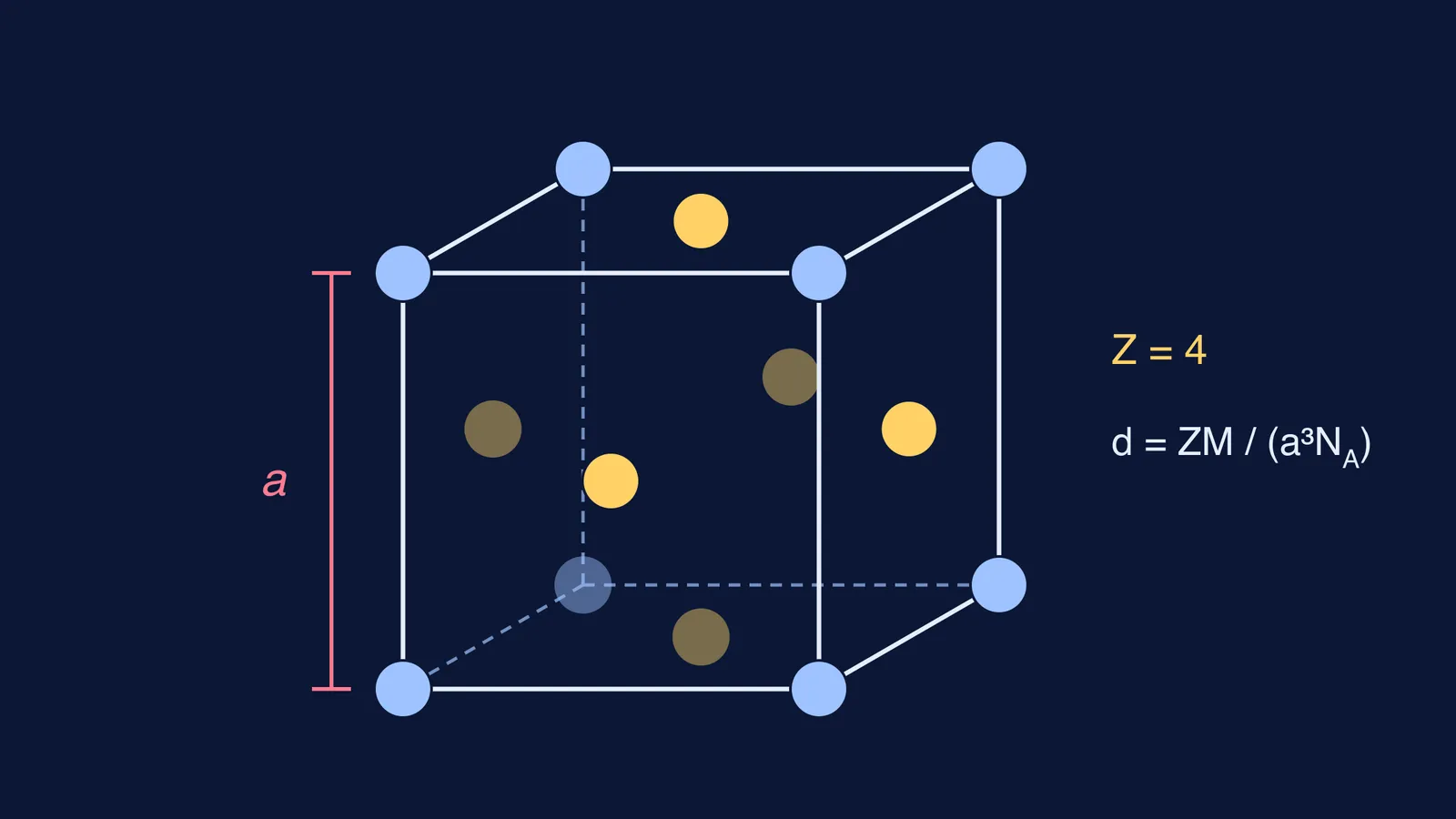
A unit cell is the smallest repeating box of a crystal, so if you know what is inside one box and how big the box is, you know the density of the whole metal. That is all d = ZM/(a³N_A) says. Below we use it twice: forwards, to get copper's density from its edge length, and backwards, to get iron's atomic mass from its density. Both use real measured data.
What does each symbol in d = ZM/(a³N_A) mean?
Density is mass divided by volume, and the formula simply works out both for one unit cell.
Z is the number of atoms that belong to one cell. A corner atom is shared by eight cells and counts as 1/8; a face atom is shared by two cells and counts as 1/2; an atom in the body counts as 1. That gives Z = 1 for simple cubic, Z = 2 for body-centred cubic (bcc) and Z = 4 for face-centred cubic (fcc), as set out in this general chemistry text on crystalline solids.
M is the molar mass in g/mol, so ZM/N_A is the mass of the atoms in one cell in grams.
a is the edge length of the cube, so a³ is the volume of one cell.
N_A is the Avogadro constant, which NIST lists as exactly 6.02214076 × 10²³ mol⁻¹.
Mass of one cell divided by its volume gives d. If you want to see why corner and face atoms are shared the way they are, our post on packing efficiency in fcc, bcc and simple cubic cells draws it out.
How do you find a metal's density from its edge length?
Take copper. It is face-centred cubic (listed as cubic close-packed, the same lattice) with an edge length of 361.49 pm, according to WebElements' copper crystal structure data. Its standard atomic weight is 63.546, from the IUPAC Commission on Isotopic Abundances and Atomic Weights.
Z = 4 (fcc) and M = 63.546 g/mol, so ZM = 254.18 g/mol.
Convert the edge to centimetres: 1 pm = 10⁻¹⁰ cm, so a = 3.6149 × 10⁻⁸ cm.
Cube it: a³ = 4.7238 × 10⁻²³ cm³.
Multiply by N_A: a³N_A = 4.7238 × 10⁻²³ × 6.02214 × 10²³ = 28.447 cm³/mol.
Divide: d = 254.18 / 28.447 = 8.94 g/cm³.
WebElements lists the measured density of solid copper as 8920 kg/m³, which is 8.92 g/cm³. The formula lands within about 0.2% of a real lump of copper.
How do you find atomic mass from density and edge length?
Now run it backwards. Rearranging d = ZM/(a³N_A) gives M = d·a³·N_A / Z. Exam questions often give a density and an edge length and ask you to name the metal.
Iron is body-centred cubic with an edge length of 286.65 pm, according to WebElements' iron crystal structure data, and its solid density is listed as 7874 kg/m³, or 7.874 g/cm³.
Z = 2 (bcc).
a = 286.65 pm = 2.8665 × 10⁻⁸ cm, so a³ = 2.3554 × 10⁻²³ cm³.
a³N_A = 2.3554 × 10⁻²³ × 6.02214 × 10²³ = 14.184 cm³/mol.
Multiply by density: 7.874 × 14.184 = 111.69 g/mol.
Divide by Z: M = 111.69 / 2 = 55.84 g/mol.
The standard atomic weight of iron is 55.845, so the crystal data identify the metal. Forget to divide by Z and you get 111.7, which matches no common metal. A wrong Z doubles or halves the answer.
Where do students lose marks on unit cell density?
Before you write the final number, run through this check:
Is Z right for the lattice? Simple cubic 1, bcc 2, fcc 4. Look for the words body-centred or face-centred.
Is a in centimetres? Density in g/cm³ needs a³ in cm³.
Did you cube the whole number? (3.6149 × 10⁻⁸)³ means cubing 3.6149 and multiplying the exponent by 3.
Is the answer sensible? A density off by a power of ten means a slipped exponent, and an atomic mass should match a real element.
Real crystals are not perfect, and missing or misplaced ions shift the measured density away from the ideal value; our explainer on Schottky and Frenkel defects and density shows how.
If you keep landing on the wrong power of ten, the Fermi Problem Library has worked problems with a step-by-step solver that explains the reasoning rather than printing an answer. For the idea underneath, how atoms are shared between cells, the Fermi Concept Library gives each chemistry concept its own lesson.
Try it yourself: pick any cubic metal, look up its edge length, and see whether your calculated density matches the measured one.