On this page
Make a prediction first. You have two identical crystals of sodium chloride. In the first, a sodium ion and a chloride ion vanish from their sites. In the second, a sodium ion jumps into a gap between other ions. Which crystal is now less dense? Write your answer down, then check it below.
What is the difference between a Schottky and a Frenkel defect?
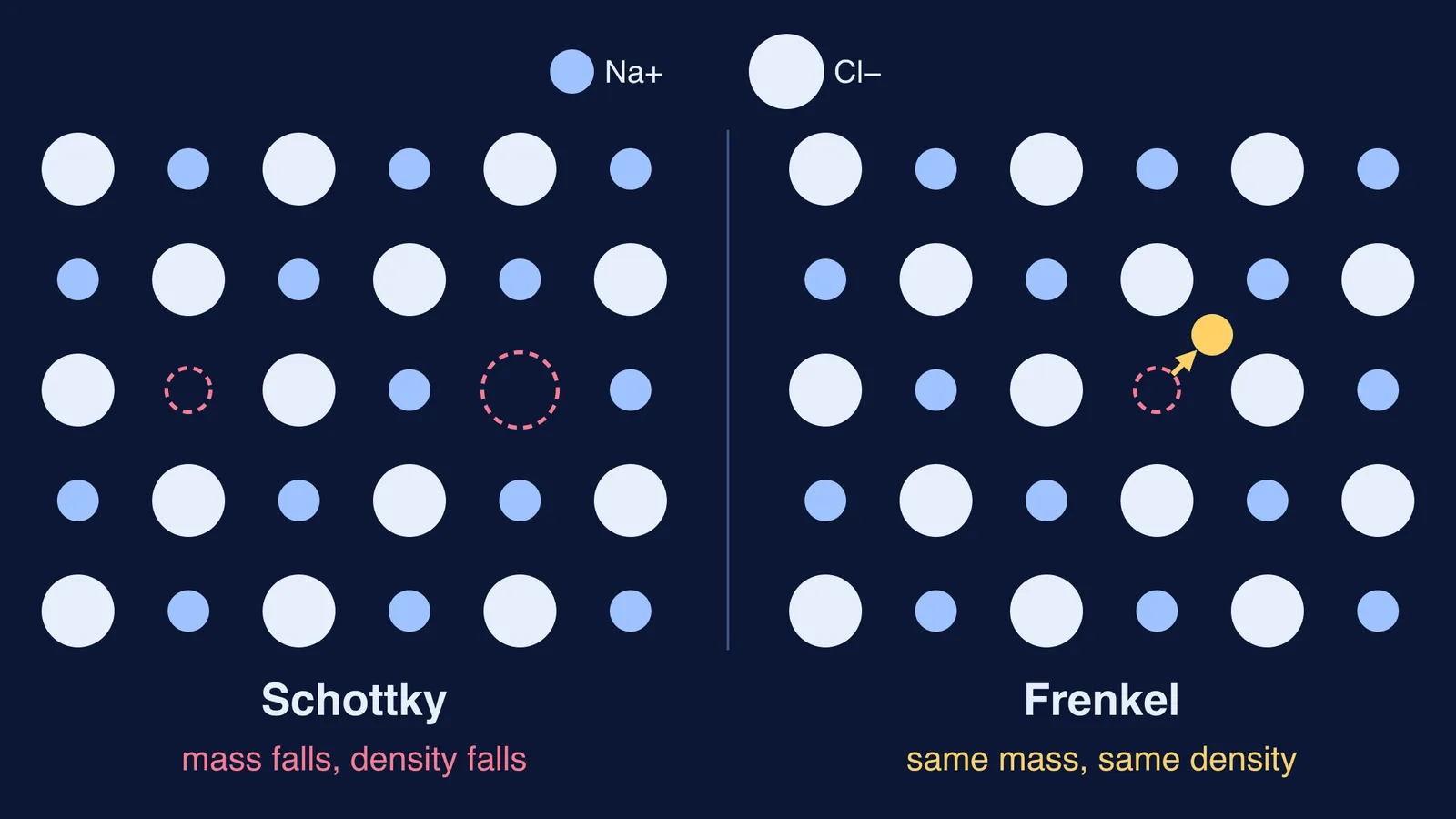
A Schottky defect is a pair of vacancies: a cation and an anion are both missing from their lattice sites, so the crystal stays electrically neutral (Chemistry LibreTexts, Schottky defects/Crystal_Lattices/Lattice_Defects/Schottky_Defects)). For a compound like MX₂, one cation vacancy comes with two anion vacancies, so the charges still balance.
A Frenkel defect is an ion that has left its normal site and sits in an interstitial position, leaving a vacancy behind (Chemistry LibreTexts, Frenkel defect/Crystal_Lattices/Lattice_Defects/Frenkel_Defect)). The ion that moves is usually the cation, because cations are generally smaller than anions and fit into the gaps.
Typical examples: Schottky disorder is seen in NaCl, KCl, KBr, CsCl and AgBr, while Frenkel defects are seen in ZnS, AgCl, AgBr and AgI (Wikipedia, Schottky defect; Wikipedia, Frenkel defect). Notice that AgBr is on both lists, so don't assume a compound can show only one type.
Why does a Schottky defect lower density but a Frenkel defect does not?
Density is mass divided by volume, so ask two questions about each defect: does the same volume of lattice now hold fewer ions, and did the lattice itself change size?
Schottky: a cation and an anion leave their sites. The same volume of lattice holds less mass, so density falls. (In a real crystal the ions end up at the surface, adding sites, so the same mass fills more volume: same answer.)
Frenkel: the ion is still inside the crystal, just in a different place. Mass and volume stay the same, so density is unchanged.
A crystal-growth course on INFLIBNET agrees: Schottky defects reduce density, and Frenkel defects do not affect it (INFLIBNET e-PG Pathshala, Crystal Defects).
Worked example: remove and move ions in a block of rock salt
Rock salt (NaCl) has a cubic unit cell with edge a = 5.640 Å and Z = 4 formula units per cell, according to the AIST crystal structure database (AIST, NaCl structure data). Use density = Z × M / (a³ × N_A).
Molar mass M of NaCl = 22.99 + 35.45 = 58.44 g/mol.
a = 5.640 × 10⁻⁸ cm, so a³ = 1.794 × 10⁻²² cm³.
Density = (4 × 58.44) / (1.794 × 10⁻²² × 6.022 × 10²³) = 233.8 / 108.0 ≈ 2.16 g/cm³. The database lists a calculated density of 2.17 g/cm³, so our arithmetic is on track.
Now build a 2 × 2 × 2 block of unit cells. It holds 8 × 4 = 32 Na⁺ and 32 Cl⁻.
Schottky: remove one Na⁺ and one Cl⁻. The block keeps its size but now has 31 formula units, so density = 2.16 × 31/32 ≈ 2.10 g/cm³, a drop of about 3%.
Frenkel: put the pair back, then move one Na⁺ into a gap. There are still 32 formula units in the same volume, so density stays at 2.16 g/cm³.
Our block exaggerates the effect on purpose. Real defects are far rarer: for a metal with a vacancy-pair formation energy of about 1 eV at 1000 K, the INFLIBNET course estimates a vacancy-pair fraction of about 10⁻⁵ (INFLIBNET e-PG Pathshala, Crystal Defects). Real density drops are tiny, but the direction is the same.
How do you check this in a 3D lattice yourself?
Try this with a ball-and-stick kit or any 3D model of rock salt:
Predict: write "Schottky" or "Frenkel" next to "density falls".
Count the ions in your block and note the number.
Remove one cation and one anion. Count again. Did the box get any smaller?
Restore them, then move one small cation into a gap. Count again.
Explain it aloud in one sentence: "Schottky removes mass from a fixed volume; Frenkel only moves mass inside it."
If you can say step 5 without looking, you are ready for the exam question. For other ideas that are easier to see than to read, the Fermi Simulation Lab has interactive simulations. To see how much space is empty to begin with, read our post on visualising packing efficiency in unit cells.
Is the "Frenkel has no effect" answer exactly true?
For school and entrance exams, yes: that is the standard model. Real crystals are messier, because ions around a vacancy or an interstitial shift slightly. Wikipedia's Frenkel article notes that in close-packed structures the strain around the interstitial ion usually outweighs the contraction at the vacancy, so Frenkel defects can lower density slightly too (Wikipedia, Frenkel defect). Treat this as a talking point, not an exam answer.
For the history, read about Yakov Frenkel and crystal defects. To see why ions hold their sites so tightly, read how charge and size set lattice energy.