

On this page
Most students can say that fcc packs 74 per cent, the figure in OpenStax Chemistry 2e. Fewer can say why. The numbers for simple cubic, body-centred cubic (bcc) and face-centred cubic (fcc) are easy to memorise and easy to swap in an exam. A better approach is to build each cell, predict three things about it, and then check.
Predicting first helps more than just watching. In a 2004 study in the American Journal of Physics, Catherine Crouch, Eric Mazur and colleagues found that students who only watched a classroom demonstration understood the idea no better than students who never saw it. Students who predicted the outcome before watching showed significantly greater understanding.
What is packing efficiency in a unit cell?
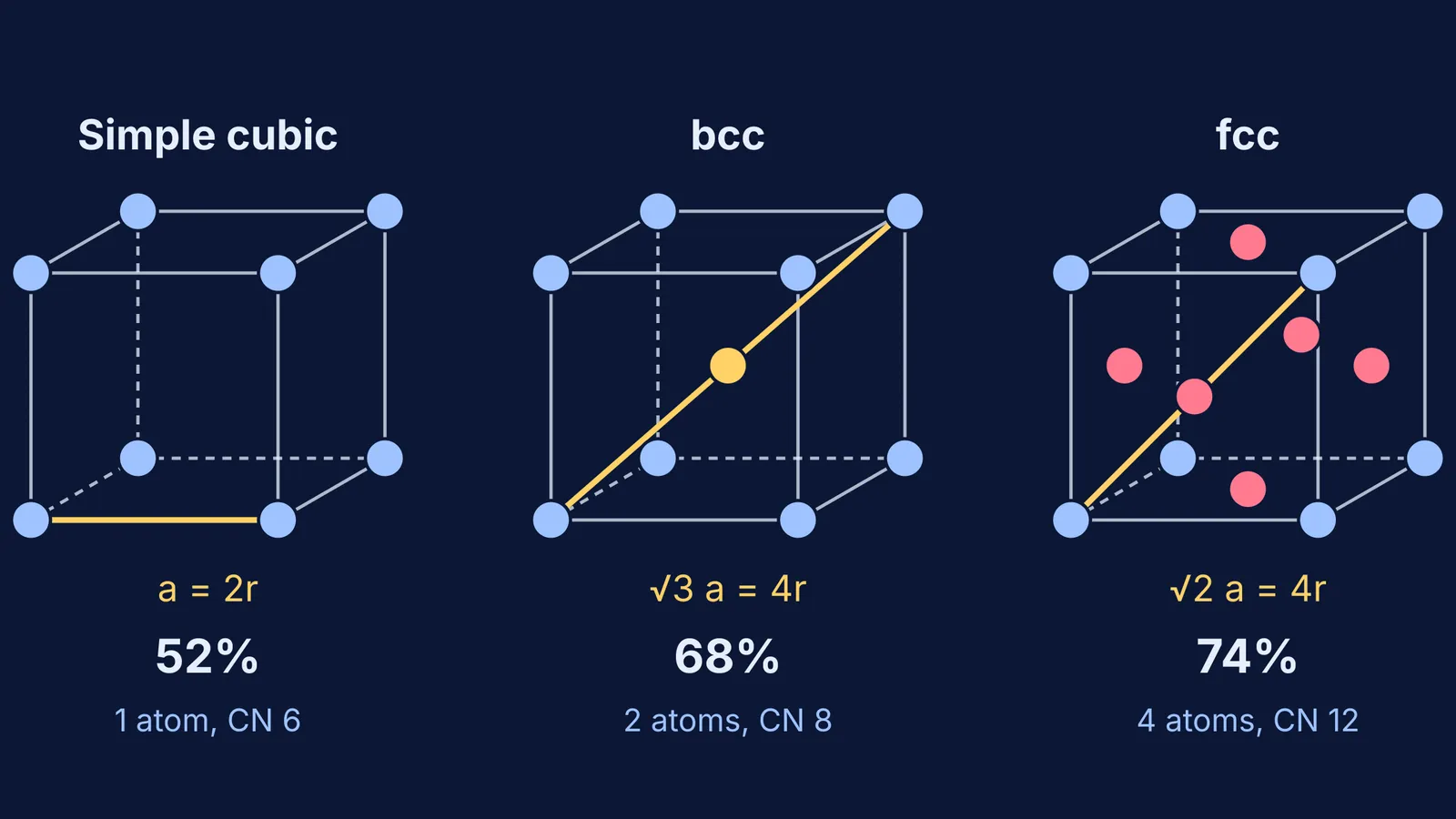
Packing efficiency is the percentage of a unit cell's volume filled by its atoms, treated as hard spheres; OpenStax Chemistry 2e gives about 52% for simple cubic, 68% for bcc and 74% for fcc.
To work it out you need three things:
Z, the number of atoms that belong to one cell
the line along which the atoms touch, which links the edge length a to the atomic radius r
the formula: packing efficiency = (Z × 4/3 πr³) ÷ a³
How do you count atoms per unit cell?
A corner atom is shared by eight cells, so only one-eighth of it belongs to any one cell; an atom on a face counts as one-half, and an atom in the body counts as one whole atom, as OpenStax sets out.
Simple cubic: 8 corners × 1/8 = 1 atom
bcc: 8 × 1/8 + 1 body atom = 2 atoms
fcc: 8 × 1/8 + 6 faces × 1/2 = 4 atoms
The coordination number (CN) is the number of nearest neighbours touching one atom. For fcc, picture the atom in the centre of the bottom face. It touches the 4 corners of that face, the 4 face-centre atoms just above it, and 4 more in the cell below. That makes 12.
Predict first: a four-step build
Write each guess down first.
Draw a cube with an atom on each corner only. Guess Z, the CN, and whether the atoms fill more or less than half the box.
Add one atom at the centre. That gives bcc. With two atoms instead of one, guess the new packing efficiency.
Take the centre atom away and put one on each face. That gives fcc. Guess whether it packs more or less tightly than bcc.
Work through the numbers below and mark your guesses.
If the 3D picture will not form, rotate a model. The Fermi Simulation Lab has interactive simulations for ideas that are easier to see than to read.
How do you get 52, 68 and 74 per cent?
Simple cubic, where atoms touch along the edge. Two corner atoms meet along each edge, so a = 2r and a³ = 8r³. Packing efficiency = (1 × 4/3 πr³) ÷ 8r³ = π/6 ≈ 0.524, about 52%, and the CN is 6, matching OpenStax, which names polonium as the only simple cubic metal.
bcc, where atoms touch along the body diagonal. The body diagonal runs corner, centre, corner and is √3a long, so √3a = 4r and a = 4r/√3. Packing efficiency = (2 × 4/3 πr³) ÷ (4r/√3)³ = √3π/8 ≈ 0.680, about 68%, with a CN of 8; OpenStax lists potassium, tungsten and iron at room temperature among bcc metals.
fcc, where atoms touch along the face diagonal. The face diagonal runs corner, face centre, corner, so √2a = 4r and a = 2√2r. Packing efficiency = (4 × 4/3 πr³) ÷ (2√2r)³ = π/(3√2) ≈ 0.740, about 74%, with a CN of 12; copper, aluminium and lead crystallise in this cubic closest-packed structure, per OpenStax.
Why does fcc pack more tightly than bcc?
Step 2 is the easy one to get wrong: the centre atom pushes the corners apart. The cell grows from a = 2r to about 2.31r, so its volume grows by about 1.54 times. You get twice the atoms in 1.54 times the space, so 52% rises to 68%, not 104%. In fcc the cell grows to about 2.83r, so its volume is about 2.83 times that of the simple cubic cell, but it holds four atoms. That is why it reaches 74%. The end values match OpenStax.
Hexagonal close packing also fills 74% of space with a CN of 12, and cubic close packing is listed with the same values as fcc, according to LibreTexts on closest packed structures.
If you get stuck mid-calculation, Fermi's AI tutor can draw the figure and check your understanding as you work.
Read what studies found on simulations versus static diagrams, or practise with chemistry tools for seeing molecules in 3D. To see how X-rays reveal these arrangements, read about Lawrence Bragg and the X-ray law that maps atoms in crystals.
Tonight, draw the three cubes from memory, write your guesses beside each, and only then check them against 52, 68 and 74.


