

On this page
Most textbook pictures of a crystal show every ion sitting neatly in its place. Yakov Frenkel, a Soviet physicist, asked what happens when one of them doesn't. He was born in Rostov-on-Don in 1894, worked at the Physico-Technical Institute in Leningrad from 1921, and died in Leningrad in 1952, according to his Wikipedia biography. The idea that carries his name is simple: an ion can leave its site and squeeze into a gap between its neighbours.
What did Yakov Frenkel propose in 1926?
Frenkel's paper "Über die Wärmebewegung in festen und flüssigen Körpern" (On heat motion in solid and liquid bodies) appeared in Zeitschrift für Physik, volume 35, in August 1926, according to its Crossref record.
In his 1926 research on the molecular theory of the condensed state, he introduced the notion of a hole in a crystal, three years before Paul Dirac proposed his Dirac sea, as his biography notes. H. Föll's lecture notes on defects put it more strongly: the discussion of this defect in silver chloride in 1926 by Frenkel "more or less introduced the concepts of point defects in crystals to science" (Föll, University of Kiel).
What is a Frenkel defect, exactly?
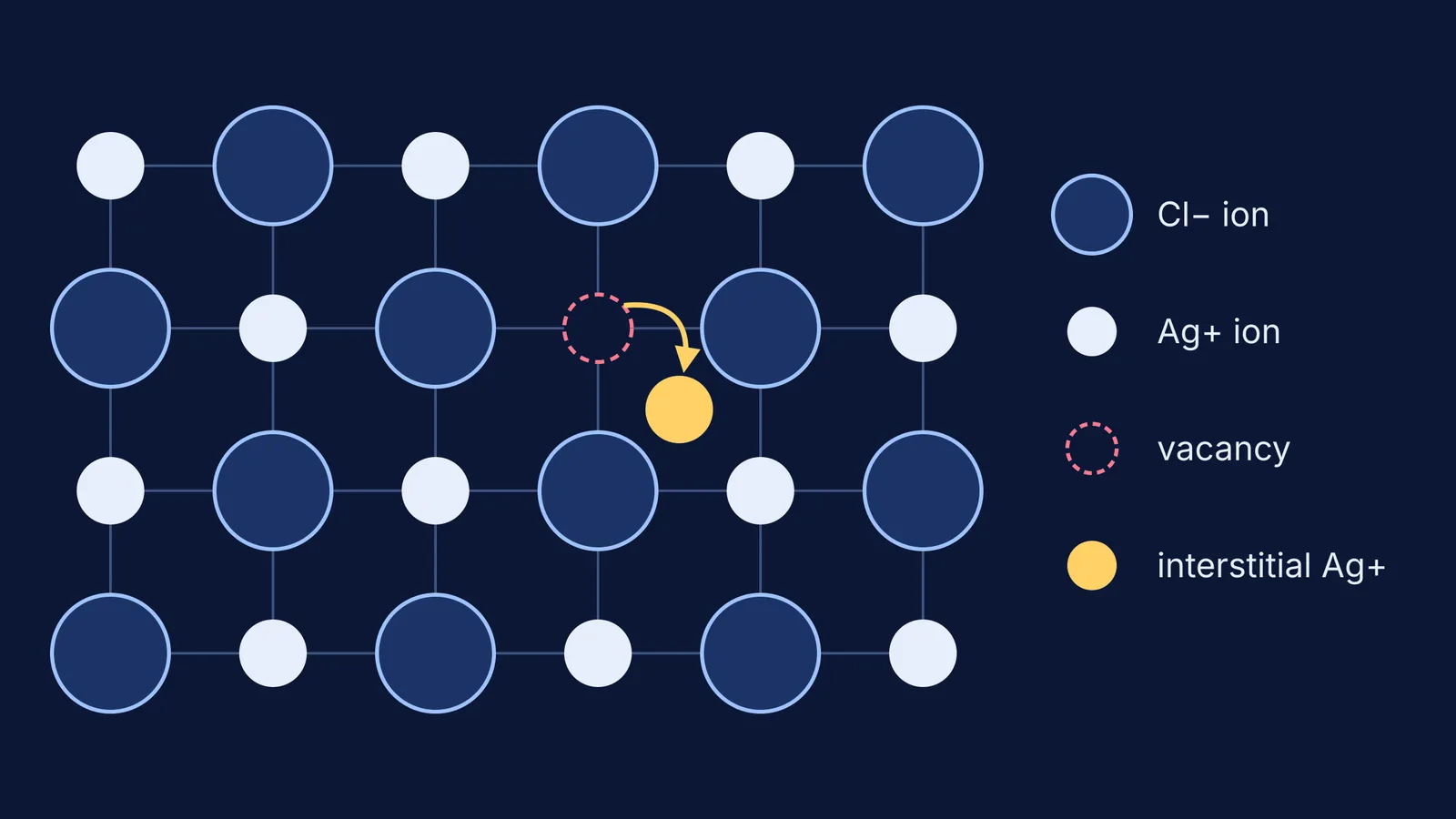
A Frenkel defect is a point defect in which an atom or smaller ion, usually a cation, leaves its place in the structure, creating a vacancy, and lodges in a nearby location as an interstitial (Frenkel defect, Wikipedia).
Each moved ion makes one vacancy and one interstitial, so the overall formula of the compound does not change: like a Schottky defect, it is a stoichiometric defect. The same source lists zinc sulfide, silver chloride, silver bromide and silver iodide as examples, because the Zn2+ and Ag+ ions are comparatively small (Wikipedia).
If the gaps themselves feel fuzzy, it helps to revisit how ions are arranged in the first place: our post on how Auguste Bravais found the 14 crystal lattices is a good refresher.
How is a Frenkel defect different from a Schottky defect?
In a Schottky defect, cation and anion sites are left empty in a stoichiometric ratio, so the crystal keeps its charge balance with missing ions rather than moved ones (Schottky defect, Wikipedia). Sodium chloride, potassium chloride and caesium chloride are the usual examples, and silver bromide shows both kinds (Wikipedia).
Use this checklist when a question asks you to classify a defect:
Did any ion leave the crystal entirely? If a cation and an anion are both missing, think Schottky.
Did an ion just move inside the crystal, from a site to a gap? That is Frenkel.
Are the two ions very different in size, as Ag+ and Cl- are? Frenkel is likely, because the small ion can fit in a gap.
Are the two ions similar in size, as in NaCl or KCl? Schottky is the usual answer.
Asked about density? Schottky lowers it. For Frenkel, the school answer is "no change", because no mass leaves.
In real close-packed crystals, though, the strain around a squeezed-in interstitial typically expands the lattice more than the vacancy shrinks it, so density can fall (Wikipedia). Write the textbook answer in an exam, and keep the nuance for interviews and olympiads.
Worked example: counting a Frenkel defect in AgCl
Imagine a tiny silver chloride crystal with 1,000 Ag+ ions and 1,000 Cl- ions, all on their sites. Now let 5 Ag+ ions hop into gaps.
Ag+ ions on proper sites: 995. Ag+ ions in gaps: 5. Total Ag+: still 1,000.
Cl- ions: 1,000, untouched.
Vacancies: 5. Interstitials: 5. So there are 5 Frenkel defects.
Formula: still AgCl, and the total charge is still zero.
Mass: unchanged, so in the textbook model the density is unchanged.
Compare a sodium chloride crystal of the same size with 5 Schottky defects. Now 5 Na+ and 5 Cl- ions are gone, leaving 995 of each. The formula is still NaCl, but 0.5% of the mass has left. If the volume stays the same, as the textbook model assumes, the density is about 0.5% lower, which is why Schottky defects lower density (Schottky defect, Wikipedia).
For the energy side of why some ions sit more tightly than others, see how ion charge and size decide the lattice energy of a crystal.
Is the Frenkel defect still in the Class 12 syllabus?
The CBSE Chemistry curriculum for 2026-27 lists 10 Class XII theory units, starting with Solutions, and Solid State is not one of them. The current NCERT Class 12 Chemistry Part I also opens with Solutions. You may still meet Frenkel and Schottky defects in older question papers, some reference books and university chemistry. For any exam, check the current official syllabus.
The Fermi Simulation Lab has interactive simulations for ideas that are easier to see than to read, and the Fermi Concept Library gives every chemistry concept its own lesson and its place in the map.
Next, see how ions behave once the lattice breaks down completely: why molten salt conducts electricity but solid salt does not.


