

On this page
Every crystal, from a grain of table salt to the silicon in your phone, is built by repeating one small box of atoms in three directions. How many truly different ways can points repeat like that? Only 14, and the person who gave the rigorous proof was the French physicist Auguste Bravais.
Who was Auguste Bravais?
Bravais was born in Annonay, France, on 23 August 1811 and died in Le Chesnay on 30 March 1863, according to the Mineralogical Record's bio-bibliography of Bravais. The entry records that he entered the École Polytechnique in 1829, was assigned to map the coast of Algeria in 1832, and worked in Norwegian Lapland from 1838 to 1839, observing astronomy, weather and the Earth's magnetism. In 1845 he became professor of physics at the École Polytechnique, and he grew interested in symmetry and regular groupings of points.
How did Bravais find the 14 crystal lattices?
The same Mineralogical Record entry says that beginning in 1848 Bravais wrote a series of papers on the figures formed by points distributed regularly in space. His memoir on the subject filled pages 1 to 128 of the Journal de l'École Polytechnique in 1850, as the University of Illinois X-ray crystallography exhibit notes. A Bravais lattice is an infinite array of points made by repeating fixed steps, so that the pattern looks exactly the same from every point (Bravais lattice, Wikipedia).
The Illinois exhibit says Bravais showed that his 14 lattices fall into seven types of symmetry, which matched the seven crystal systems already recognised. You can rebuild the logic of the count in three steps, using today's textbook method:
Start with the seven box shapes (lattice systems): cubic, tetragonal, orthorhombic, monoclinic, triclinic, hexagonal and rhombohedral.
Try adding extra points to each box: none (primitive, P), one in the centre of two opposite faces (base-centred, C), one in the body centre (I), or one in every face centre (F).
Throw out every candidate that turns out to be a lattice you already have, described with a needlessly big box.
What survives is three cubic, two tetragonal, four orthorhombic, two monoclinic and one each of triclinic, hexagonal and rhombohedral, which adds up to 14 (Bravais lattice, Wikipedia). Read as a string, 3-2-4-2-1-1-1 is an easy way to remember it.
Bravais was not the first to try. The German-born physicist Moritz Frankenheim had concluded there were no more than 15 lattice types, and Bravais later corrected the number to 14 because Frankenheim had counted one type twice (Illinois exhibit on Frankenheim). The Bravais page of the same exhibit adds that historians later found earlier work on the result by Frankenheim and Johann Hessel, but credits Bravais with a rigorous proof and with bringing it to the attention of the scientific community.
Why is there no base-centred tetragonal lattice?
You can answer this with a pencil. A tetragonal box has a square base of side a and a different height c, with all angles 90 degrees.
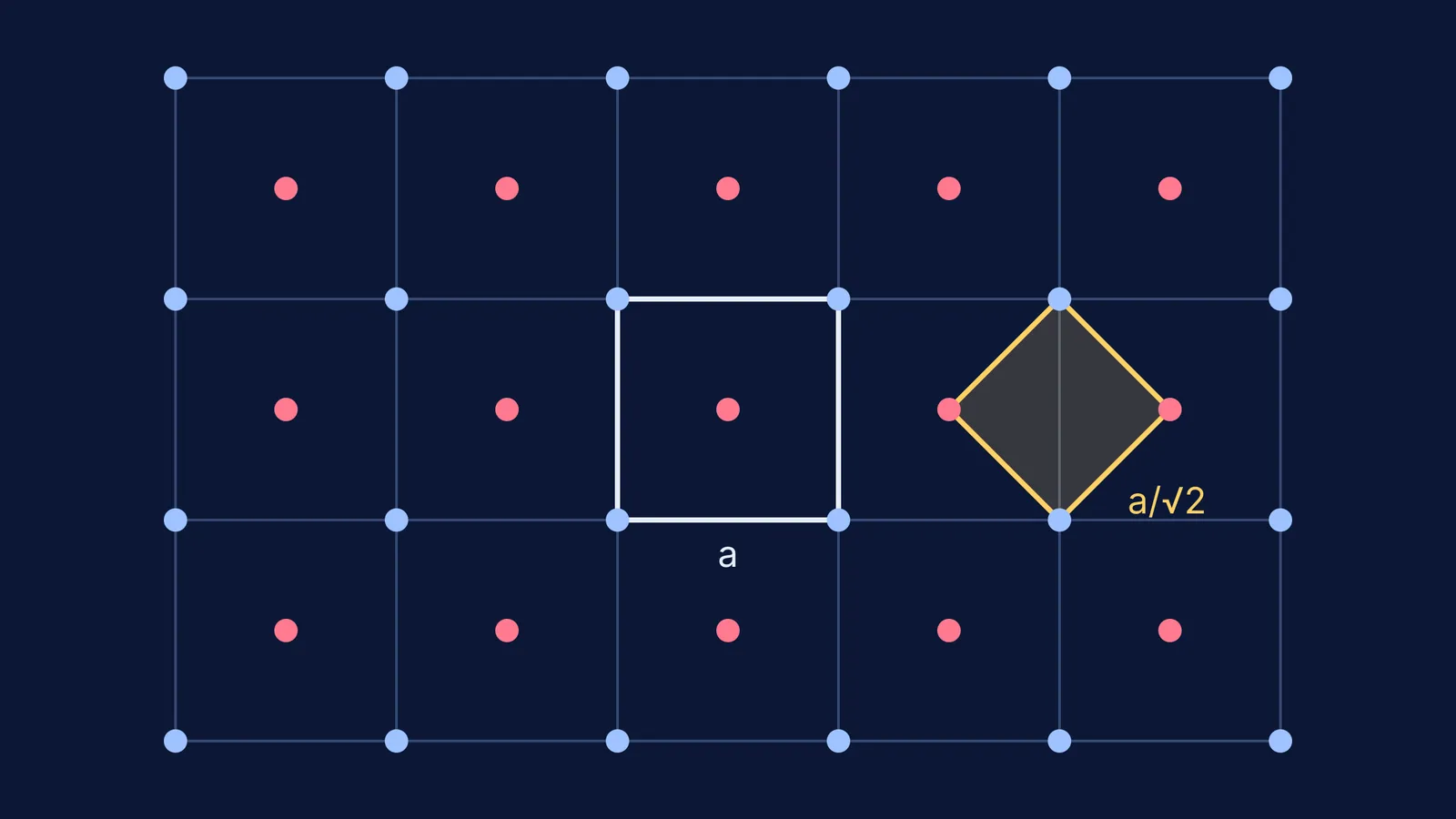
Put an extra point at the centre of the top and bottom faces. Looking down from above, you now see a grid of squares of side a with a dot at every corner and every centre.
Measure from a corner to the nearest centre: the distance is the square root of (a/2)² + (a/2)², which is a/√2.
Join corner, centre, next corner, next centre. You get a square of side a/√2, turned 45 degrees, with dots only at its corners.
The layers sit straight above one another at height c, so the new box is a/√2 by a/√2 by c with right angles everywhere: an ordinary primitive tetragonal box, holding half the volume of the old one.
So the "new" lattice is primitive tetragonal in disguise, which is why it is left out (Tetragonal crystal system, Wikipedia). The same page notes that face-centred tetragonal is likewise just body-centred tetragonal with a smaller box.
If the 45-degree turn is hard to hold in your head, the Fermi Simulation Lab is built for interactive simulations of ideas that are easier to see than to read.
Is the solid state chapter still in Class 12?
For CBSE, not right now. The CBSE 2025-26 senior secondary chemistry curriculum lists ten Class XII theory units, from Solutions to Biomolecules, and The Solid State is not one of them. Other boards and exams set their own syllabi, so check the current official syllabus for yours rather than an old guide.
Lattices matter beyond one chapter. They are what X-rays scatter from in Max von Laue's crystal diffraction experiment and in Lawrence Bragg's law for mapping atoms, and Dan Shechtman's quasicrystals show what happens when a real solid refuses to repeat the usual way.
If unit cells or crystal systems still feel loose, the Fermi Concept Library gives each concept in physics, chemistry, biology, mathematics and computing its own lesson. Then try the next step yourself: show why face-centred tetragonal collapses into body-centred.


