

On this page
Every crystal, students were taught, is a pattern that repeats in all directions, like tiles on a floor. In 1982 an Israeli materials scientist looked at a metal alloy and saw a pattern that broke that rule. He was ridiculed for it, and he turned out to be right. This post covers what Dan Shechtman saw, why it was considered impossible, a worked example of the maths behind the rule, and what his story says about evidence.
Who is Dan Shechtman?
His Nobel Prize facts page gives his birth as 24 January 1941 in Tel Aviv. He earned his PhD in materials science at the Technion – Israel Institute of Technology in Haifa in 1972 and has been associated with the Technion since. He made the discovery while working in the United States in the early 1980s. He received the 2011 Nobel Prize in Chemistry alone, "for the discovery of quasicrystals".
What did he see on 8 April 1982?
The Nobel Committee's popular information tells the story. Shechtman had rapidly chilled a molten mix of aluminium and manganese and put it in an electron microscope. The diffraction pattern showed concentric circles, each made of ten bright dots at equal distances. Turning the picture by a tenth of a circle, 36 degrees, gave the same pattern. In his notebook he wrote "10 Fold???".
He checked whether he was seeing a twin crystal, two crystals grown together, which can make odd patterns. He found no sign of one. By rotating the sample, he showed that the crystal itself had fivefold symmetry, which was just as forbidden.
Why did other scientists say it was impossible?
Crystals had been defined by repetition. The popular information explains that patterns with threefold, fourfold and sixfold symmetry can repeat to fill space, but a fivefold pattern cannot: some distances between atoms come out shorter than others.
The reaction was harsh. According to the press release, he was asked to leave his research group while defending his findings. The head of his laboratory handed him a crystallography textbook. One of his fiercest critics was Linus Pauling, who had won two Nobel Prizes (you can read about Pauling's work on the chemical bond).
He did not give up. With Ilan Blech, John Cahn and Denis Gratias he published Metallic phase with long-range orientational order and no translational symmetry in Physical Review Letters in November 1984. Five weeks later Dov Levine and Paul Steinhardt published Quasicrystals: a new class of ordered structures, which gave the materials their name.
Worked example: why a repeating pattern cannot have fivefold symmetry
There is a short proof using Class 11 trigonometry. If a repeating lattice is unchanged by a rotation of 360°/n, then 2cos(360°/n) must be a whole number. (The reason: written in coordinates along the lattice's own directions, the rotation's entries are all integers, and their diagonal sum equals 2cos of the angle.)
Test each n:
n = 2: 2cos 180° = −2, a whole number. Allowed.
n = 3: 2cos 120° = −1. Allowed.
n = 4: 2cos 90° = 0. Allowed.
n = 6: 2cos 60° = 1. Allowed.
n = 5: 2cos 72° ≈ 2 × 0.309 = 0.618. Not a whole number. Forbidden.
n = 10: 2cos 36° ≈ 2 × 0.809 = 1.618. Also forbidden.
So a repeating crystal can only have 1, 2, 3, 4 or 6-fold rotations. Shechtman's tenfold pattern meant his material could not be a repeating crystal.
Notice the number 1.618. The popular information explains that the golden ratio, about 1.618, keeps appearing in quasicrystals, for example in ratios of distances between atoms. You can reach it with the Fibonacci sequence: 144 ÷ 89 ≈ 1.6180.
Common mistakes:
Mixing up the pattern and the crystal. A tenfold diffraction pattern came from a crystal with fivefold symmetry.
Thinking "not repeating" means "random". Glass is disordered. A quasicrystal is ordered.
Forgetting the sign of cosine. cos 120° is negative; −1 still counts as a whole number.
What changed because of him?
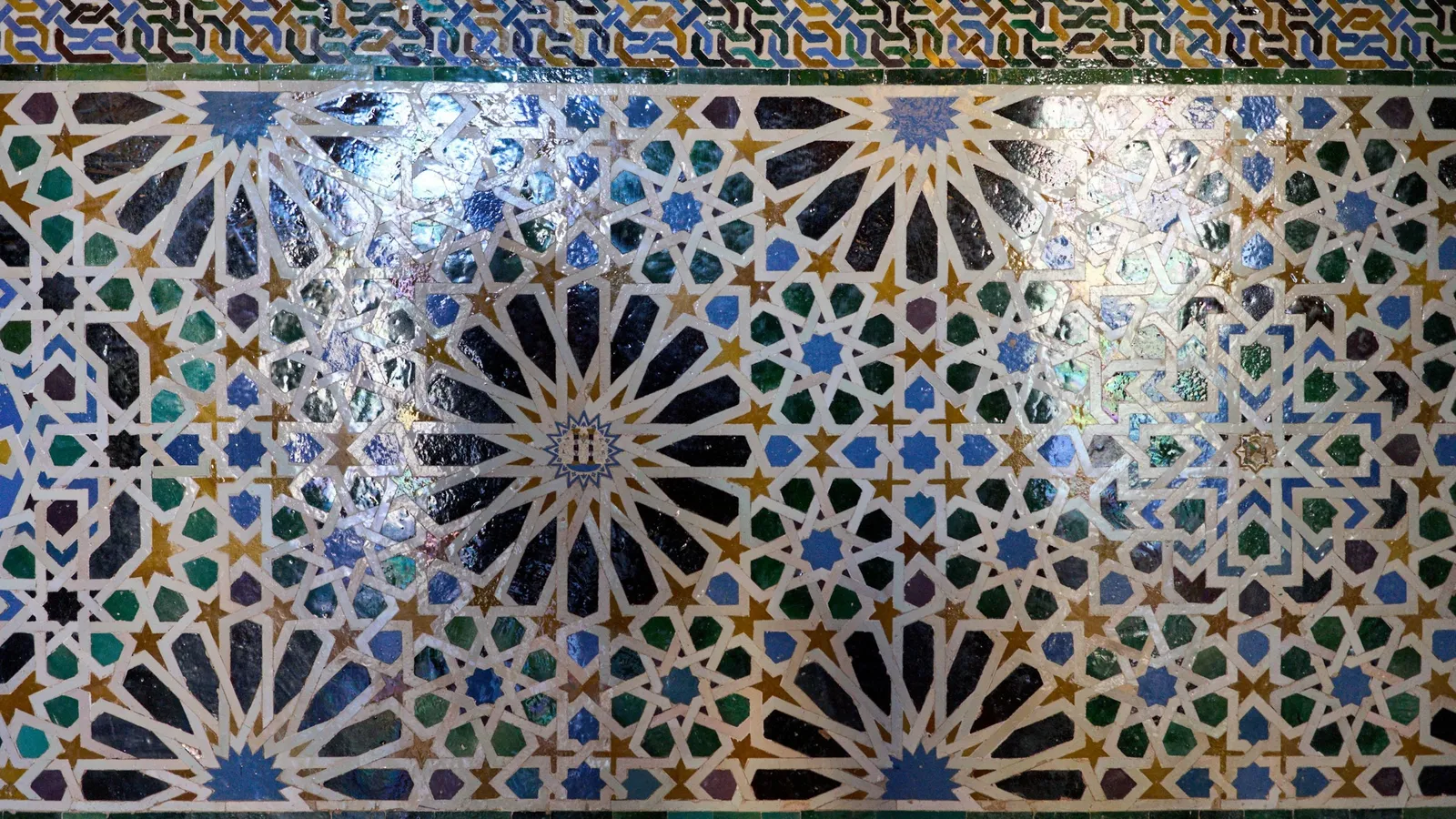
The popular information records that in 1992 the International Union of Crystallography changed its definition of a crystal, from a regularly repeating pattern to "any solid having an essentially discrete diffraction diagram". In 2009 scientists reported natural quasicrystals in mineral samples from the Khatyrka River in eastern Russia, and a Swedish company found quasicrystals in a very durable steel. Mathematicians had already drawn such patterns: Roger Penrose made non-repeating tilings with just two tile shapes in the 1970s, and medieval Islamic mosaics at the Alhambra in Spain show aperiodic patterns.
What can a student take from his way of working?
Shechtman did not trust his first look. He counted the dots again, tested the obvious alternative of a twin crystal, and rotated the sample to understand the real symmetry. Only then did he trust his data over the textbook. He also found collaborators who could check his work. That is the order to follow: test your result hard, then defend it.
Proofs like the one above are easier when you can see each step. The Fermi Problem Library has worked problems with a step-by-step solver that explains the reasoning rather than printing an answer.
Try it now: draw a regular pentagon and try to tile a page with copies of it. Note where the gaps appear.


