

On this page
Both diamond and graphite are composed entirely of carbon atoms, yet they look and behave completely differently. Diamond is a transparent, electrically insulating crystal that ranks as the hardest known natural substance. Graphite, found in pencil leads, is an opaque, soft material that conducts electricity. The explanation for these drastically different properties lies entirely in their three-dimensional arrangement of atoms.
By looking at their 3D lattices, you can predict their physical properties without having to memorise them as disconnected facts. Here is exactly how the bonding in these two carbon allotropes determines their behaviour.
What is the difference between diamond and graphite structure?
The core difference is how the carbon atoms hybridize and bond to their neighbors.
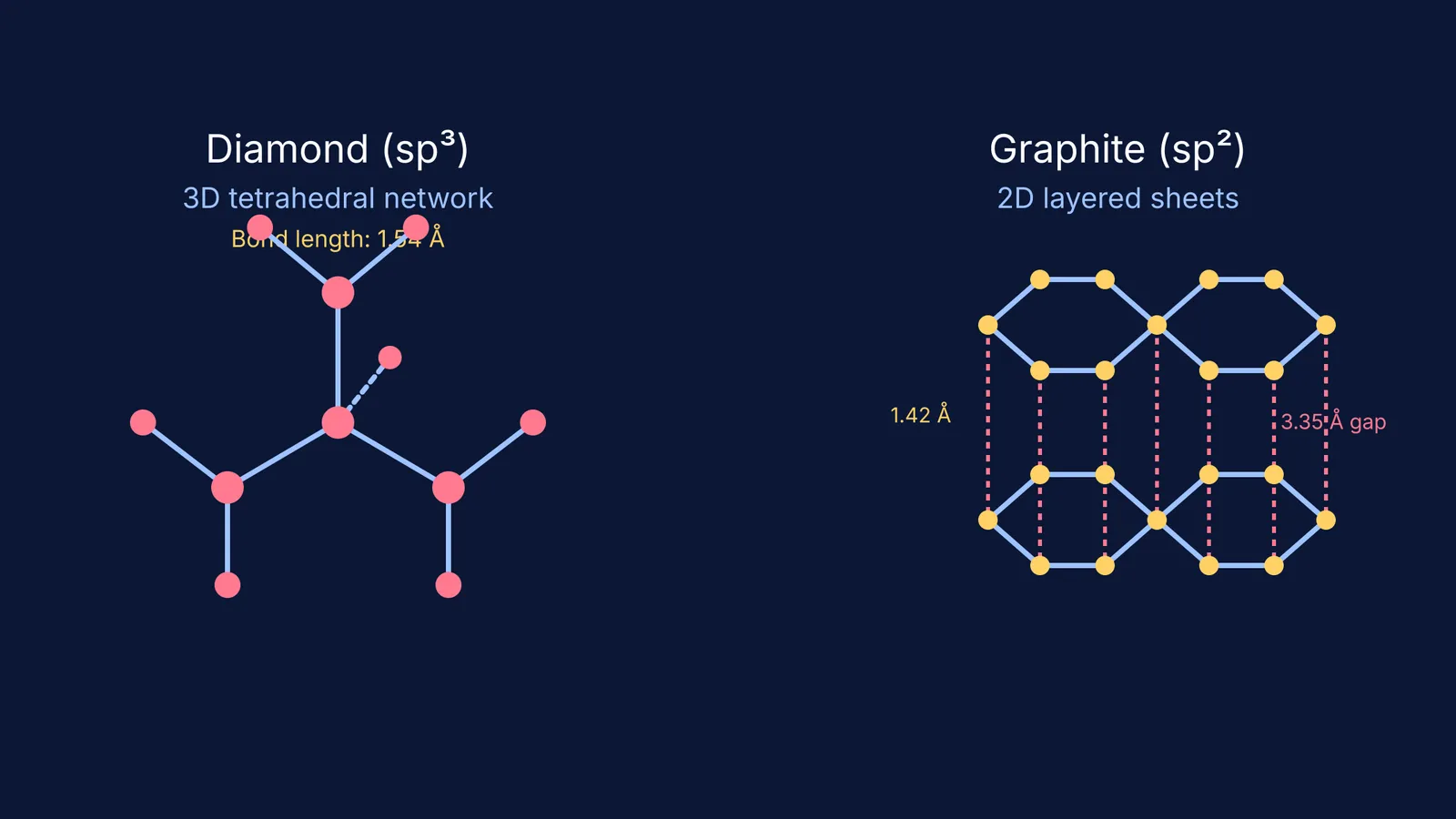
In diamond, every carbon atom undergoes sp³ hybridization, allowing it to form strong single covalent (σ) bonds with four other carbon atoms in a tetrahedral geometry. According to the structural data on Wikipedia, the C–C bond length in this rigid, three-dimensional network is 1.54 Å (154 pm). This interlocking structure extends in all directions, creating a single giant molecule. Because this network structure is uniform and isotropic in its strength, diamond can withstand immense pressure. This makes it an ideal material for cutting tools and drill bits in heavy industry, beyond its obvious value in jewellery. Furthermore, the tightly bound electrons also explain why diamond is completely transparent; without free electrons to absorb and interact with incoming light, most visible wavelengths pass straight through the crystal.
Graphite, on the other hand, forms a two-dimensional layered structure. Its carbon atoms undergo sp² hybridization, meaning each atom bonds to only three neighbors to form flat, hexagonal rings. Within a layer, the carbon-carbon bond length is 1.42 Å (142 pm), which is actually shorter and stronger than the bonds in diamond. However, the distance between adjacent layers is a massive 3.35 Å (335 pm) (Wikipedia). This wide gap proves that the separate layers are not held together by covalent bonds, but by much weaker van der Waals forces. This large interlayer distance is significant because it explains why graphite is less dense than diamond. The weak forces acting across this relatively empty space are easily overcome by physical shear.
Why does graphite conduct electricity but diamond does not?
Electrical conductivity requires mobile charge carriers. The hybridization of carbon dictates whether these carriers are present in the bulk material.
In diamond, all four of carbon's valence electrons are localized tightly within the four sp³ covalent bonds. There are no free electrons available to move through the crystal lattice, making diamond an excellent electrical insulator. Every electron is permanently assigned to holding the atoms together.
In graphite, because each carbon atom only uses three of its valence electrons to form the sp² sigma bonds, one electron remains in an unhybridized p orbital, which points perpendicularly above and below the flat plane. These p orbitals overlap sideways across the entire layer to form a continuous, delocalized pi (π) bond system. The electrons in this delocalized cloud are free to move parallel to the sheets when an electric field is applied, giving graphite its high electrical conductivity. This is precisely why graphite rods are commonly used as electrodes in batteries and electrolysis cells.
Why is diamond harder than graphite?
When you apply a force to diamond, you are pushing against a continuous, three-dimensional network of strong covalent bonds. To scratch or break a diamond, you have to break these strong 1.54 Å C–C bonds simultaneously in multiple directions. The energy required to disrupt this lattice is incredibly high.
When you apply force to graphite, the situation is different. While the bonds within the hexagonal sheets are very strong, the van der Waals forces holding the layers together are remarkably weak. When rubbed, the layers easily slide past each other and peel off. This macroscopic sliding is why graphite is soft enough to write on paper, leaving layers of carbon behind, and is widely used as an industrial dry lubricant for heavy machinery.
How do you compare crystal structures?
When studying the properties of carbon compounds in Class 10 or higher secondary chemistry, run through this mental checklist to predict a material's macroscopic properties from its atomic structure:
Count the bonds per atom: Are all valence electrons used? (Four bonds per carbon in diamond means an insulator; three in graphite leaves one free electron for conduction).
Identify the hybridization: Does the geometry match sp³ (3D tetrahedral) or sp² (2D flat sheets)?
Look for weak links: Are there distinct layers separated by large distances (like graphite's 3.35 Å gap)? The material will break or slide along these planes.
Compare bond lengths: Shorter bonds (1.42 Å in graphite's layers) are generally stronger than longer ones (1.54 Å in diamond), but the 3D interlocking makes the bulk diamond material harder.
A textbook page gives you a flat projection, but these are inherently three-dimensional concepts. If you open the Fermi Simulation Lab, you can predict which carbon form conducts electricity and which is harder, then rotate both lattices in 3D and compare bonds directly. Examining these molecular models, similar to other molecule visualisation tools, replaces memorisation with genuine physical intuition.


