

On this page
The haloform reaction is one mechanism that looks long but is really one move repeated three times, then one cut. If you can explain why the halogenation does not stop after the first step, and why a carbon group can leave at all, you can handle most iodoform questions in JEE Main or a CBSE board paper.
What is the haloform reaction?
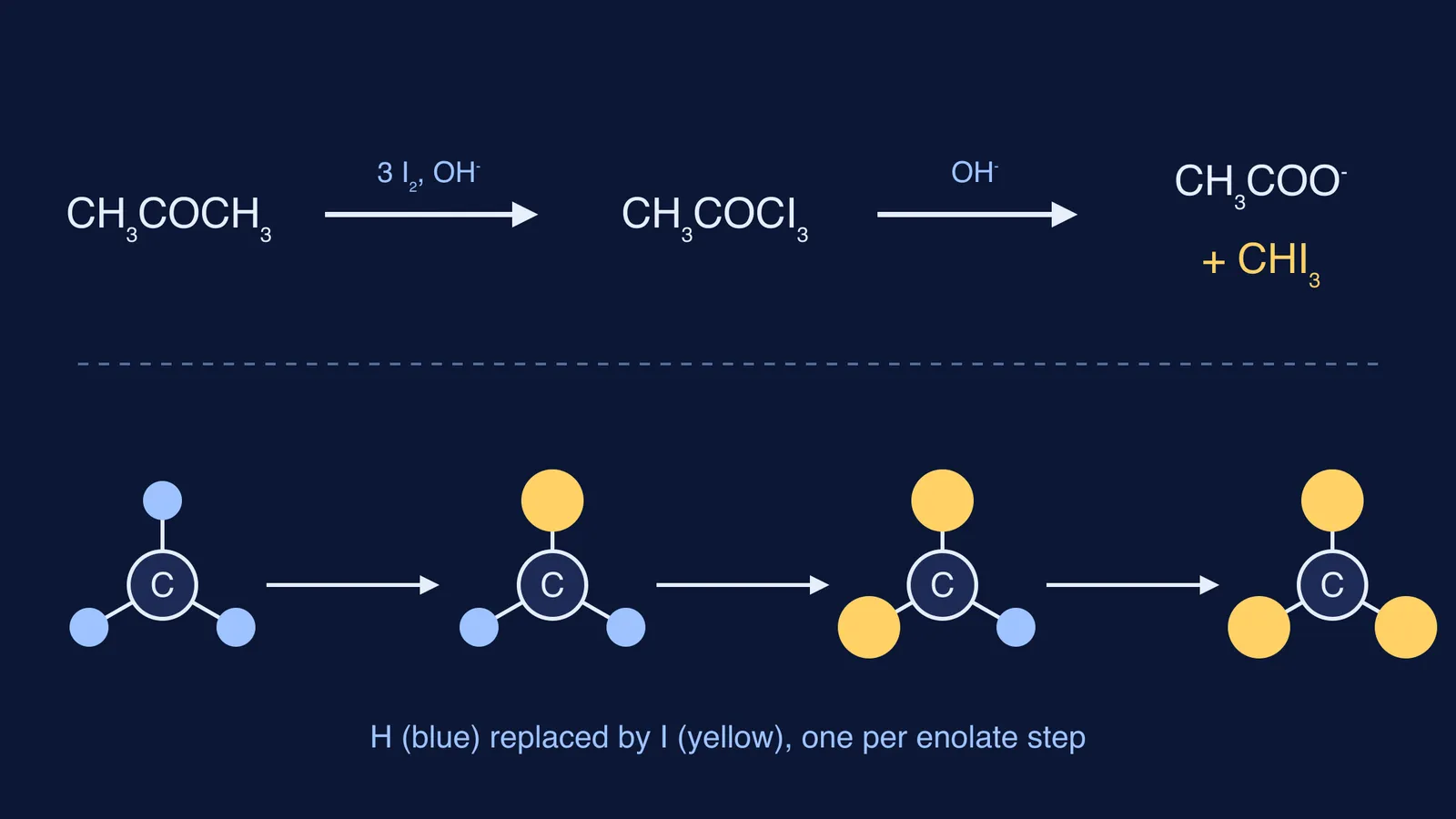
The haloform reaction is the reaction of a methyl ketone with chlorine, bromine or iodine in the presence of hydroxide, giving a carboxylate ion and a haloform (CHX3), as described in William Reusch's organic chemistry text at Michigan State University. With iodine the product is iodoform, CHI3, which forms pale yellow crystals and melts at 119 °C.
The overall equation for a methyl ketone with iodine and sodium hydroxide is:
RCOCH3 + 3 I2 + 4 NaOH → RCOONa + CHI3 + 3 NaI + 3 H2O
Count the atoms yourself once: apart from R, there are 6 iodine, 4 sodium, 5 oxygen and 7 hydrogen on each side. The acid salt you get has one carbon fewer than the ketone, because the methyl carbon leaves as CHI3.
How does the haloform mechanism work, step by step?
The steps below follow the mechanism summarised on Wikipedia's haloform reaction page and LibreTexts' chapter on enolate reactivity/22%3A_Carbonyl_Alpha-Substitution_Reactions/22.06%3A_Reactivity_of_Enolate_Ions).
Iodine meets hydroxide and disproportionates into iodide and hypoiodite (I2 + 2 OH- → I- + IO- + H2O). This is why the reagent is often written as NaOI.
Hydroxide removes an alpha hydrogen from the methyl group, giving an enolate.
The enolate's alpha carbon attacks the halogen (I2 or hypoiodite), giving RCOCH2I.
Steps 2 and 3 repeat twice more: RCOCH2I becomes RCOCHI2, then RCOCI3.
Hydroxide adds to the carbonyl carbon of RCOCI3, giving a tetrahedral intermediate.
The C=O reforms and pushes out CI3- as the leaving group, leaving a carboxylic acid, RCOOH.
Proton transfer: CI3- takes a proton from the acid or the solvent, giving CHI3, and the acid ends up as the carboxylate RCOO-.
If the enolate step feels shaky, our post on keto-enol tautomerism and alpha hydrogens covers why the hydrogen next to C=O is the one that comes off.
Why doesn't base stop at one halogen?
Each halogen pulls electron density away from the alpha carbon, so the alpha-halo ketone is more acidic than the ketone you started with, as Master Organic Chemistry explains. The second hydrogen therefore comes off faster than the first, and the third faster still. LibreTexts makes the same point/22%3A_Carbonyl_Alpha-Substitution_Reactions/22.06%3A_Reactivity_of_Enolate_Ions): halogenated carbonyl products usually have more acidic alpha hydrogens, so halogenation in base keeps going.
Why can CX3- leave when CH3- cannot?
A plain CH3- anion is far too unstable to leave a molecule. CI3- is different: it is a carbon attached to three electron-withdrawing atoms, which stabilise the negative charge, according to Master Organic Chemistry. Reusch describes the cleavage as reflecting the relative stability of the trihalomethyl anion as a leaving group (MSU virtual text).
The last step also drives the reaction forward. In excess base the acid stays in solution as its carboxylate, while iodoform comes out as a solid.
Which compounds give a positive iodoform test?
Use this four-question check on any structure in an exam:
Does it contain CH3CO- with the carbonyl carbon bonded to H or to another carbon? If yes, positive. Acetone, butan-2-one, acetophenone and acetaldehyde all qualify.
Does it contain CH3CH(OH)- with the CH(OH) carbon bonded to H or to another carbon? If yes, positive, because hypoiodite first oxidises it to CH3CO-. Ethanol and propan-2-ol qualify.
Is it an aldehyde or primary alcohol other than acetaldehyde or ethanol? Then negative: those two are the only ones that react.
Is the CH3CO- part of an acid derivative, or the CH3 on an oxygen (an ester's OCH3)? Then it does not count: acetyl chloride and acetamide do not react.
Worked example: butan-2-one, CH3COCH2CH3, with I2 and NaOH. The CH3CO- end is halogenated three times to give CI3COCH2CH3. Hydroxide attacks, CI3- leaves, and you get CHI3 plus sodium propanoate, CH3CH2COONa. Pentan-3-one, CH3CH2COCH2CH3, has no methyl next to its C=O, so it gives no yellow solid.
For more practice on spotting positive compounds, see which compounds give the iodoform test, and for a related base-driven reaction of alpha-haloketones, the Favorskii rearrangement step by step.
How to practise this mechanism
Draw the mechanism from memory for acetone, then acetophenone, checking each arrow against the steps above. If you lose the thread at the cleavage step, the Fermi Problem Library has worked problems with a step-by-step solver that explains the reasoning rather than printing an answer. If the gap is earlier, in enolates or acidity, the Fermi Concept Library gives each chemistry concept its own lesson.


