

On this page
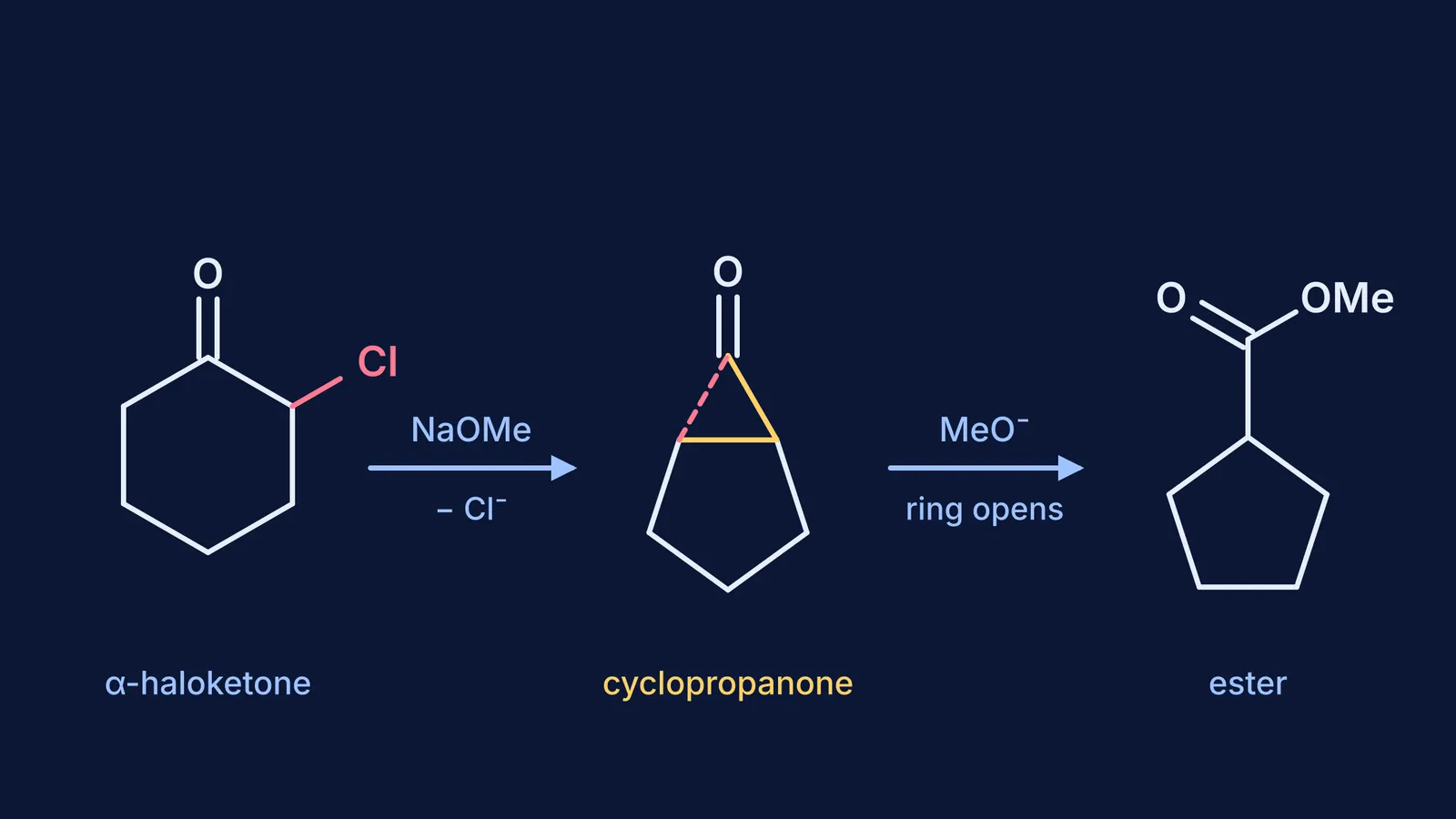
You may have met this in a JEE-style paper: 2-chlorocyclohexanone, sodium methoxide, four options. The answer is not a cyclohexane at all but a five-membered ring carrying an ester. Once you can see the cyclopropanone in the middle, every version of the question becomes the same question.
What is the Favorskii rearrangement?
The Favorskii rearrangement is the reaction of an alpha-haloketone with a nucleophilic base to give a rearranged carboxylic acid derivative (Favorskii rearrangement, Wikipedia). It is named after the Russian chemist Alexei Favorskii and was first reported in 1894, according to the same source.
The base decides the product. Andrew S. Kende's review of the reaction in *Organic Reactions* describes hydroxides giving carboxylic acid salts, alkoxides giving esters and amines giving amides (Kende, Organic Reactions). The same review notes that suitable dihaloketones give unsaturated acids, and calls the reaction a direct method of ring contraction in simple alicyclic systems and in steroids.
How does the Favorskii mechanism work, step by step?
The mechanism usually given runs through a cyclopropanone intermediate (Favorskii rearrangement, Wikipedia). Robert Loftfield took up this question in a 1951 paper titled "The Mechanism of the Faworskii Reaction", using the older spelling of the name (Loftfield, Journal of the American Chemical Society).
Enolate. The base removes a hydrogen from the alpha carbon on the side away from the halogen (call it the alpha-prime carbon). That hydrogen is acidic for the reasons in our post on why the alpha hydrogen of aldehydes and ketones is acidic.
Ring closure. The enolate carbon attacks the carbon holding the halogen and pushes the halide out. Three carbons, one of them the old carbonyl carbon, now form a cyclopropanone.
Attack. The base (hydroxide, methoxide or an amine) adds to the carbonyl carbon of that small ring.
Ring opening. One of the two ring bonds to that carbon breaks. The ring opens to give the more stable carbanion, which is quickly protonated (same Wikipedia source).
The cyclopropanone opens easily because its three-membered ring forces strained bond angles, the same strain that explains why cyclopropane is more reactive than cyclohexane.
What does 2-chlorocyclohexanone give with sodium methoxide?
This classic case is a real laboratory procedure. The checked Organic Syntheses method adds 2-chlorocyclohexanone dropwise to sodium methoxide in dry ether, heats the mixture under reflux for 2 hours, and isolates methyl cyclopentanecarboxylate in 56–61% yield (Goheen and Vaughan, Organic Syntheses).
Work it through with numbered carbons:
Label the ring: C1 is the C=O, C2 carries the chlorine, C6 is the other alpha carbon.
Methoxide removes a hydrogen from C6, giving an enolate.
C6 attacks C2 and chloride leaves. C1, C2 and C6 now form a cyclopropanone fused to a five-membered ring (C2, C3, C4, C5, C6).
Methoxide adds to C1. Either the C1–C2 or the C1–C6 bond breaks; here the two are equivalent, so both give the same product.
C1 is now a CO2Me group hanging off a cyclopentane ring. Six-membered ring in, five-membered ring plus ester out.
Order matters: the chloroketone goes into the methoxide, because the reverse order gives lower yields and more high-boiling condensation products (Organic Syntheses).
Which bond breaks when the cyclopropanone is unsymmetrical?
This is where marks are lost. The ring opens towards the more stable carbanion.
Take PhCH2–CO–CH2Cl with sodium methoxide. The enolate forms on the benzyl side, closes onto the CH2Cl carbon, and gives a cyclopropanone with a phenyl group on one ring carbon. When methoxide adds and the ring opens, the bond to the phenyl-bearing carbon breaks, because a negative charge next to a benzene ring is stabilised. After protonation you get PhCH2CH2CO2Me, methyl 3-phenylpropanoate.
Now try the isomer PhCHCl–CO–CH3. The enolate forms on the methyl side, closes onto the CHClPh carbon, and gives the same cyclopropanone, so the product is the same ester. Two starting materials, one product: a neat check on your intermediate.
How do you spot a Favorskii question in an exam?
Run this checklist before you look at the options:
Is there a halogen on a carbon next to a ketone C=O?
Is the reagent a nucleophilic base: hydroxide, an alkoxide or an amine?
Is there a hydrogen on the other alpha carbon? If not, a related quasi-Favorskii reaction can still occur under harsher conditions, probably with the base adding to the ketone first, much like the benzilic acid rearrangement (Wikipedia).
Does the answer have the right functional group for the base (acid, ester or amide), and has any ring shrunk by one carbon?
Do not mix it up with making alpha-halo compounds: a carboxylic acid with bromine and red phosphorus is the Hell-Volhard-Zelinsky alpha-halogenation of acids, not a Favorskii step.
If you get the cyclopropanone right but keep breaking the wrong bond, practise a few in the Fermi Problem Library, where a step-by-step solver explains the reasoning rather than printing an answer. If enolates themselves feel shaky, the Fermi Concept Library gives each chemistry concept its own lesson and its place in the map.
Tonight, draw the 2-chlorocyclohexanone mechanism from memory, then redo it with sodium hydroxide and with dimethylamine, and name both products.


