

On this page
Zero-order kinetics comes down to one equation, one straight-line graph and one half-life formula. Once you see how each follows from the others, graph-matching questions take seconds.
What is a zero-order reaction?
A zero-order reaction is one whose rate does not change when the reactant concentration rises or falls, so rate = k (LibreTexts, Zero-Order Reactions/Kinetics/02%3A_Reaction_Rates/2.10%3A_Zero-Order_Reactions)). Because the rate is a concentration per unit time, k for a zero-order reaction has units of mol L⁻¹ s⁻¹ (M s⁻¹), which is a quick way to spot the order from the units of k alone.
Integrating rate = k from time 0 to t gives the integrated zero-order law: [A] = [A]₀ − kt (OpenStax Chemistry 2e, section 12.4).
What does a zero-order reaction graph look like?
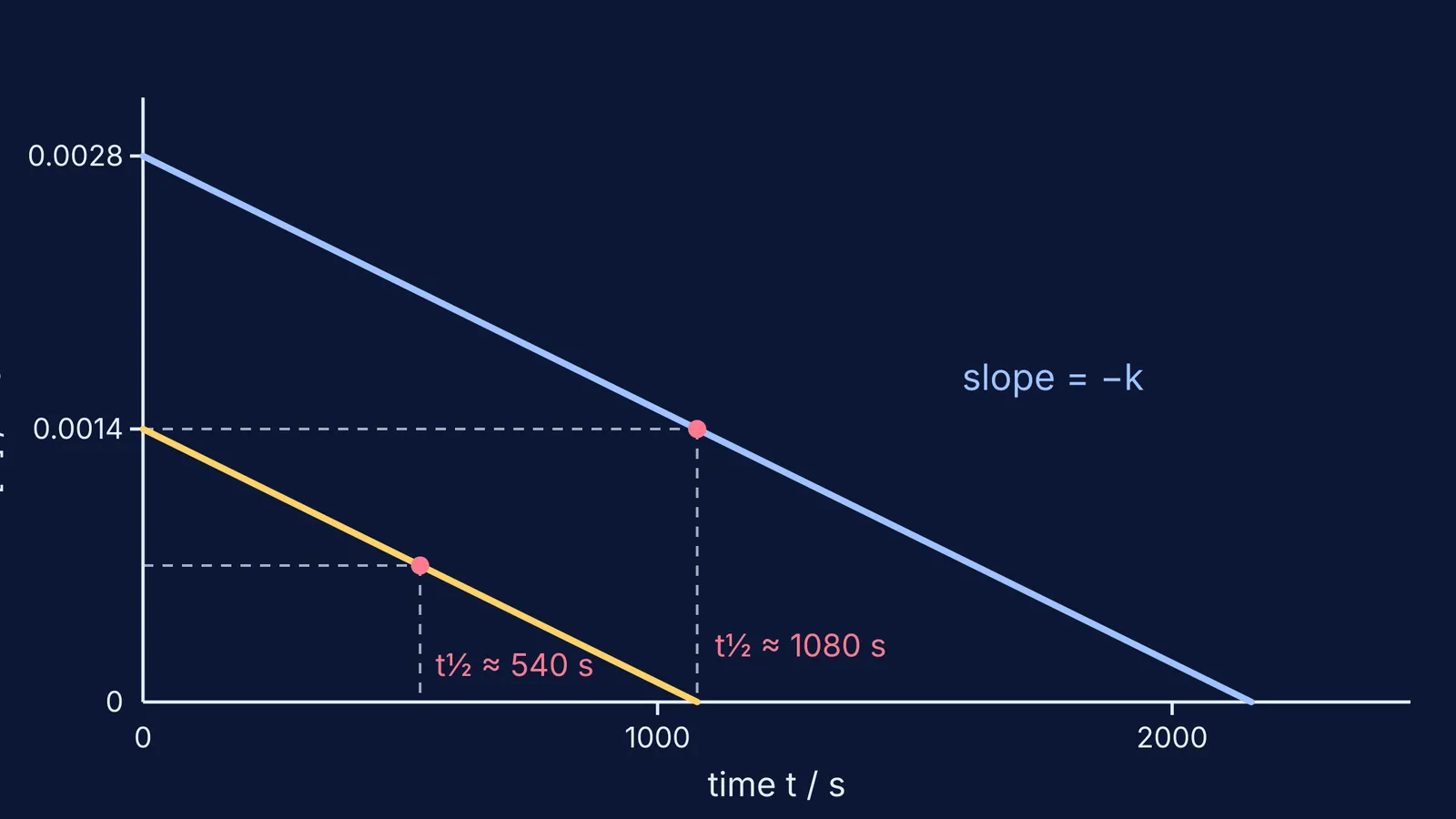
The integrated law has the form y = mx + c, so a plot of [A] against t for a zero-order reaction is a straight line with slope −k and y-intercept [A]₀ (OpenStax Chemistry 2e). Three graphs follow from that one fact:
[A] against t: a straight line falling with slope −k. First order needs ln[A] against t to get a straight line.
Rate against [A]: a flat horizontal line at height k, because the rate does not depend on [A].
t½ against [A]₀: a straight line through the origin with slope 1/2k.
If you want to see how the zero-, first- and second-order plots compare side by side, our guide to reading reaction order from integrated rate law graphs puts all three together.
Why is zero-order half-life proportional to initial concentration?
Put [A] = [A]₀/2 into the integrated law: [A]₀/2 = [A]₀ − k·t½, so t½ = [A]₀/2k (OpenStax Chemistry 2e). The reaction removes the same amount every second, so the more you start with, the longer it takes to remove half of it.
Each successive half-life is half as long as the one before, because each starts from half the concentration. First order is the opposite case, where every half-life is the same. For the full set of rate laws and half-lives across orders, see our chemical kinetics guide to rate laws, order and half-life.
Worked example: ammonia on hot tungsten
OpenStax uses the decomposition of ammonia on a hot tungsten surface, 2NH₃ → N₂ + 3H₂, as its zero-order example: [NH₃] falls in a straight line from 0.0028 mol L⁻¹ to 0.0015 mol L⁻¹ over 1000 s, giving k = 1.3 × 10⁻⁶ mol L⁻¹ s⁻¹ (OpenStax Chemistry 2e). Work it through:
Slope: (0.0015 − 0.0028)/(1000 − 0) = −1.3 × 10⁻⁶ mol L⁻¹ s⁻¹, so k = 1.3 × 10⁻⁶ mol L⁻¹ s⁻¹.
Half-life: t½ = 0.0028/(2 × 1.3 × 10⁻⁶) ≈ 1077 s.
Second half-life, starting from 0.0014 mol L⁻¹: 0.0014/(2 × 1.3 × 10⁻⁶) ≈ 538 s, half the first.
Time to use up all the ammonia on paper: [A]₀/k = 0.0028/(1.3 × 10⁻⁶) ≈ 2154 s, twice the first half-life.
Double the start to 0.0056 mol L⁻¹ and t½ doubles to about 2154 s.
Which reactions are zero order, and why?
Zero order usually means something other than the reactant is limiting the rate. On a solid catalyst only molecules attached to the surface react, so once every site is occupied, adding more gas cannot speed things up (LibreTexts, Zero-Order Reactions/Kinetics/02%3A_Reaction_Rates/2.10%3A_Zero-Order_Reactions)). That page gives nitrous oxide decomposing on a hot platinum wire as an example, and notes that enzyme reactions can appear zero order when there are few enzyme molecules compared with substrate molecules. The University of Toronto LibreTexts course notes that ammonia decomposes by zero-order kinetics on tungsten but by first-order kinetics on silica, so the surface decides the order (LibreTexts, Integrated Rate Laws).
A reaction can also look like it has a lower order when one reactant is in large excess. Our post on pseudo first-order reactions such as ester hydrolysis explains the same idea one order up.
How do you spot zero order in an exam question?
Use this checklist before you choose an option:
Is [A] against t a straight line? Zero order. Is ln[A] against t a straight line? First order.
Are the units of k mol L⁻¹ s⁻¹? Zero order.
Does the half-life double when [A]₀ doubles? Zero order. Does it stay the same? First order.
Is the rate-against-[A] graph flat? Zero order.
Does the question mention a metal surface or a saturated enzyme? Expect zero order at high concentration.
To test yourself, try kinetics questions in the Fermi Problem Library, where a step-by-step solver explains the reasoning rather than printing an answer. If the graphs still feel shaky, each concept in the Fermi Concept Library has its own lesson and its place in the map.


