

On this page
Many olympiad inequalities share one shape: positive numbers with a fixed total, a sum of the same expression in each variable, and equality when all the variables are equal. The tangent line trick turns that three-variable problem into a one-variable check you can finish with school algebra.
What is the tangent line trick in inequalities?
In his handout A Brief Introduction to Olympiad Inequalities (30 April 2014, section 2.2), Evan Chen fixes a as the average of the variables and proves the one-variable bound f(x) ≥ f(a) + f′(a)(x − a).
In Chen's words, "If this inequality manages to hold for all x, then simply summing the inequality will give us the desired conclusion. This method is called the tangent line trick."
Summing works because the right-hand side is a straight line in x: adding it over a, b and c turns the x-terms into the fixed total, leaving the constant reached at the equality case.
Chen introduces the trick for when f is not convex: then "we can sometimes still prove" the tangent bound. If f is convex over the whole range, Jensen already finishes the job; our explainer on Jensen's inequality and convex functions covers that case.
How do you find the tangent line for an inequality?
Write the inequality as f(a) + f(b) + f(c) compared with a constant.
Find the equality case. For symmetric problems with a + b + c = 3, it is usually a = b = c = 1.
Compute f(1) and f′(1). The tangent is y = f(1) + f′(1)(x − 1).
Clear denominators in f(x) ≤ tangent (or ≥) and move everything to one side.
Factor. The polynomial must contain (x − 1)², because the line touches the curve at x = 1. If it does not, recheck your derivative.
Read off where the remaining factor has the right sign. If that covers every allowed x, sum and you are done. If not, handle the leftover range separately.
Worked example: what happens when the tangent bound fails?
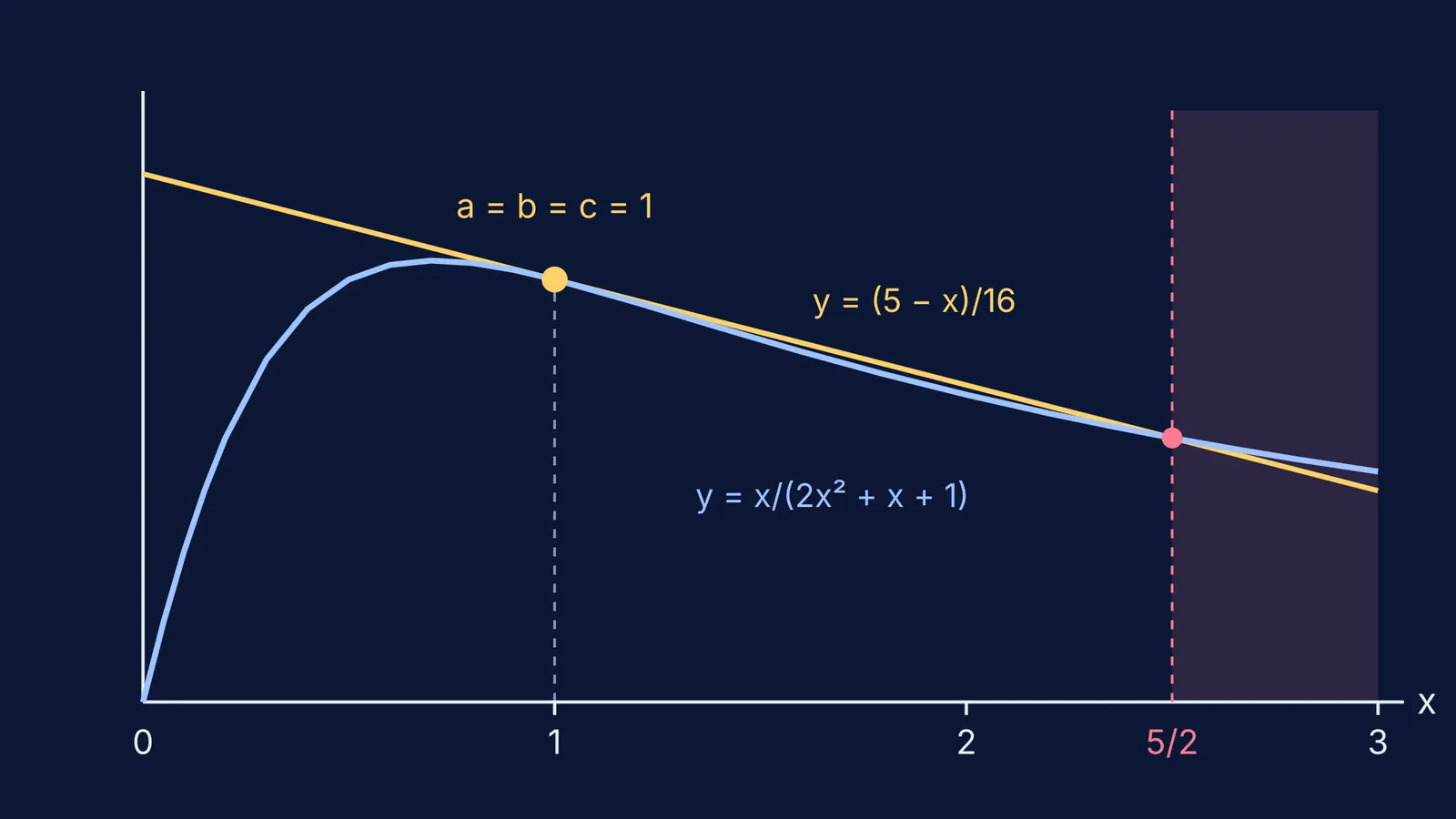
This is practice problem 3 in section 2.4 of Chen's handout. Let a, b, c be positive reals with a + b + c = 3. Prove that a/(2a² + a + 1) + b/(2b² + b + 1) + c/(2c² + c + 1) ≤ 3/4.
Step 1: the equality case. Let f(x) = x/(2x² + x + 1). At a = b = c = 1 each term is 1/4, giving exactly 3/4.
Step 2: the tangent. By the quotient rule, f′(x) = (1 − 2x²)/(2x² + x + 1)², so f′(1) = −1/16. The tangent at x = 1 is y = 1/4 − (x − 1)/16 = (5 − x)/16.
Step 3: the one-variable check. We want x/(2x² + x + 1) ≤ (5 − x)/16. Multiply both sides by 16(2x² + x + 1), which is positive: 16x ≤ −2x³ + 9x² + 4x + 5. Rearranged, that is 2x³ − 9x² + 12x − 5 ≤ 0, which factors as (x − 1)²(2x − 5) ≤ 0.
The double root at x = 1 is there, but the bound only holds when x ≤ 5/2, and a variable could be almost 3.
Step 4: the main case. If a, b and c are all at most 5/2, add the three tangent bounds: the sum is at most (15 − (a + b + c))/16 = 12/16 = 3/4.
Step 5: the leftover case. Since the total is 3, at most one variable can exceed 5/2; call it a. The sign of f′ shows f increases up to x = 1/√2 and decreases after it. So f(a) < f(5/2) = 5/32, and every term is at most f(1/√2) = 1/(2√2 + 1), about 0.261. The sum is less than 5/32 + 2 × 0.262 < 0.69, under 3/4. Both cases are covered.
When does the tangent line trick not work?
The bound fails on part of the range. Split the range as in Step 5, using a cruder bound on the leftover piece.
Equality is not at the all-equal point. A tangent at the average is then not sharp. Chen's next method, n − 1 EV, says that when f has exactly one inflection point, the extreme sum has n − 1 variables equal.
The terms are not all the same function of one variable. These need other tools; our guide to Schur's inequality for olympiads covers one of them.
The problem has no fixed total. If it is homogeneous, you can impose one. Chen does this for a problem from Japan by assuming a + b + c = 3 before applying the trick.
How should you practise it?
Run the six steps by hand on three fixed-total problems. The Fermi Problem Library has worked problems with a step-by-step solver that explains the reasoning, so you can compare your factoring line by line. If derivatives or convexity feel shaky, the Fermi Concept Library gives every concept in mathematics its own lesson.
New to inequalities? Start with our guide on where to begin with olympiad algebra inequalities, then try the trick on the problems in Chen's handout.


