

On this page
In olympiad inequalities, AM-GM usually works when the equality case is x = y = z. Schur's inequality is one of the first tools to try when it stalls. If AM-GM is still new to you, start with the relation between AM, GM and HM of two numbers.
What is Schur's inequality?
Schur's inequality, named after the mathematician Issai Schur (1875–1941), states that for non-negative real numbers x, y, z and t, x^t(x − y)(x − z) + y^t(y − z)(y − x) + z^t(z − x)(z − y) ≥ 0 (Schur's inequality, Wikipedia).
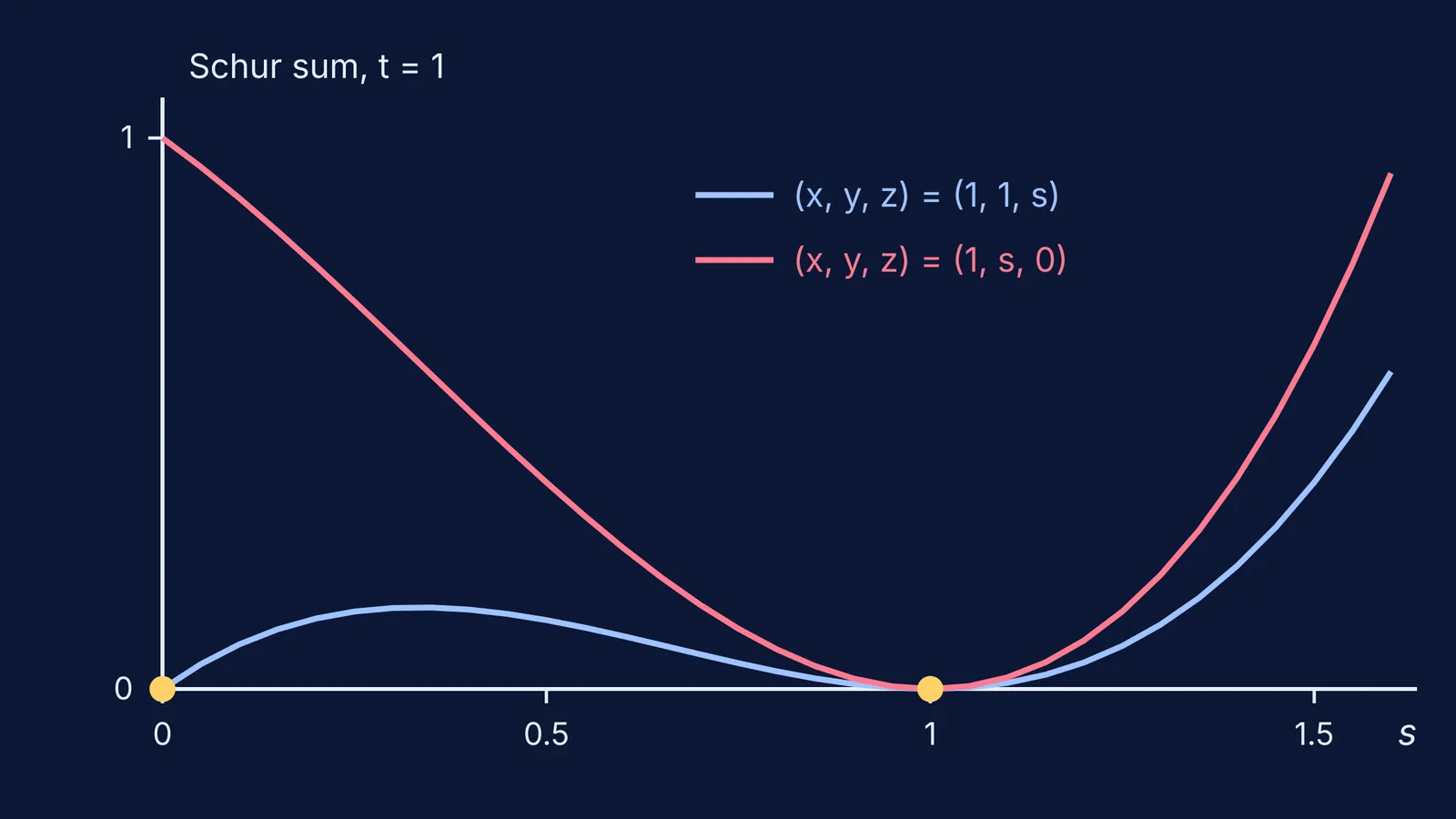
For t > 0, equality holds if and only if x = y = z, or two of the variables are equal and the third is zero. At t = 0 only x = y = z gives zero.
The best-known special case is t = 1: x(x − y)(x − z) + y(y − z)(y − x) + z(z − x)(z − y) ≥ 0. Multiply it out and it becomes x³ + y³ + z³ + 3xyz ≥ xy(x + y) + yz(y + z) + zx(z + x).
How do you prove Schur's inequality for t = 1?
The expression is symmetric, so relabel the variables so that x ≥ y ≥ z ≥ 0. This is the proof Wikipedia gives, step by step:
Group the first two terms: x(x − y)(x − z) + y(y − z)(y − x) = (x − y)[x(x − z) − y(y − z)].
Each factor is non-negative: x − y ≥ 0, and x ≥ y together with x − z ≥ y − z ≥ 0 gives x(x − z) ≥ y(y − z).
The last term is z(z − x)(z − y) = z(x − z)(y − z), a product of three non-negative numbers.
Three non-negative pieces add up to something non-negative. The same grouping works for every t ≥ 0, because x ≥ y still gives x^t ≥ y^t.
The same idea drives the rearrangement inequality and its proofs.
What is the pqr form of Schur's inequality?
Write p = x + y + z, q = xy + yz + zx and r = xyz. Two identities convert the expanded form: x³ + y³ + z³ = p³ − 3pq + 3r, and xy(x + y) + yz(y + z) + zx(z + x) = pq − 3r. Substituting gives p³ − 4pq + 9r ≥ 0, which you can also write as 9r ≥ p(4q − p²).
This is the version to remember: a lower bound on xyz in terms of the sum and the pairwise products.
When should you use Schur instead of AM-GM?
AM-GM on three numbers gives xyz ≤ ((x + y + z)/3)³, that is r ≤ p³/27. It caps xyz from above, and its only equality case is x = y = z. Schur bounds r from below and is tight at points like (1, 1, 0) as well. Reach for it when:
the inequality is symmetric in three non-negative variables and has degree 3, or becomes degree 3 with a constraint such as x + y + z = 1;
xyz appears with a minus sign on the side you need to keep small, so you need r from below;
plugging in (1/2, 1/2, 0) makes the inequality tight or nearly tight, which AM-GM alone, tight only at x = y = z, cannot reach.
Worked example: IMO 1984 Problem 1
Problem 1 of the 1984 International Mathematical Olympiad asks you to prove that 0 ≤ yz + zx + xy − 2xyz ≤ 7/27, where x, y and z are non-negative real numbers with x + y + z = 1 (IMO 1984 paper, imo-official.org).
In pqr terms, p = 1 and you must show 0 ≤ q − 2r ≤ 7/27.
Lower bound. Each variable is at most 1, so xy ≥ xyz, and likewise for each pair; adding gives q ≥ 3r ≥ 2r.
Upper bound. Here −2r needs a lower bound on r, which is exactly where AM-GM fails. Schur with p = 1 says 9r ≥ 4q − 1, so q − 2r ≤ q − 2(4q − 1)/9 = (q + 2)/9. Finally, q ≤ p²/3 = 1/3, because (x − y)² + (y − z)² + (z − x)² ≥ 0. So q − 2r ≤ (1/3 + 2)/9 = 7/27, with equality at x = y = z = 1/3.
At (1/2, 1/2, 0) the expression is 1/4, just below 7/27. That near miss is a hint to try Schur.
If you get stuck on the next step in problems like this, the Fermi Problem Library has worked problems with a step-by-step solver that explains the reasoning rather than printing an answer. To revise symmetric polynomials or AM-GM first, the Fermi Concept Library gives each concept its own lesson. For what to study alongside Schur, see our guide on how to start olympiad algebra.
Your next step: write the t = 1 proof from memory on a blank page, then solve IMO 1984 Problem 1 again without looking.


