On this page
If school algebra feels easy but olympiad papers look like a different language, you are not behind. School asks you to find x. An olympiad asks you to prove that something is always true, and why. The starting tools are few, and you already know the algebra they are built on.
What does olympiad algebra actually cover?
The official HBCSE mathematical olympiad syllabus lists algebra as one of four major areas, alongside combinatorics, geometry and number theory. Under algebra it names inequalities, progressions, indices, systems of linear equations, polynomials, the binomial theorem, complex numbers and functional equations. The page says the list is not exhaustive and that difficulty rises from RMO to INMO to IMO.
At the top of that ladder, the International Mathematical Olympiad has 6 problems worth 7 points each, sat over two days with four and a half hours for three problems each day. That is about 90 minutes per problem: the real skill is staying with one hard question, then writing a clean argument.
Which inequality should you learn first?
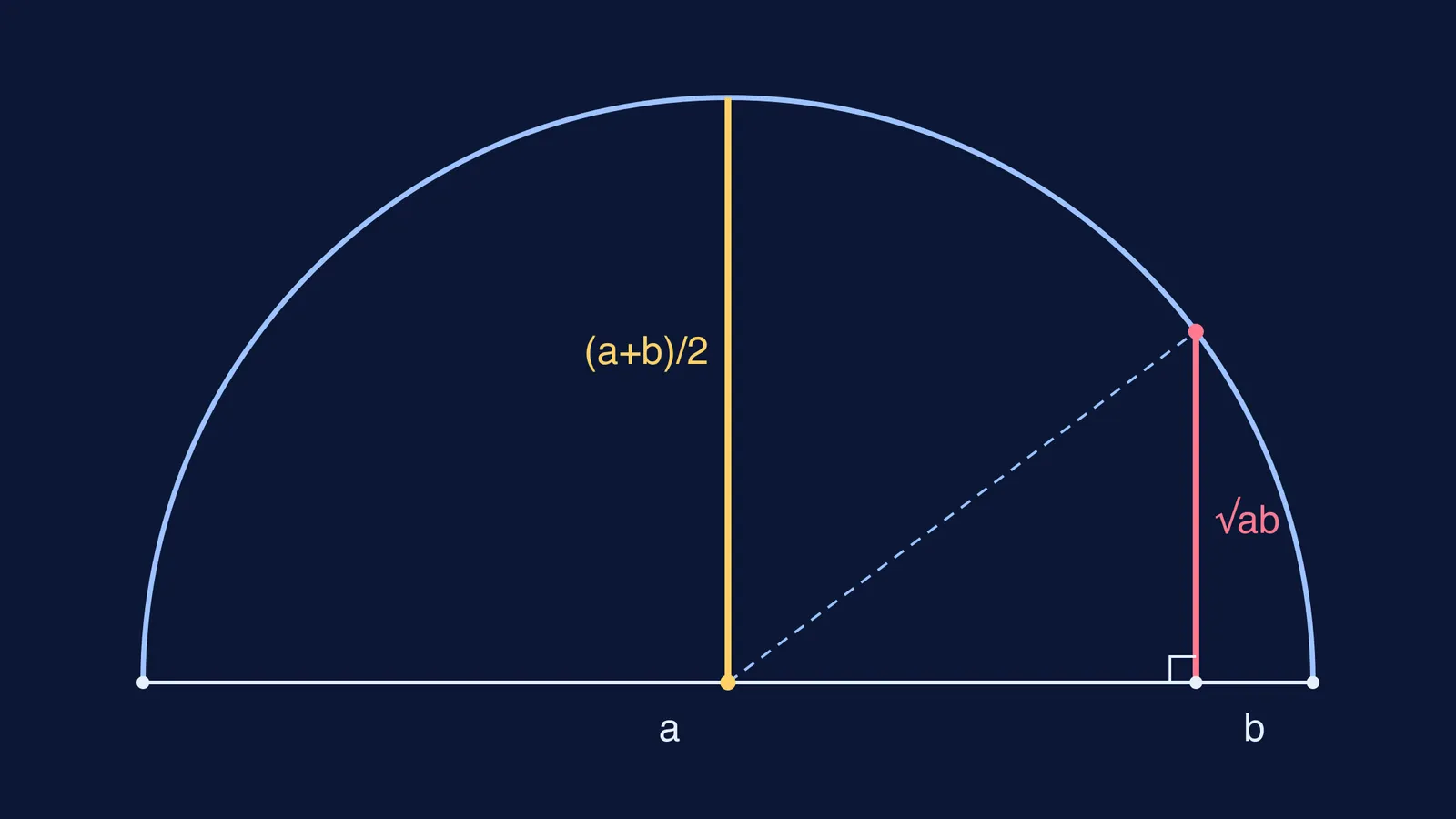
Learn AM-GM first. The AM-GM inequality says that the arithmetic mean of non-negative real numbers is at least their geometric mean, with equality only when all the numbers are equal. For two numbers, that is (a + b)/2 ≥ √ab.
Here is a worked example of the kind you will meet early.
Problem. For positive a, b, c, prove that (a + b)(b + c)(c + a) ≥ 8abc.
Apply AM-GM to each bracket: a + b ≥ 2√ab, b + c ≥ 2√bc, c + a ≥ 2√ca.
All six quantities are positive, so you may multiply the three inequalities.
The right side becomes 8√(a²b²c²) = 8abc. Done.
Equality case: each step is tight only when a = b, b = c and c = a, so equality holds exactly when a = b = c.
Steps 2 and 4 are where beginners lose marks: multiply inequalities only when everything is positive, and always name the equality case.
Once AM-GM feels natural, move to Cauchy-Schwarz, which Wikipedia describes as one of the most important and widely used inequalities in mathematics.
How do polynomials show up in olympiad problems?
Often the trick is to use the roots without ever finding them. Vieta's formulas say that for ax² + bx + c with roots r and s, r + s = −b/a and rs = c/a.
Problem. If r and s are the roots of x² − 5x + 3, find r² + s² and 1/r + 1/s.
From Vieta, r + s = 5 and rs = 3.
r² + s² = (r + s)² − 2rs = 25 − 6 = 19.
1/r + 1/s = (r + s)/rs = 5/3.
No square roots, no decimals. When a problem mentions roots but never asks for them, write everything in terms of their sum and product. If factorising or the quadratic formula still feels shaky, patch that first with the matching lesson in the Fermi Concept Library, which covers every concept in mathematics, each with its own lesson.
How do you practise proofs as a beginner?
Reading solutions feels productive; recalling them is what sticks. In a 2006 study by Henry Roediger and Jeffrey Karpicke, students who restudied a passage did better on a test 5 minutes later, but students who had practised recalling it retained substantially more on tests 2 days and 1 week later. Proofs work the same way: close the book and rebuild the argument.
Use this routine for every problem:
Set a timer and work alone first, noting what you tried.
If stuck, read only the first line of the solution, then close it.
Write the proof in full sentences: what is given, each step with its reason, the equality case.
The next day, rewrite the proof from a blank page without looking.
Note the one idea that cracked it, not the whole solution.
When your proof breaks at one step and you cannot see why, the Fermi Problem Library has worked problems with a step-by-step solver that explains the reasoning rather than printing an answer, so you can compare its logic with yours.
What does a four-week starter plan look like?
Week 1: two-variable AM-GM, the x + 1/x ≥ 2 family, and testing inequalities with numbers.
Week 2: AM-GM for three or more terms, choosing what to group, and equality cases.
Week 3: Vieta's formulas, symmetric expressions in roots, and factorising tricks.
Week 4: algebra problems from past RMO papers, written up in full and rewritten from memory a day later.
If you are not sure which week to begin with, Fermi's AI tutor can work out what you already know and build a plan for the session. Either way, pick one inequality today, prove it twice, and rewrite it tomorrow.