On this page
Online tutoring is now a common part of school and exam prep in India. The risk is rarely the subject or the screen. It is a setup where an adult and a child are alone on camera, with no record and a private chat that nobody else sees. Change the setup and problems become much harder to hide.
Is online tutoring safe for my child?
It can be, if sessions are visible, recorded and kept on one channel. The UK's Internet Watch Foundation reported that in the first six months of 2020, 44% of the child sexual abuse content it dealt with involved self-generated material, which can be created using webcams, sometimes in the child's own room (Internet Watch Foundation, 2020). That finding is not about tutors, but it is a reason to keep one-to-one video calls with adults out of the bedroom.
The checklists below draw on safeguarding guidance from SWGfL, a UK online-safety charity, written for schools in England that appoint online tutors, and on Indian law.
How do I choose a safe online tutoring platform?
Before you pay, check these:
Classes run inside the platform, not on the tutor's personal WhatsApp or Instagram.
The platform tells you how tutors are checked and who to contact with a concern.
There is a written recording policy (see the next section).
The privacy policy says what is collected about your child and who sees it.
Under India's Digital Personal Data Protection Act, 2023, a child is anyone under 18 (PRS Legislative Research). Section 9(3) of the Act says a data fiduciary, such as a tutoring platform, shall not undertake tracking or behavioural monitoring of children or targeted advertising directed at children (CyberPeace Foundation). The DPDP Rules were notified in November 2025 with an 18-month phased timeline (The Tribune), and the rule requiring verifiable parental consent before a child's data is processed takes effect on 13 May 2027 (SCC Online). Some education providers get limited exemptions from the children's-data obligations, so ask the platform directly what it collects.
Should online tutoring sessions be recorded?
We think so, as long as everyone agrees first. SWGfL's guidance asks schools to agree whether sessions are recorded, and lists adherence to a pre-agreed recording policy among its expectations for tutors (SWGfL). For a family, that means settling it before the first class. Agree four things in writing:
Who records: the platform, the tutor or you.
Where the file is stored and when it is deleted.
Who can watch it. You should be on that list.
That nobody records separately on another phone or laptop.
Then actually open a recording now and then.
What camera rules should we set for online classes?
SWGfL's guidance lists cameras as optional but preferred, asks schools to discourage pupils, where possible, from making video calls from their bedroom, and expects appropriate clothing for all participants and no personal items visible in the background (SWGfL). Turn that into house rules:
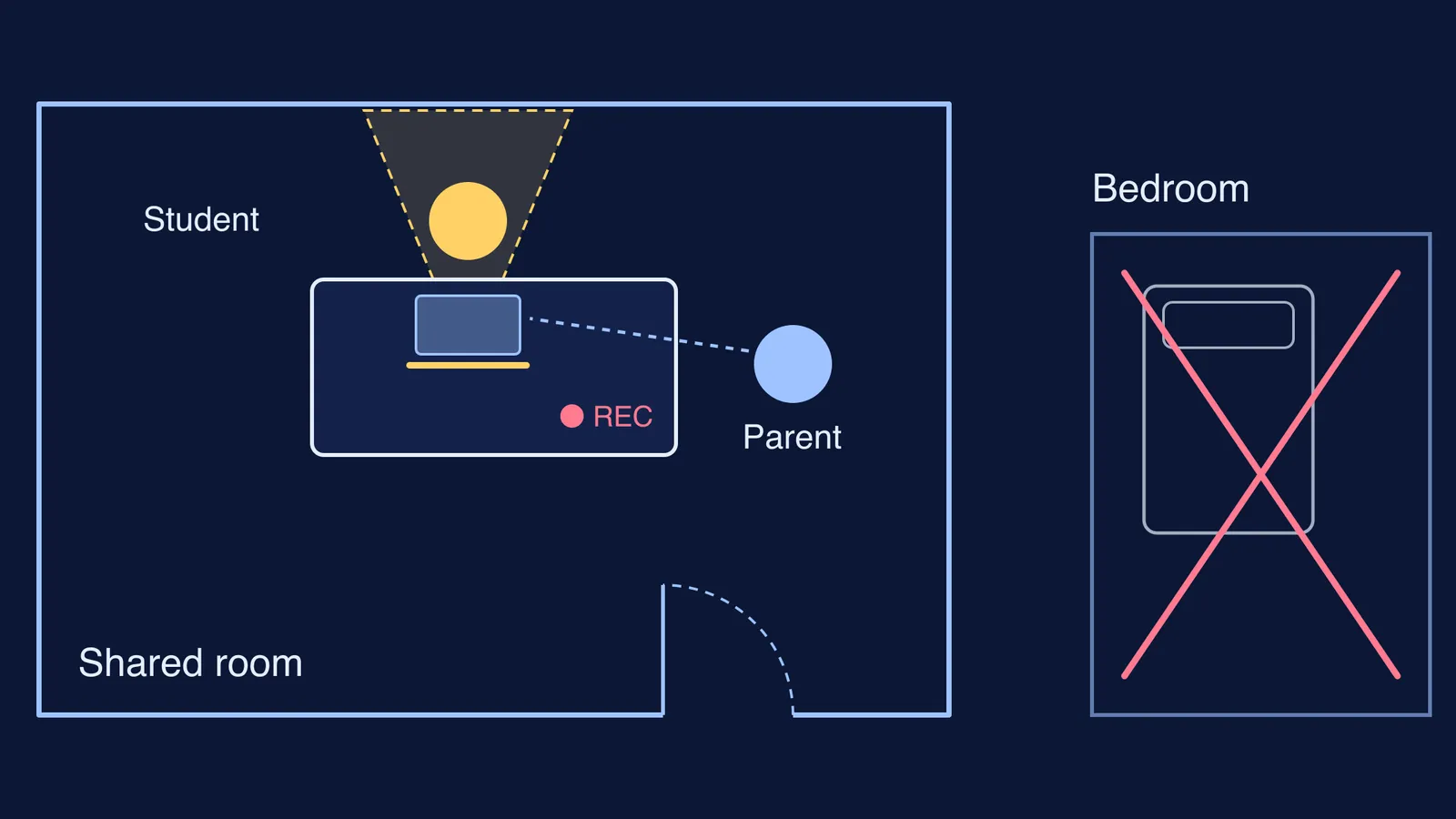
Class happens in a shared room, door open, an adult within earshot.
A parent says hello on camera at the start of the first few sessions.
The camera faces a plain wall: no school name, address, family photos or uniform badge.
When class ends, the camera goes off and the laptop closes.
CBSE's Cyber Safety handbook, made with the Cyber Peace Foundation, lists bribes such as bonus points, flattery, threats and subtle sexual allusions as reasons a message to a student is not legitimate.
What should I say to my child and the tutor?
To the tutor, before class one: "We are glad to have you. Our rules for every class: we use the platform only, sessions are recorded, our child sits in the living room, and any messages come to my number. Does that work for you?" A good tutor should be comfortable with that.
To your child: "You will never be in trouble for telling me about anything that happens in class, even if someone says to keep it secret. If something feels odd, close the laptop and come and find me."
Some families also add self-study between sessions. Fermi's AI tutor works through problems alongside the student, and progress, notes and everything generated along the way stay in the student's library, so there is a record you can look at together.
What should I do if something feels wrong?
Pause the sessions before you confront anyone.
Take screenshots, save recordings and note dates.
Report the tutor to the platform.
Report on the National Cyber Crime Reporting Portal at cybercrime.gov.in or call 1930, which Kerala Police lists as available 24 hours a day (Kerala Police).
If your child seems upset, anxious or withdrawn afterwards, talk to a doctor or counsellor, or call Tele MANAS on 14416, a free 24x7 national mental-health helpline (IIT Kanpur Counselling Service).
Agree the rules before the first class, write them down, and check them again with your child after a month.