On this page
If you write a pen-and-paper exam like NEET-UG, only the bubbles on your OMR sheet count. The circles in your question booklet do not. So the question is not really "now or later". It is how many solved answers you are willing to leave on the booklet and nowhere else when time runs out.
Should you fill OMR bubbles as you go or at the end?
The NEET(UG)-2026 Information Bulletin from NTA describes a pen-and-paper exam with 180 questions, marked +4 for a correct answer, -1 for a wrong one and 0 for one left blank. For NEET-UG 2026, NTA also displayed the scanned images of OMR answer sheets and the recorded responses to candidates. In other words, what the scanner reads from your sheet is your result.
Each approach has a real cost:
As you go: every answer is safe the moment you solve it. The cost is constant switching between booklet and sheet, which breaks your focus and adds small chances to misread a row number.
All at the end: you stay focused while solving. The cost is that every answer stays unscored until the final minutes. If a hard question eats your buffer, or your hands shake, solved questions go in blank.
We could not find a controlled study that compares these two habits in exams like NEET-UG, so the advice below rests on simple timing arithmetic you can check yourself.
How long does bubbling 180 answers actually take?
Time yourself on a printed practice sheet. Suppose darkening one bubble neatly takes you 4 seconds, which is only an example; your own number may differ.
Bubbling 180 answers at 4 seconds each takes 720 seconds, which is 12 minutes.
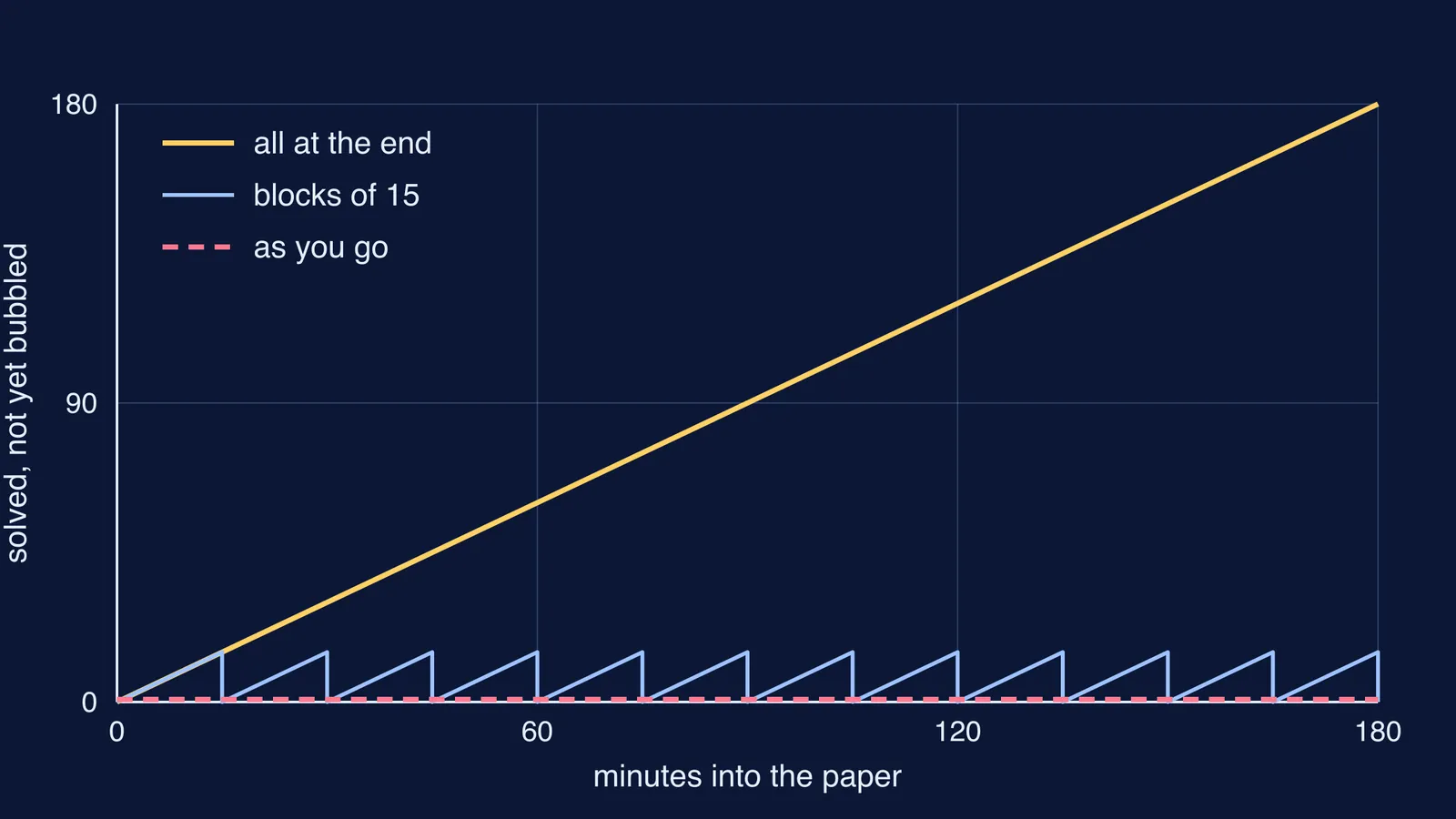
That 12 minutes is the same whether you bubble one by one or all at once. Batching only saves the time spent switching back and forth, which is a small part of it.
If you plan to bubble at the end and finish solving 5 minutes later than planned, you have 7 minutes for 12 minutes of work. At 4 seconds each, that is 105 bubbles, so 75 solved answers would go in blank.
The second risk is a shifted row. Under the +4/-1 scheme in the NTA bulletin, if you rush and slide 10 answers one row down, you could turn a possible +40 into -10. That is a 50-mark swing from one slip.
What is the safe middle routine?
This is a block routine. You keep most of your focus and never carry a big pile of unscored answers.
Circle the answer in the booklet as you solve. Use only the marks your exam's instructions allow, and read them in the first minute; our guide to scanning question paper instructions in 60 seconds shows how.
Transfer in blocks of 10 to 15, or at the end of each booklet page, whichever comes first.
Check the row number before each block. Say the first question number in your head, find the same number on the sheet, then bubble. Check again at the last question of the block.
Leave skipped questions blank on the sheet and put a clear mark beside them in the booklet so you can find them on your second pass.
Set one hard checkpoint 30 minutes before the end: everything solved so far is bubbled. After that, bubble each new answer straight away.
Use the last 2 to 3 minutes to scan for empty rows you meant to fill, not to start new questions.
A watch helps you hit the checkpoint without guessing. If your exam allows one, our post on which watches are allowed in NEET and CBSE exam halls explains the rules.
How do you practise OMR bubbling before exam day?
A routine only holds under pressure if you have rehearsed it. In at least three full mocks, use a printed OMR sheet and follow the block routine exactly. Our guide to simulating real exam conditions with a full mock covers the rest of the set-up.
After each mock, write down:
How long one block of 15 took to bubble.
Whether you reached the 30-minute checkpoint with everything bubbled.
Any row you bubbled in the wrong place, and where your attention slipped.
How many questions you solved but could not bubble.
If that last number is not zero, move your checkpoint earlier. When the mock review shows answers that were wrong because the method was wrong, not the bubbling, the Fermi Problem Library has worked problems with a step-by-step solver that explains the reasoning rather than printing an answer.
Pick your block size and checkpoint this week, test them in your next mock, and adjust once. Then stop changing the routine, so on exam day it runs without thought.