On this page
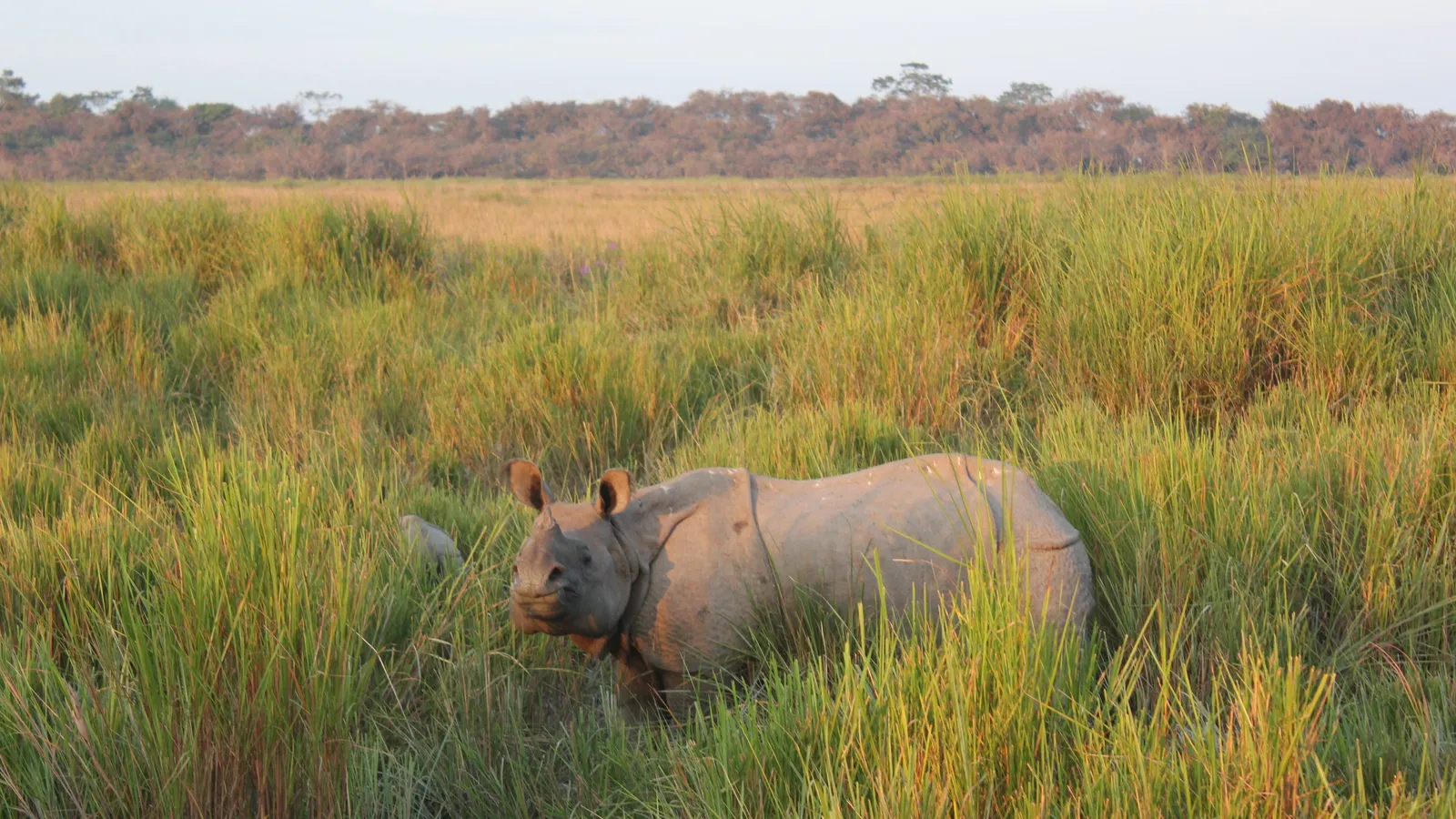
Assam's Kaziranga National Park holds the world's largest population of one-horned rhinos, according to the IUCN World Heritage Outlook, which makes it central to the species' recovery. If you are studying biodiversity for CBSE or NEET-UG biology, it is also a clear Indian example of in situ conservation, with real numbers you can calculate from.
Why is the one-horned rhino threatened by poaching?
The greater one-horned rhino (Rhinoceros unicornis) is listed as Vulnerable on the IUCN Red List.
Poachers want one thing: the horn. Rhino horn is made of compressed keratin fibres, the same material as your fingernails and hair, according to the International Rhino Foundation. The same source says illegal trade in horn continues and drives the poaching of rhinos.
Kaziranga has felt that pressure directly. The IUCN World Heritage Outlook assessment of Kaziranga records that 27 rhinos were killed in the park in 2013, and notes that poaching rhinos for their horn is still profitable for heavily armed hunters.
A slow-breeding animal cannot easily absorb losses like that. Gestation lasts about 15 to 16 months and a mother gives birth to one calf every 2 to 3 years, says the International Rhino Foundation species page.
How did Kaziranga protection help rhino numbers recover?
Protection came in layers over more than a century. Kaziranga became a reserve forest in 1908, a wildlife sanctuary in 1950 and a national park in 1974, and UNESCO listed it as a World Heritage Site in 1985, according to the history of Kaziranga National Park. The IUCN World Heritage Outlook notes the protected area has since grown from 42,996 hectares to 85,942 hectares.
The same IUCN assessment credits the recent fall in poaching to enforcement: a special task force of Assam police and forest department staff, high-tech devices and canine units brought a dramatic decrease. In 2022 no rhino was poached in the park, the first time since 1977; two were killed in each of 2023 and 2024.
The census points the same way. Kaziranga's 2022 count estimated 2,613 rhinos, up from 2,413 in 2018, EastMojo reported. Counters on 50 elephants covered all 84 compartments of the park.
Across India and Nepal, the International Rhino Foundation's State of the Rhino report estimates 4,075 greater one-horned rhinos, up from 4,014 in 2022. Its species page says the population has recovered from fewer than 100 animals under strict protection.
Why does the rhino need Kaziranga's grassland habitat?
Wet alluvial grasslands cover nearly two-thirds of Kaziranga and are kept open by annual flooding and burning, according to the IUCN World Heritage Outlook. That matters because the one-horned rhino is a grazer of riverine floodplain grasslands and nearby woodland, says the International Rhino Foundation.
Floods are both the engine and the danger. They renew the grassland, but heavy floods kill animals: the park lost more than 360 animals, including 31 rhinos, in two waves of floods in 2017, the same IUCN assessment records. In 2019 the state government built 33 new highlands where animals can shelter during floods. Invasive plants such as Mikania micrantha and water hyacinth also degrade the habitat.
To see where the rhino sits among producers and consumers, read our explainer on the grassland ecosystem food chain and food web.
How do you use Kaziranga in an exam answer?
Try these with the census figures from EastMojo and the International Rhino Foundation before reading the working.
Growth between censuses: (2,613 - 2,413) / 2,413 = 200 / 2,413, about 0.083, so roughly 8.3% over four years.
Average yearly growth: (2,613 / 2,413) to the power 1/4 is about 1.020, so roughly 2% a year. It is slightly less than 8.3 / 4 because growth compounds.
Kaziranga's share of the species: 2,613 / 4,075 is about 0.64. The two counts come from different years, so say roughly two in three, not an exact percentage.
Adult sex ratio: the 2022 census counted 903 adult females and 750 adult males, about 1.2 females for every male.
For a five-mark answer on in situ conservation, cover these five points, using the poaching record from the IUCN World Heritage Outlook:
Place and method: Kaziranga National Park, Assam, protects rhinos in their natural habitat.
Threat: poaching for horn, which is only keratin.
Measures: legal protection in stages, a special anti-poaching task force, regular censuses.
Evidence: 2,413 rhinos in 2018 to 2,613 in 2022; zero poaching in 2022.
Habitat: wet alluvial grassland kept open by floods and burning.
Kaziranga also shows a risk: most of a species in one park. Compare it with why Asiatic lions live only in the Gir forest, and revise the definitions with in situ vs ex situ conservation examples.
If compound growth trips you up, the Fermi Problem Library has worked problems with a step-by-step solver that explains the reasoning rather than printing an answer. If terms like in situ conservation or population density feel shaky, the Fermi Concept Library gives every biology concept its own lesson and its place in the map.
Next time you revise biodiversity, work through the four calculations above once from memory.